Pronunciation practice
Listen to the phrase, repeat into the mic — your teacher analyzes the audio and gives a real pronunciation score with corrections and comments.
1 / 3
안녕하세요, 잘 지내세요?
hello, how are you?
All phrases done
Soo-jin starts with your goal: Seoul travel, K-drama phrases, TOPIK prep, or just curiosity. She teaches standard Seoul Korean, explains polite and casual speech levels, and instantly corrects your particles, word order, and tricky batchim pronunciation. Each lesson is a live conversation, not a textbook. GoTxt gives you a personal AI teacher who remembers what you struggle with, offers voice practice, and builds your vocabulary with smart memory. No fixed schedule—your tutor is always online, from alphabet to advanced.
Chat · voice · progress · vocabulary — one learner profile
Try them here — same pronunciation check and flashcards as in lessons.
Listen to the phrase, repeat into the mic — your teacher analyzes the audio and gives a real pronunciation score with corrections and comments.
1 / 3
안녕하세요, 잘 지내세요?
hello, how are you?
After every lesson you get review cards — and you can generate your own decks on any topic.
안녕하세요
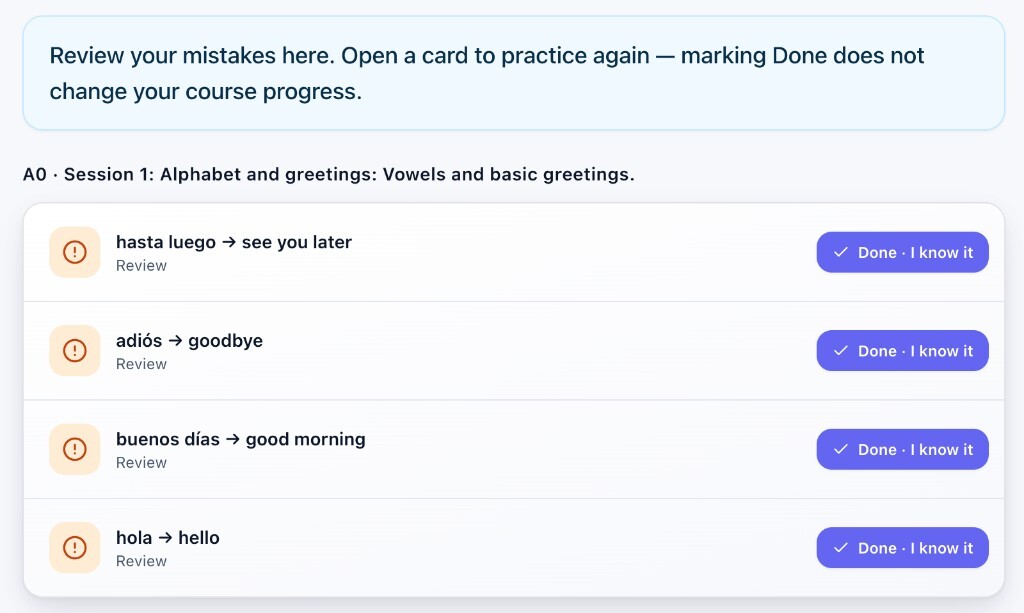
Weak spots from your lessons land here: open a card and practice again. Mark Done when you know it — it leaves the shelf; course progress stays intact.
 In full access →
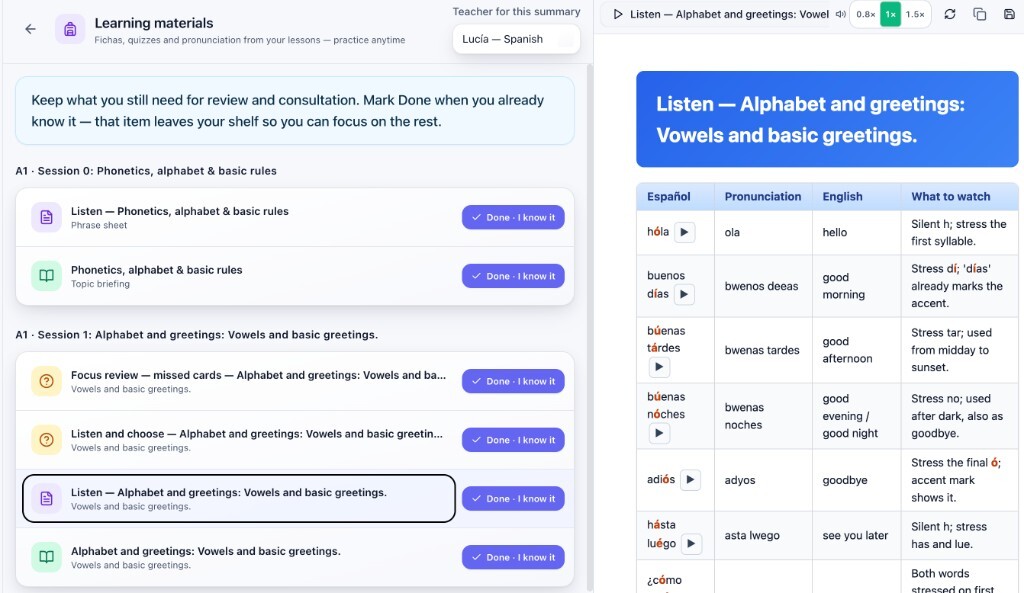
Sheets, quizzes and pronunciation from your lessons — listen, review and come back anytime.
 In full access →
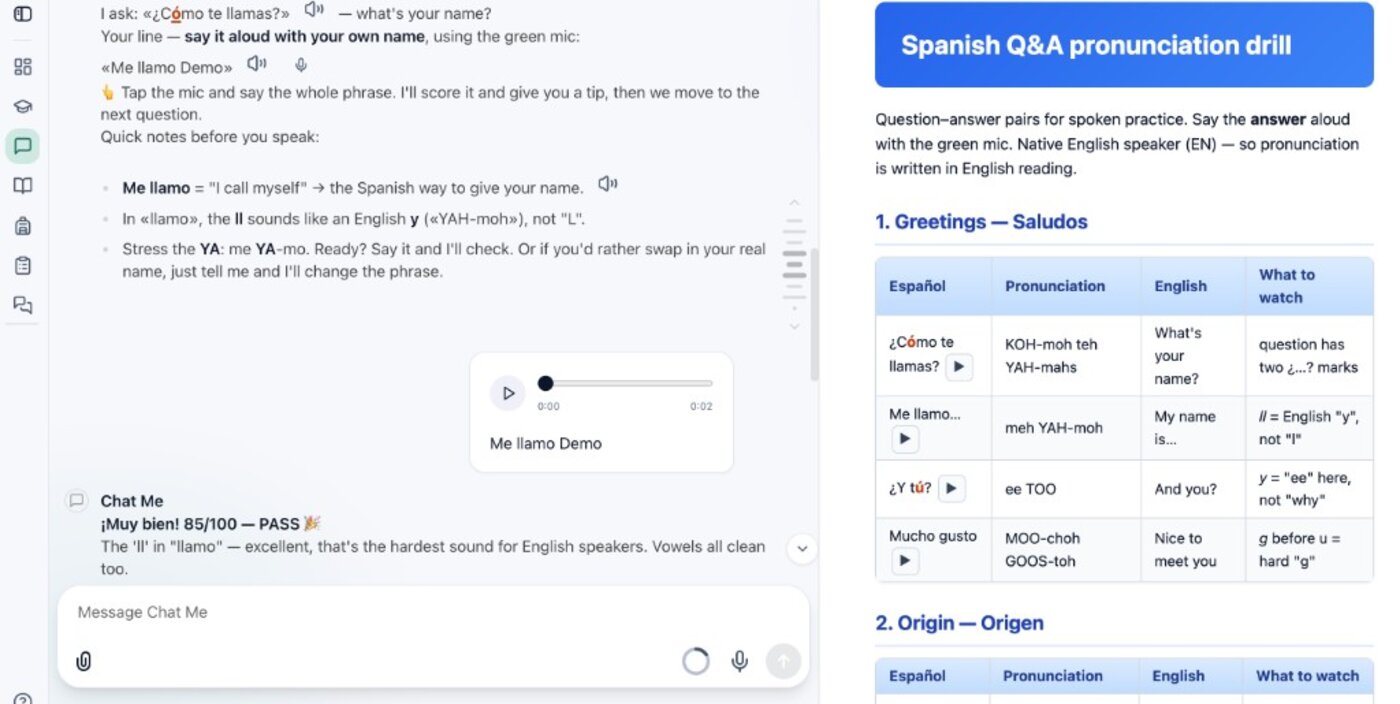
Your off-lesson consultant: questions, plans and practice anytime — no schedule required.
Not a planned lesson and it does not track CEFR progress — free mode: ask anything, drill pronunciation, or open a sheet beside the chat.
 In full access →
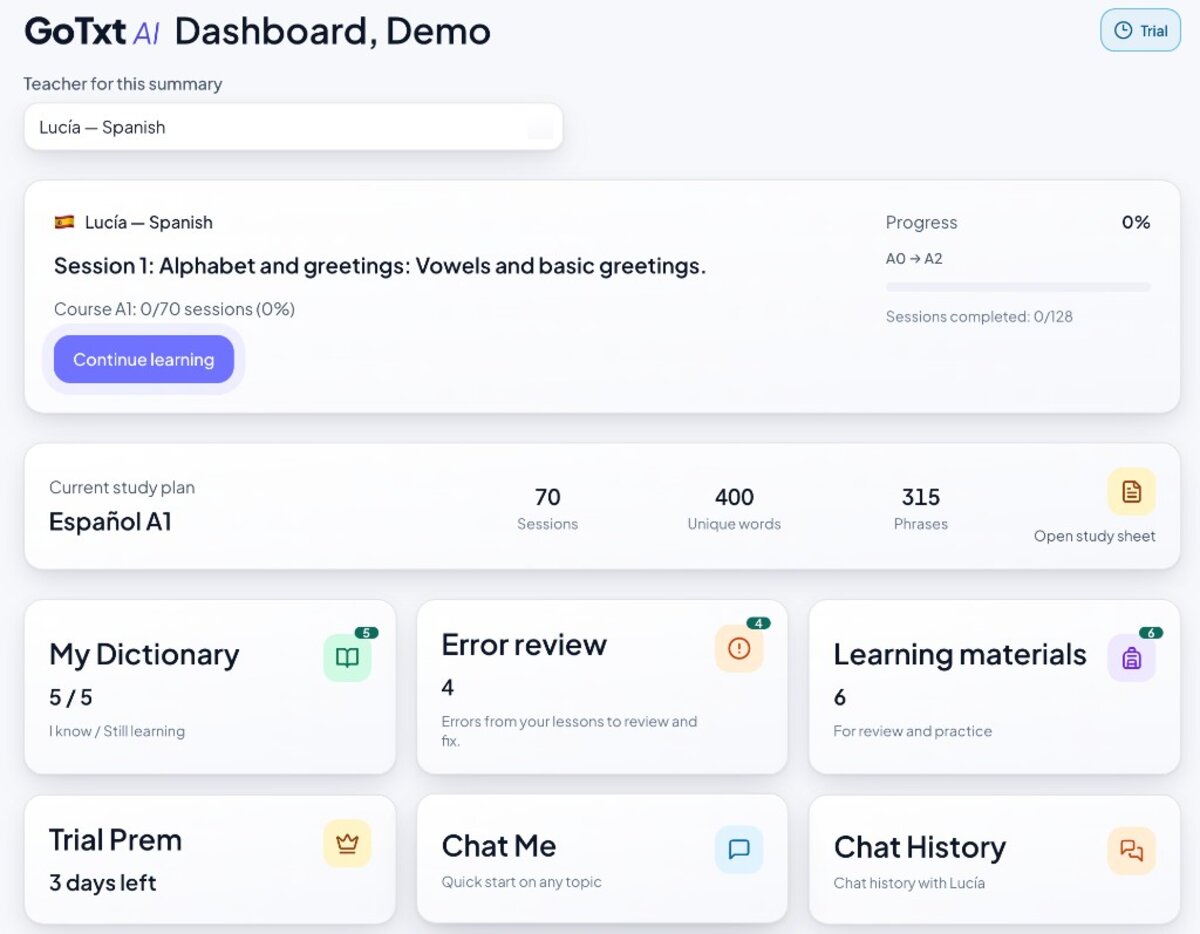
Your study résumé in one place: current session, course progress, study plan, and quick links to vocabulary, mistakes, materials and Chat Me.
 In full access →
Not a translator and not a quiz bank. Our AI teachers run real dialogue: they listen, correct, remember your progress, and adapt the plan to your goal — travel, work, exam, or confident conversation.
Your AI tutor
Soo-jin is your dedicated AI tutor, born from GoTxt's language engine. She doesn't follow a fixed curriculum—she adapts to your pace, interests, and mistakes. With a deep understanding of Korean speech levels, honorifics, and everyday Seoul expressions, she guides you from Hangul to natural conversation. Soo-jin listens to your voice, corrects your pronunciation, and explains grammar in clear English. She remembers your vocabulary gaps and brings them back for revision, making every session more effective than the last.
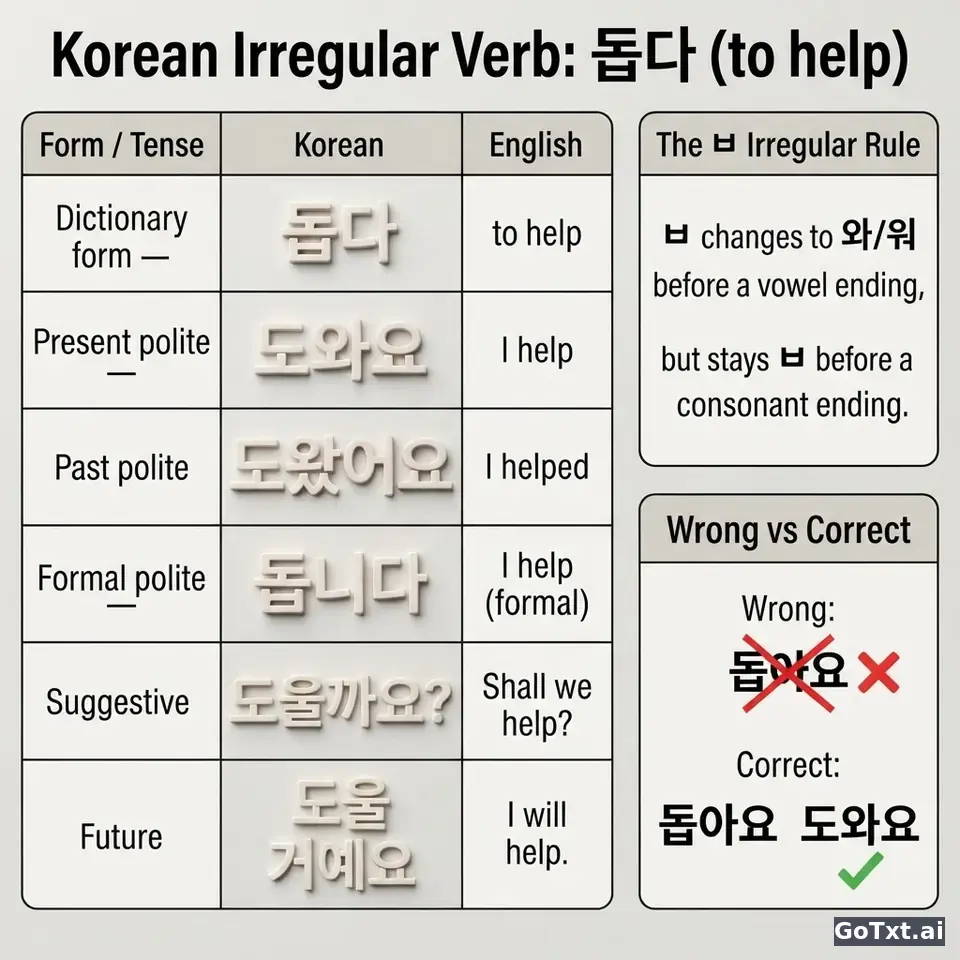 Korean Irregular Verbs: One Verb, All Its Forms, Step by Step Every Korean learner eventually meets a verb that refuses to behave. You memorize the polite ending -아요, you feel confident, and then the verb 돕다 (to help) suddenly turns into 도와요 and your confidence…
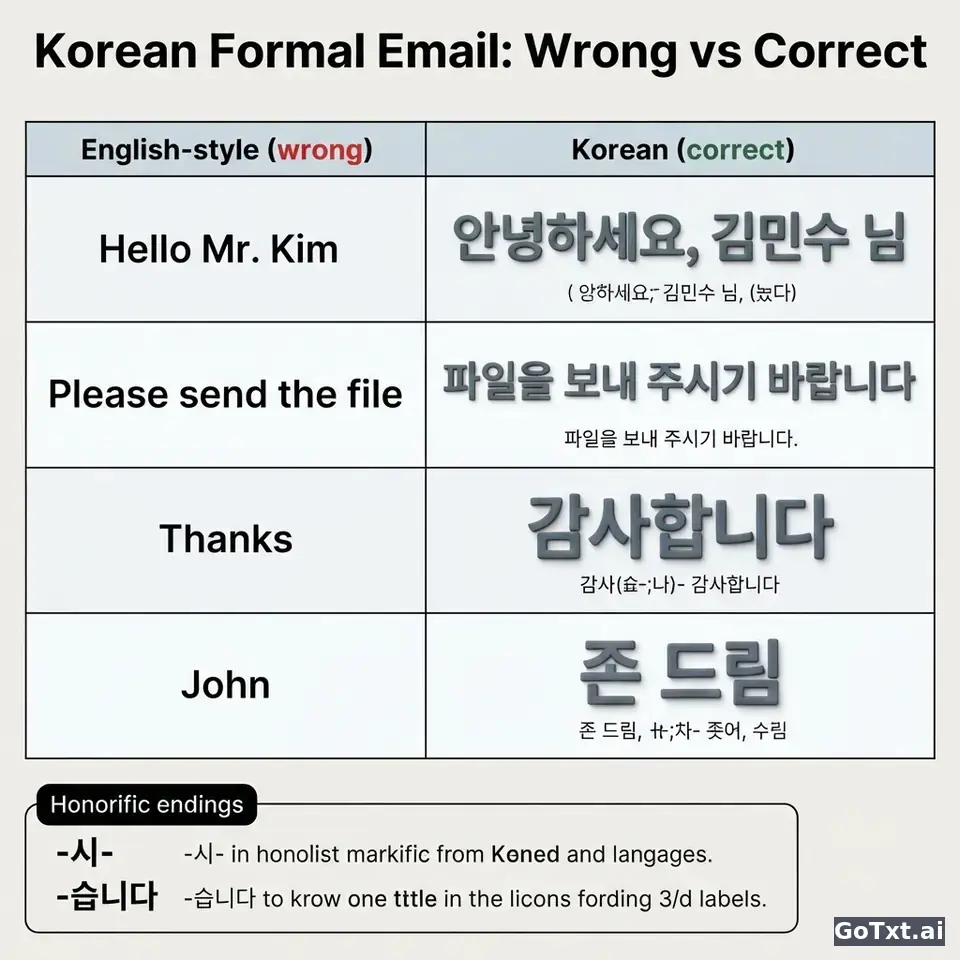 Formal Emails in Korean: 4 Traps That Instantly Reveal You're Not a Native I've read a lot of Korean business emails written by English speakers, and the same four wounds show up almost every time. The grammar is fine. The tone is not. Korean workplace writing runs on…
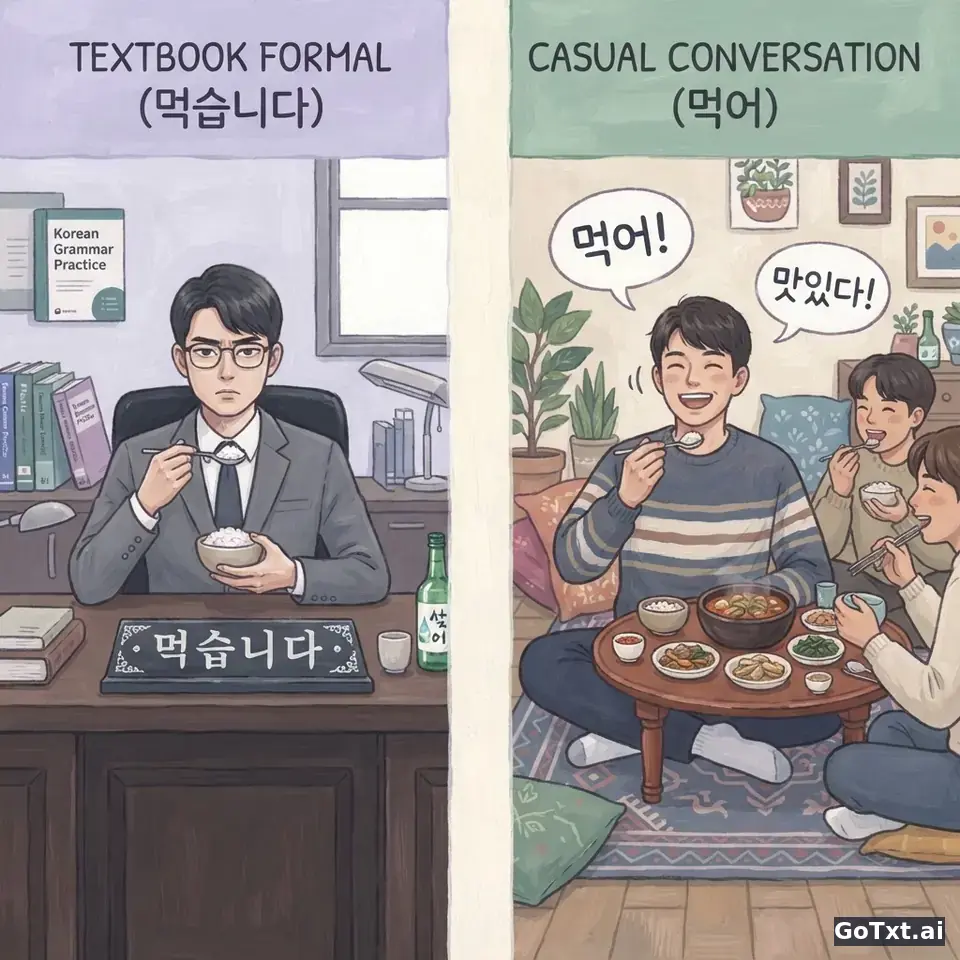 Grammar That Sounds Weird: 4 Korean Traps That Mark You as a Foreigner Every semester a student comes to me with the same proud look. They've memorized the conjugation tables, they can conjugate into every polite form, and then they say something like 저는 밥을 먹고 싶어요 at a…
 You vs. You: How Korean Really Handles "You" (and Why You Should Say It Less) When English speakers start Korean, the first thing they hunt for is the word for "you." They find 너, feel relieved, and then use it with their boss — and watch the room go quiet. Here's the honest…
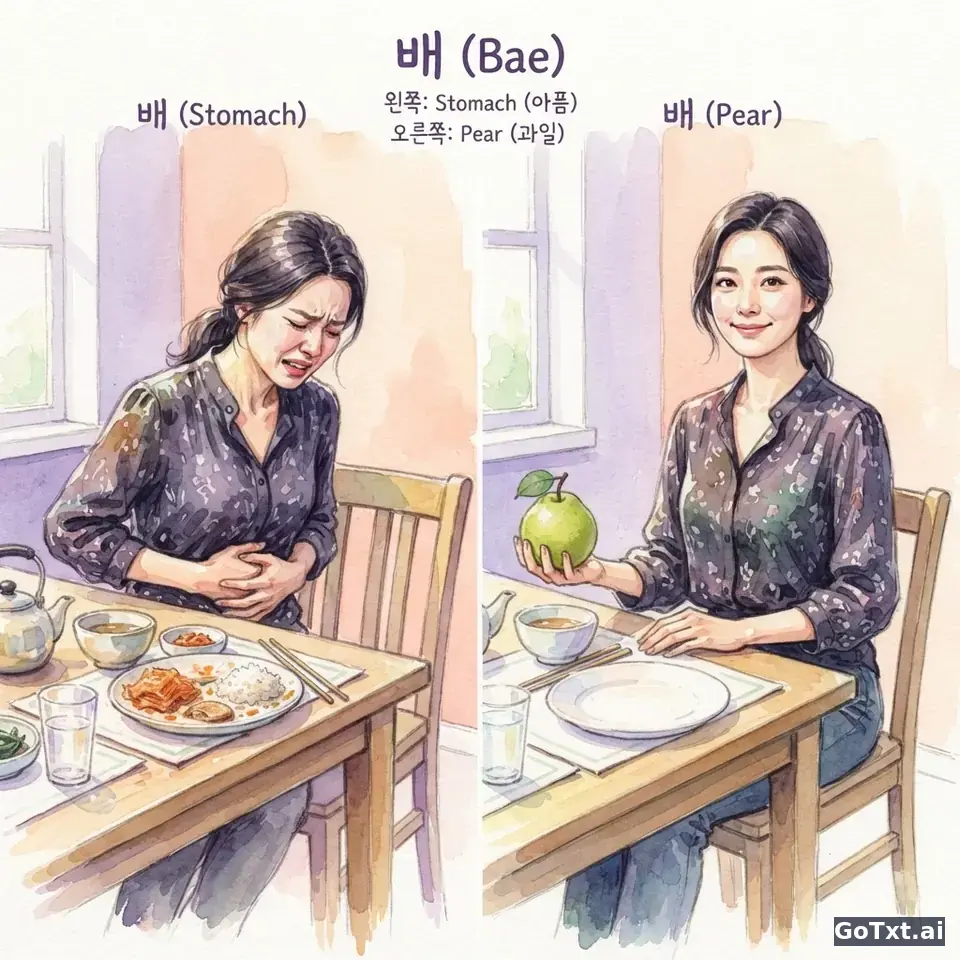 Decoding Korean Humor: Why "My Legs Are Fine, My Stomach Is Full" Makes No Sense (And All the Sense) Every language hides its sense of humor in the small stuff — not in punchlines, but in the way a sentence is built. My students often ask me why Korean jokes feel "untranslatable." They are…
 The Korean Verb 알다 (to know): Forms, Traps, and Why You Keep Saying It Wrong Every Korean learner meets ("to know") in their first week and thinks, "Great, an easy one." Then three months later they say 나를 알아요? to a friend and watch the friend's face do something complicated.…
 Why “I’m Stealing Your Rice” Makes No Sense (And How to Actually Learn It) Let’s be honest: the first time a Korean friend asked me 밥 먹었어? — literally “Did you eat rice?” — I panicked and checked my teeth for spinach. It took me three more encounters to realize she wasn’t…
 4 Korean Slang Words You Won’t Find in Textbooks (But Hear Everywhere) Let’s be honest: if you walked into Seoul’s Hongdae neighborhood speaking the Korean from your textbook, people would understand you—but they’d also think you’re a walking time capsule from 1995.…
 Four Verbs You Can’t Live Without in Korean (And How to Actually Use Them) Welcome back to GoTxt, everyone! I’m Soo-jin, and today we’re going to talk about the absolute backbone of the Korean language. Forget the fancy grammar for a second. If you only learn four things,…
 Lost in Translation: Why Korean Memes Fall Flat When You Translate Them Word-for-Word You know that moment when you send a Korean meme to a friend who’s learning the language, and they just stare at you? You wait for the laugh, but instead you get a polite nod and a “that’s… nice?”.…
💡 When you meet a new verb, ask Soo-jin: 'How do I use this politely?' She'll show you the formal and casual forms with example sentences.
«I always wanted to watch K-dramas without reading subtitles. Soo-jin helped me understand the casual speech between characters and the polite speech to elders. Now I catch phrases my friends miss!»
«I had a short trip to Seoul for work. Soo-jin drilled me on polite phrases and how to order food. When I said '감사합니다' to my Korean host, she was impressed.»
«I needed to pass TOPIK I for a scholarship. Soo-jin created a focused plan, tested my vocabulary, and explained the grammar patterns. I passed on my first try!»
The perfect taste