Soo-jin Blog Formal Emails in Korean: 4 Traps That Instantly Reveal You're Not a Native
Formal Emails in Korean: 4 Traps That Instantly Reveal You're Not a Native
Learn the four places where English speakers accidentally sound rude in Korean business emails — greetings, address, requests, and sign-offs — and the exact phrases that fix them.
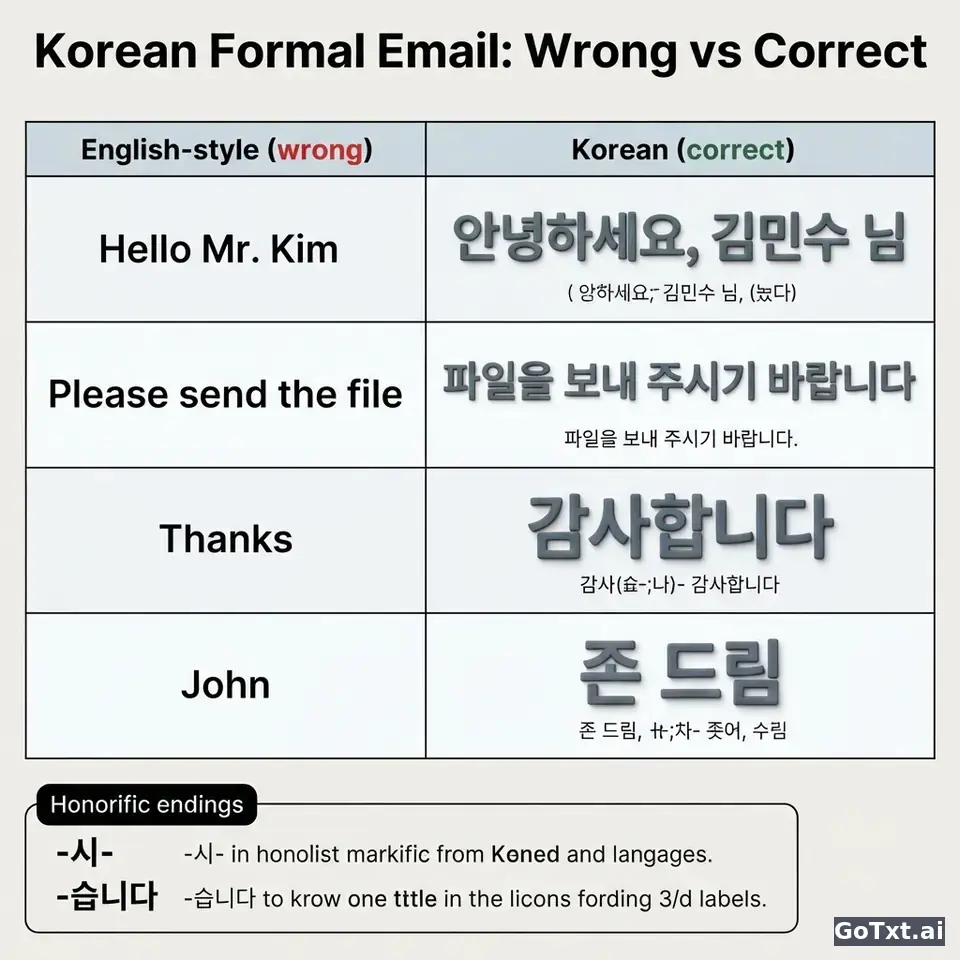
I've read a lot of Korean business emails written by English speakers, and the same four wounds show up almost every time. The grammar is fine. The tone is not. Korean workplace writing runs on honorifics and set formulas, and when you skip them, your reader doesn't think "foreigner" — they think "careless." The good news: the fixes are short and memorizable. Start with the greeting 안녕하세요, 김민수 님 instead of a bare "Hello Mr. Kim," and you're already ahead of half the inbox.
Trap 1: The greeting that skips the honorific
English lets you open with "Hi Min-su" and it's friendly. Korean splits the room: 안녕하세요 for the polite opener, then the name with the honorific suffix 님 attached — 김민수 님, never just "Mr. Kim." Using the bare name without 님 reads as either a boss scolding an intern or a close friend texting. Neither is what you want in a first email.
| English habit | Korean formal | Why it matters |
|---|---|---|
| Hi Min-su | 안녕하세요, 김민수 님 | 님 marks respect; skipping it sounds curt |
| Dear Sir | 담당자님께 | Use when you don't know the name |
| Hey | 안녕하십니까 | Full formal greeting for cold contacts |
Trap 2: "Please" is not a word — it's a verb ending
This is the trap that stings most. English "please send" feels polite. Translate it word-for-word and you get something that sounds like an order. Korean builds politeness into the verb itself with -시- (honorific infix) and -습니다 or
| English | Weak Korean | Formal Korean |
|---|---|---|
| Please send it | 보내 주세요 | 보내 주시기 바랍니다 |
| Please check | 확인해 주세요 | 확인해 주시기 바랍니다 |
| Please reply | 답장 주세요 | 회신 부탁드립니다 |
Trap 3: The sign-off that undoes everything
You can write a flawless email and then sign it "John" and lose the room. Korean sign-offs carry the relationship. 감사합니다 closes warmly, 존 드림 ("John, with respect") is the standard personal sign-off, and 존 배상 is the more formal variant you'll see in official correspondence. Pick one and keep it consistent — mixing them mid-thread looks like you pasted from two different templates.
| Situation | Sign-off | Register |
|---|---|---|
| Standard business | 감사합니다 | Polite, safe default |
| Personal close | 존 드림 | Warm, respectful |
| Official / legal | 존 배상 | Most formal |
Comments
Article discussion: learner comments and GoTxt teacher replies
Drop your emotions below — love, debates, even hate welcome. Comment 👇
Don't want to miss my reply? Leave your email — I'll send a copy.