Soo-jin Blog Grammar That Sounds Weird: 4 Korean Traps That Mark You as a Foreigner
Grammar That Sounds Weird: 4 Korean Traps That Mark You as a Foreigner
You studied the grammar, you know the rules — so why does your Korean still sound off? Here are four traps where "correct" grammar makes a native speaker wince, plus how to fix them.
Every semester a student comes to me with the same proud look. They've memorized the conjugation tables, they can conjugate
Why "Correct" Isn't "Natural"
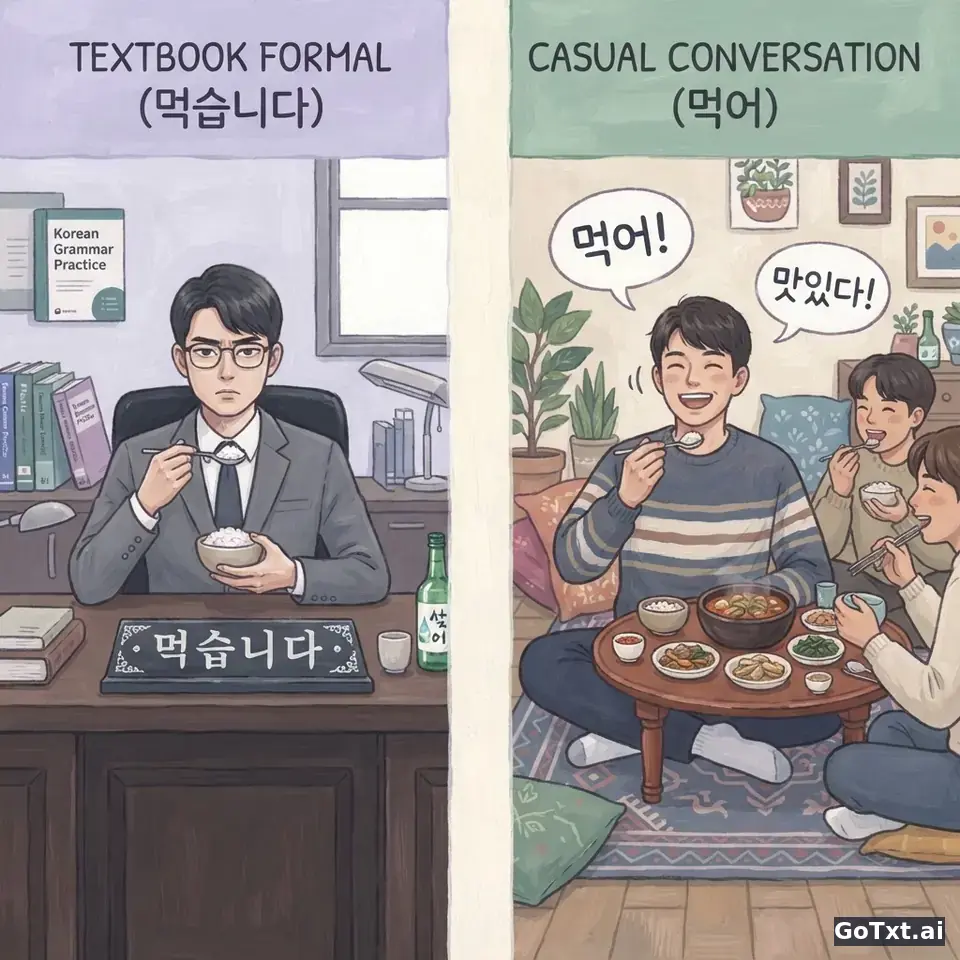
Korean encodes in grammar what English pushes into tone or word order. English says "I'm hungry" with flat words and lets your sigh do the work. Korean bakes the emotion, the relationship, and the situation into the ending itself. When you use the wrong ending, you're not making a grammar mistake — you're making a social one, and that's why it sounds weird. The listener hears a mismatch between the situation and the shape of your sentence. A textbook sentence in a casual moment sounds like wearing a tuxedo to a barbecue. Nobody says "wrong," but everybody notices.
Trap 1: The Over-Polite Robot
Learners fall in love with -습니다 because it's safe. So they say 물을 마십니다 to a close friend, and the friend blinks. To a Korean ear, that ending is a formal news broadcast. With friends, you'd just say 물 마셔 or 물 마실래?.
| Situation | Natural | Sounds Weird |
|---|---|---|
| To a close friend | 물 마셔 | 물을 마십니다 |
| To a boss | 물 드시겠어요? | 물 마셔 |
| To a stranger | 물 좀 주시겠어요? | 물을 마십니다 |
Trap 2: The Subject That Won't Leave
English demands a subject. Korean drops it the moment it's obvious. Saying 나는 밥을 먹었어 when everyone already knows it's you sounds stiff and slightly self-centered — like narrating your own life out loud. Koreans say 밥 먹었어. The subject vanishes, and the sentence breathes.
| English habit | Korean that sounds odd | What Koreans say |
|---|---|---|
| I ate. | 나는 밥을 먹었어 | 밥 먹었어 |
| I'm going home. | 나는 집에 가 | 집에 가 |
| I like it. | 나는 이게 좋아 | 이게 좋아 |
Trap 3: The Tense That Isn't About Time
Korean -겠- doesn't mean "future." It means intention, assumption, or polite resolve. Say 먹겠습니다 and you're not saying "I will eat later" — you're announcing a decision with ceremony. Learners use it for plain future plans and sound like they're making a formal vow over dinner.
| You mean | You say | Native hears |
|---|---|---|
| I'll eat later | 나중에 먹겠습니다 | a solemn declaration |
| I'll eat later | 나중에 먹을게요 | a casual promise |
| I'll eat later | 나중에 먹을 거예요 | a simple plan |
Trap 4: The Honorific You Forgot to Aim
Korean honorifics don't just change the verb — they change who the sentence is about. 드시다 honors the eater; 먹다 doesn't. Mix them up and you accidentally honor yourself or disrespect your elder.
Comments
Article discussion: learner comments and GoTxt teacher replies
Drop your emotions below — love, debates, even hate welcome. Comment 👇
Don't want to miss my reply? Leave your email — I'll send a copy.