GoTxt · Indonesian · Dewi

Online Indonesian Tutor: Dewi, Your AI Language Teacher

Dreaming of wandering through Ubud's rice terraces, bargaining at a Jakarta market, or connecting with Indonesian friends and family? Meet Dewi, your online Indonesian tutor powered by AI. She's here to take you from zero to confident conversation, whether you want to master standard Indonesian for travel, business, or just for the joy of learning. With Dewi, you'll chat, laugh, and learn at your own pace, tackling real-life situations and getting instant feedback on everything from pronunciation to polite phrasing. No rigid lessons, just natural conversation that builds your skills. Ready to start speaking Indonesian? Dewi is waiting in chat.

Chat · voice · progress · vocabulary — one learner profile

D
Dewi · Indonesian teacher online

Try a demo chat

Halo! Saya Dewi. I'm your Indonesian teacher. Welcome to GoTxt, where we'll learn by talking, not by memorizing. Tell me why you want to learn Indonesian—are you planning a trip to Bali, moving to Jakarta, or just love the culture? We'll start from wherever you are. If you're a complete beginner, don't worry. We'll take it slow, and I'll explain everything in English when you need it. Let's make this fun!
Tools

Our language learning tools

Try them here — same pronunciation check and flashcards as in lessons.

Pronunciation practice

Listen to the phrase, repeat into the mic — your teacher analyzes the audio and gives a real pronunciation score with corrections and comments.

1 / 3

Halo, apa kabar?

hello, how are you?

Your personal vocabulary

After every lesson you get review cards — and you can generate your own decks on any topic.

0 Still learning
0 I know
Show hint

Halo

Still learning
I know

Error review

Weak spots from your lessons land here: open a card and practice again. Mark Done when you know it — it leaves the shelf; course progress stays intact.
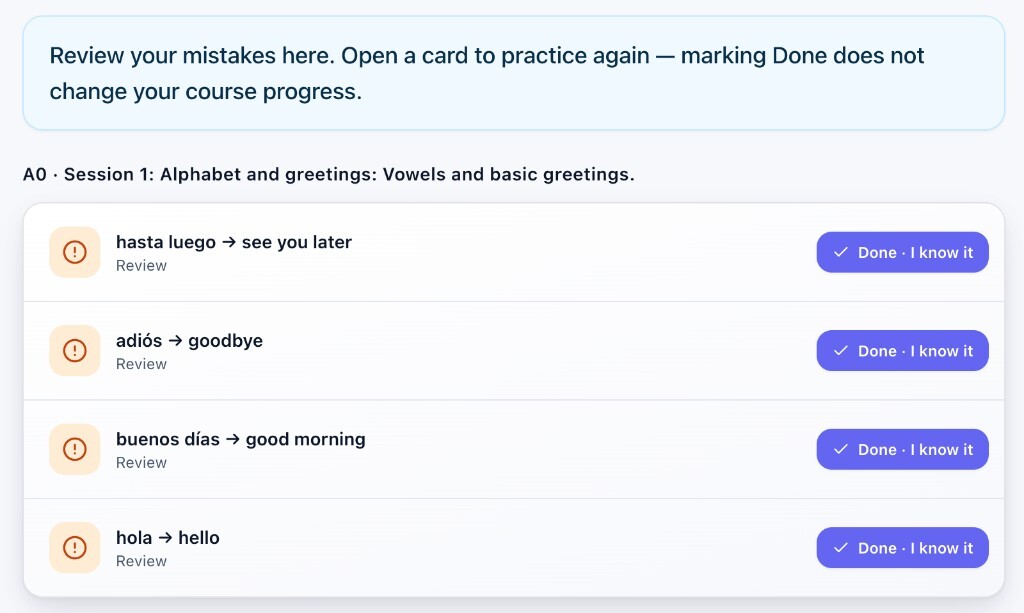
Error review In full access →

Learning materials

Sheets, quizzes and pronunciation from your lessons — listen, review and come back anytime.
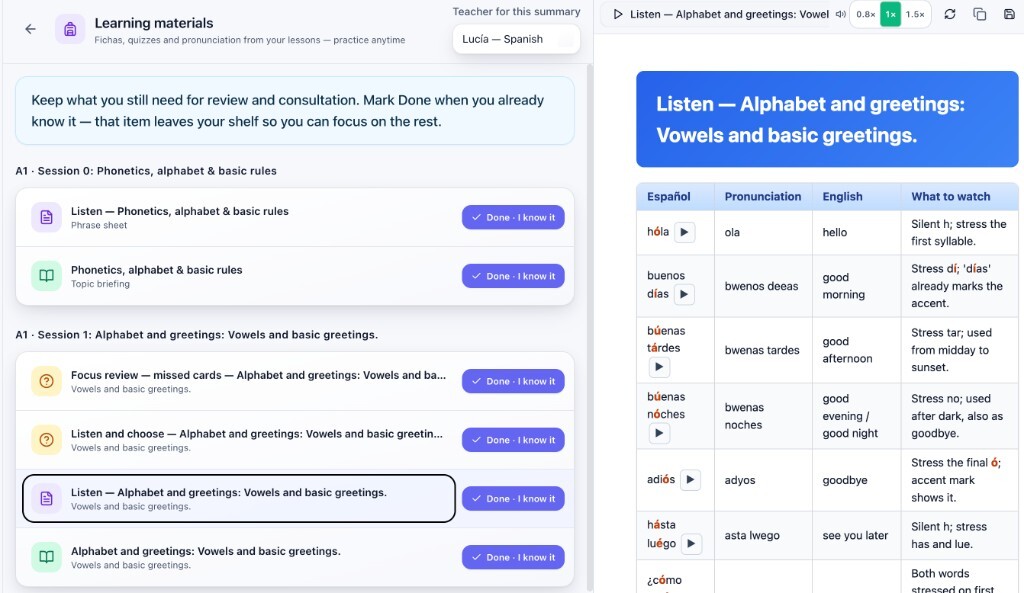
Learning materials In full access →

Chat Me

Your off-lesson consultant: questions, plans and practice anytime — no schedule required.

Not a planned lesson and it does not track CEFR progress — free mode: ask anything, drill pronunciation, or open a sheet beside the chat.
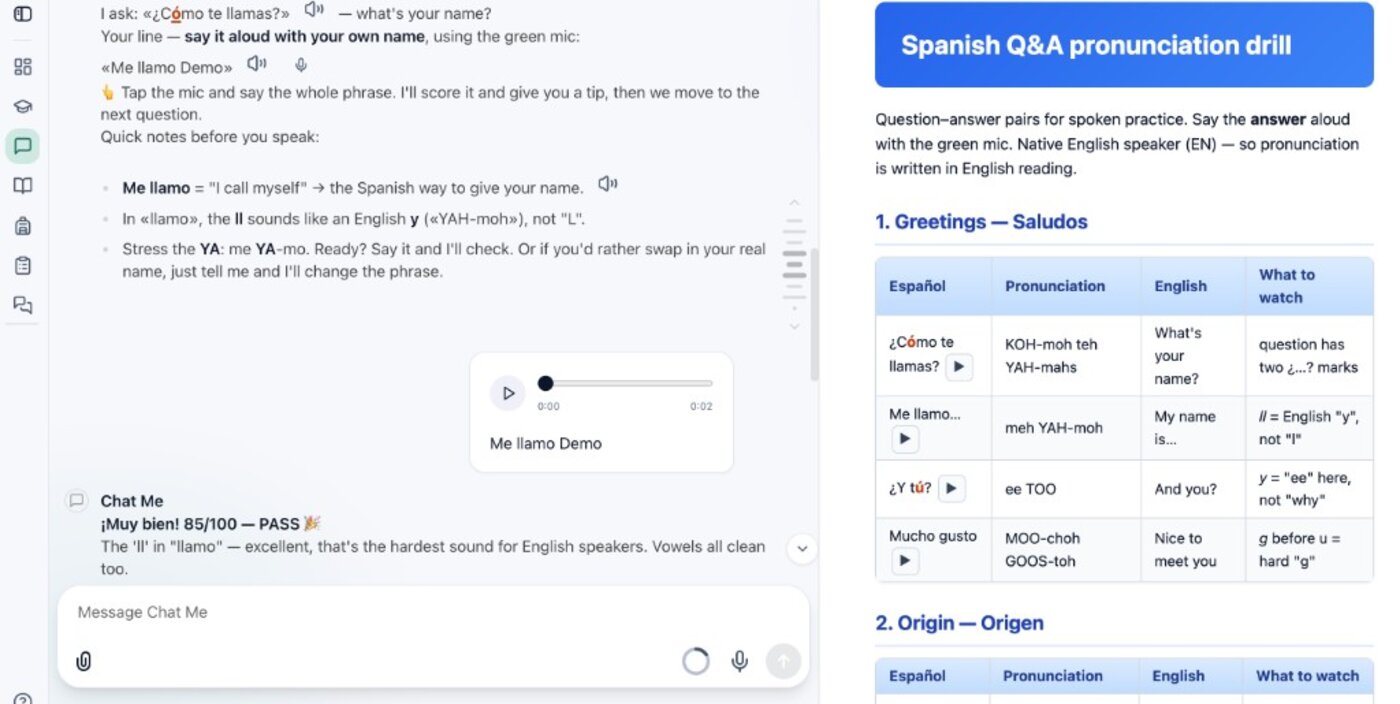
  • Any off-lesson topic — study, daily life, humor, plans
  • Voice and text: mic, pronunciation score, corrections
  • On-demand sheets and drills (Q&A, phrases, what to watch)
  • Personal consultant whenever you need — no schedule
Chat Me In full access →

Learner dashboard

Your study résumé in one place: current session, course progress, study plan, and quick links to vocabulary, mistakes, materials and Chat Me.
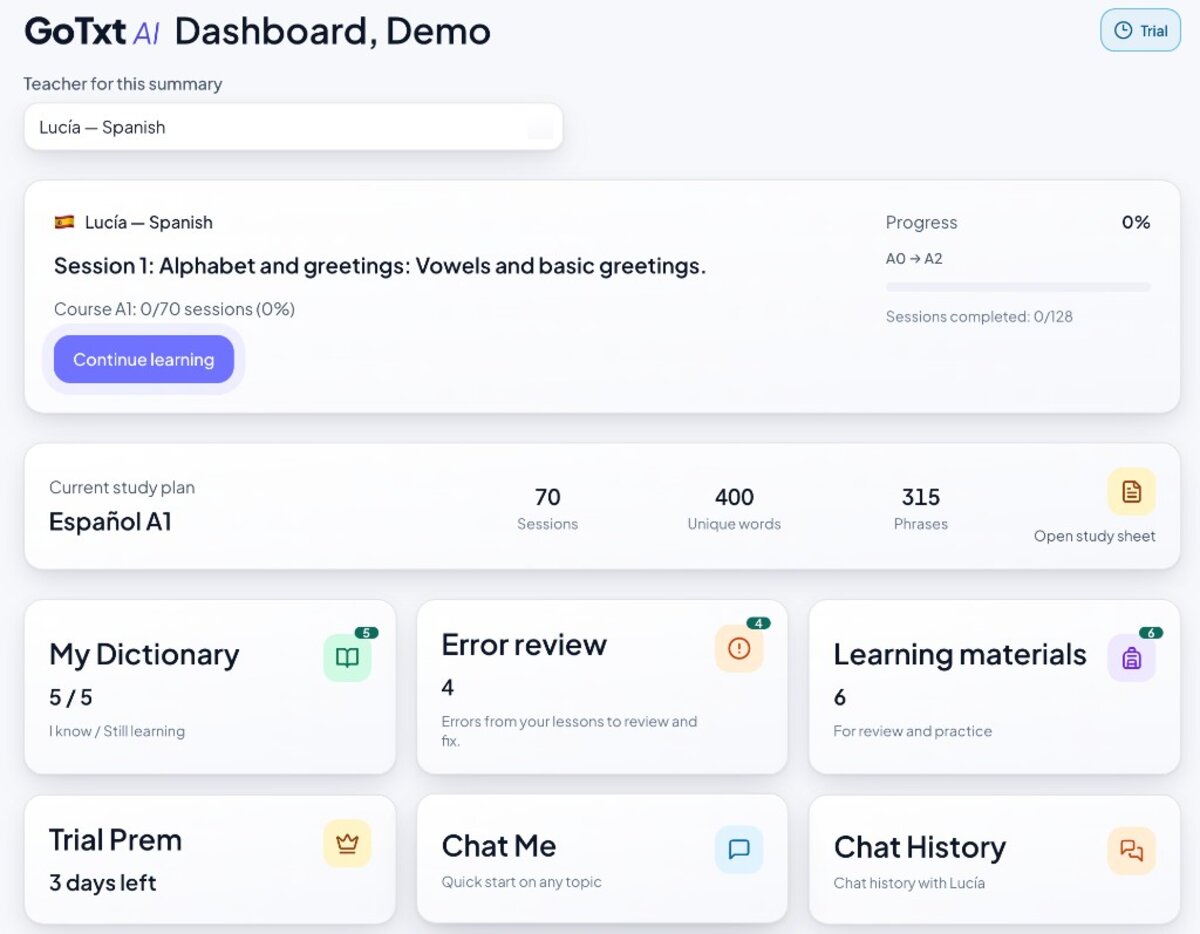
  • Session résumé and Continue learning
  • Course progress and current study plan
  • Quick links: vocabulary, mistakes, materials, Chat Me
  • Chat history with your teacher in one place
Learner dashboard In full access →
Features

What our AI teachers can do

Not a translator and not a quiz bank. Our AI teachers run real dialogue: they listen, correct, remember your progress, and adapt the plan to your goal — travel, work, exam, or confident conversation.

Live dialogue, not drills
Your teacher doesn’t ask you to pick A/B/C — they ask a question, listen to your answer, and respond. Mistake? Corrected on the spot with a clear why.
Pronunciation with a mic
Say a phrase into the mic and get clear feedback. Prefer text-only? That’s fine too.
Live voice call
Speak in realtime — like a private lesson, without a fixed slot. Talk, listen, ask again: your teacher keeps up and guides you.
Level that fits from minute one
Short onboarding, then the teacher knows where to start. Pace adapts: no time wasted on what you already know, no skipped gaps.
Smart spaced vocabulary
New words land in your dictionary and return just before you’d forget them.
Memory between sessions
Goals, weak spots, and your current module stay saved. Come back next week — continue where you left off.
Grammar in your language
Hard rules explained in English first — clear, without jargon walls — then practiced in the language you’re learning.
Your rules — “Brains”
Stricter or more supportive? Slang or formal? You set learning rules and change them anytime.

Dewi

Your AI tutor

Dewi is more than an AI—she's a cultural bridge between English and Indonesian. She grew up in Jakarta but spent years in Bali, so she knows both the formal Bahasa Indonesia and the casual, street-smart Jakartan dialect. Dewi understands exactly which parts of Indonesian confuse English speakers: those tricky prefixes and suffixes, the subtle differences between formal and informal speech, and the playful reduplication that changes meanings. She'll gently correct your mistakes, explain the 'why' behind the rules, and keep you motivated with fun, relevant conversations. Whether you're a total beginner or looking to polish your existing skills, Dewi adapts to your level and goals, making every session feel personal and productive.
  • Native-level fluency in both standard and informal Indonesian
  • Patient with beginners—explains grammar in clear English
  • Tailors lessons to your interests: travel, business, or pop culture
  • Provides instant pronunciation feedback to sound natural
  • Makes learning fun with jokes, stories, and real-life dialogues
Dialogue, not drills
You learn by having real conversations with Dewi, not by filling in blanks. Discuss your weekend plans, order food at a warung, or ask for directions—Dewi responds naturally, introducing new vocabulary and grammar in context. For example, she'll teach you 'saya mau pergi' (I want to go) just as you're telling her about your travel dreams.
Voice that adapts to you
Practice speaking out loud and get feedback. Use the voice feature to hear Dewi's clear pronunciation, then record yourself. She'll point out if your 'c' sounds too much like an English 'ch' (in Indonesian, 'c' is like 'ch' but shorter) or if your 'ng' is too sharp. Speak as slowly as you need—Dewi adjusts.
From zero to first sentences
No prior knowledge? Perfect. Dewi starts with the essentials: 'Selamat pagi' (good morning), 'Terima kasih' (thank you), and builds from there. You'll learn to form simple sentences like 'Saya dari Amerika' (I'm from America) within your first chat. She breaks down everything into digestible steps, so you never feel lost.
Master the affixes
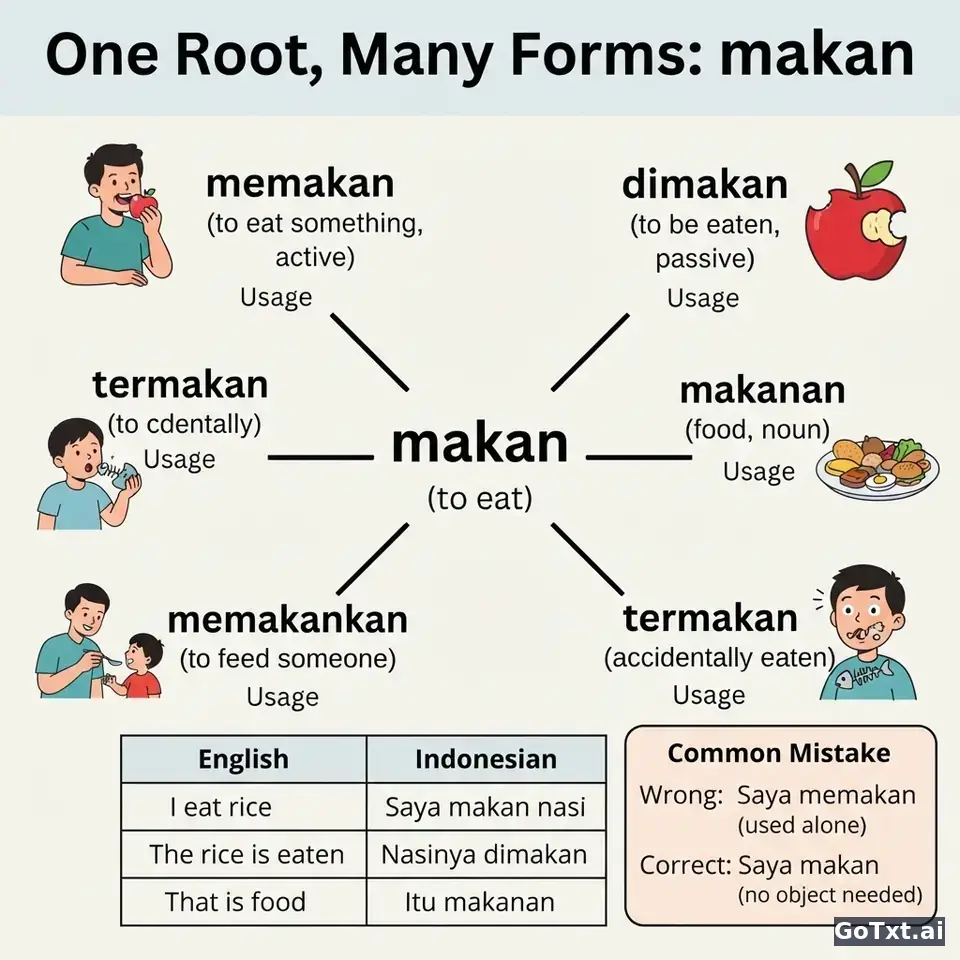
Indonesian verbs are built with affixes like me- and di-, which can be confusing. Dewi explains them with examples: 'melihat' (to see) vs. 'dilihat' (to be seen). She'll show you how adding 'ber-' changes meaning, like 'bicara' (speak) becoming 'berbicara' (to have a conversation). You'll practice until it clicks.
Slang and informal talk
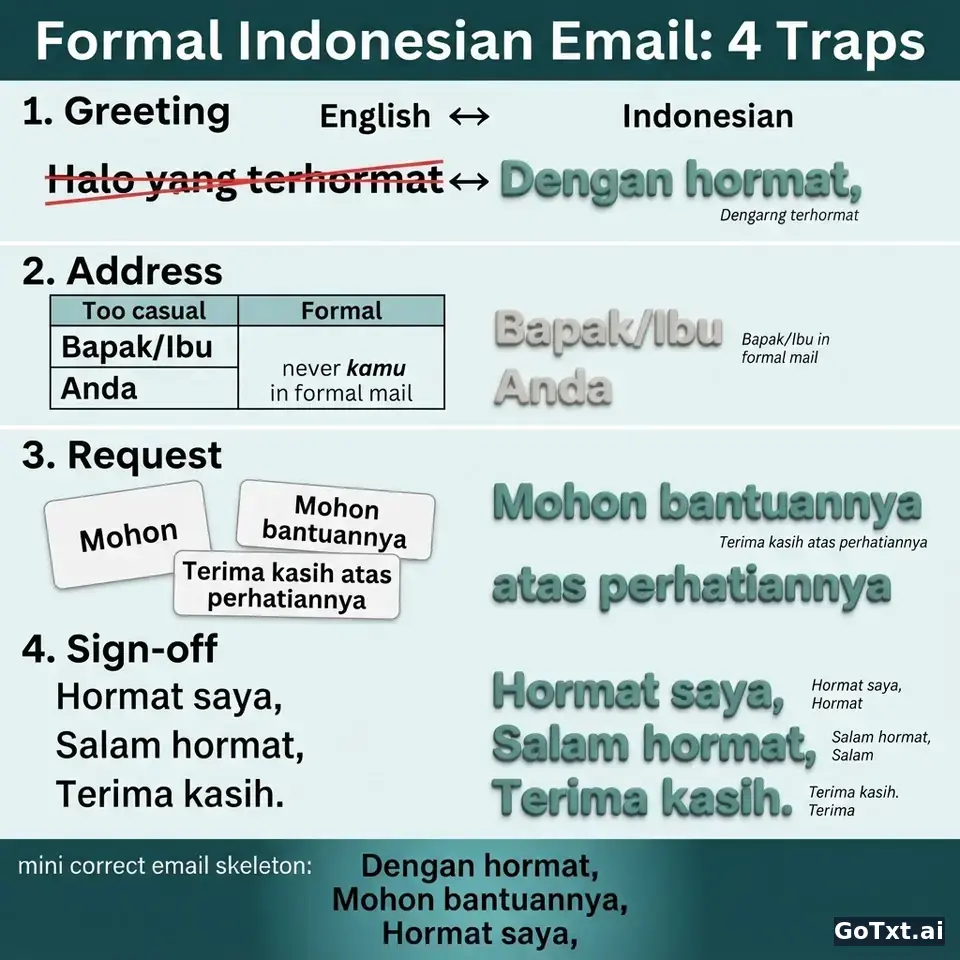
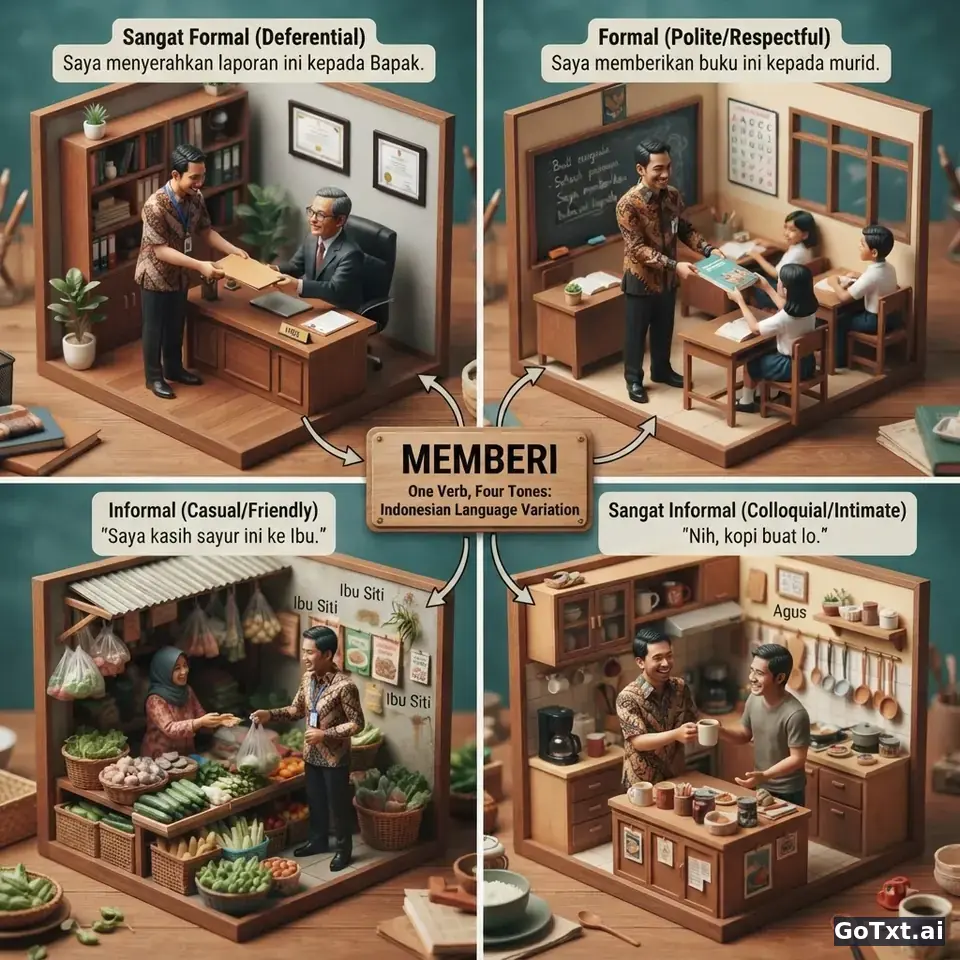
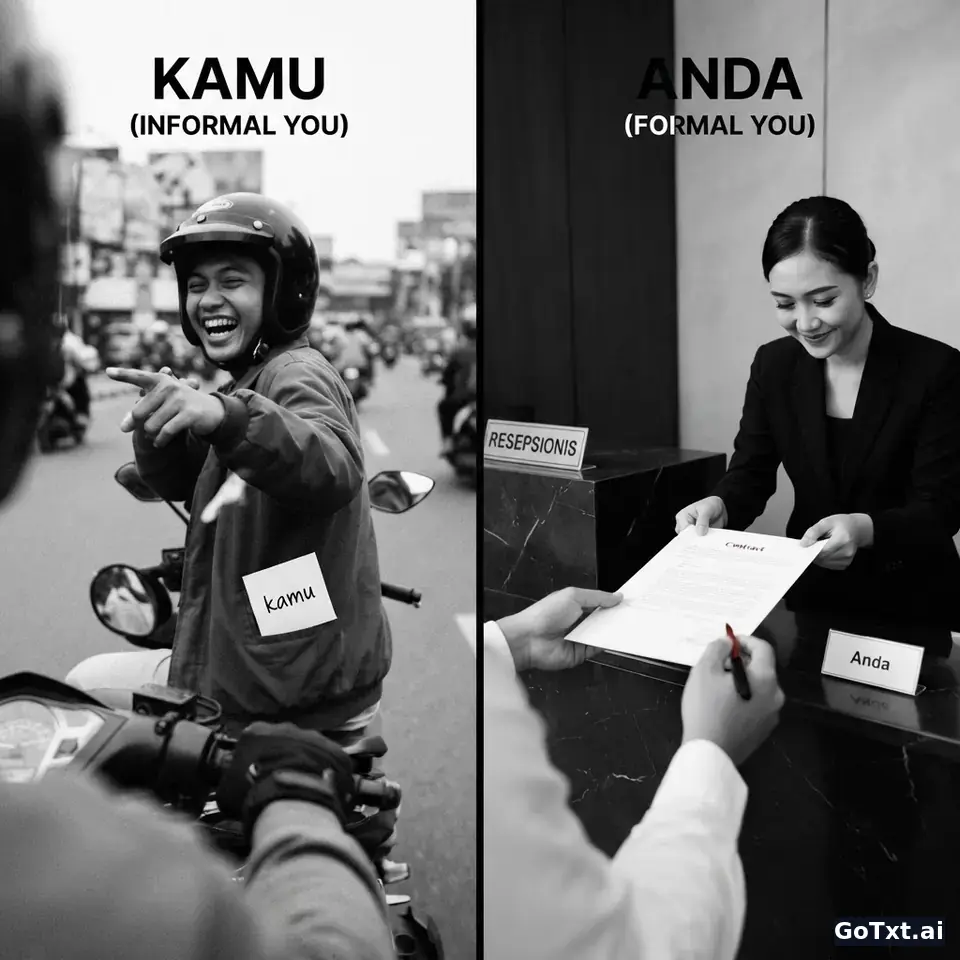
Textbooks teach 'tidak' (no), but Indonesians often say 'nggak' or 'gak' in casual chat. Dewi introduces you to slang like 'gue' (I, informal) and 'lu' (you, informal) used in Jakarta. You'll learn when to use formal vs. informal, so you sound natural with friends but polite in professional settings.
Pronunciation perfected
Indonesian is phonetic, but English speakers trip on certain sounds. Dewi drills you on the 'ng' sound (as in 'ngopi'—coffee) and the 'e' sounds (like in 'senang'—happy). She gives instant feedback on your accent, helping you avoid common mispronunciations that might cause confusion.
Vocabulary that sticks
Dewi uses a smart flashcard system that reintroduces words just before you're about to forget them. She weaves new terms into your conversations naturally, like using 'makan' (eat) in different contexts: 'saya sudah makan' (I've eaten) and 'mau makan apa?' (what do you want to eat?). This way, words stay in your memory.
Memory between sessions
Whenever you return, Dewi remembers everything you've learned. She'll start by reviewing key phrases and even ask about things you mentioned before, like 'How was your trip to Yogyakarta?' This personalized approach makes you feel she's truly invested in your progress, and it reinforces your long-term retention.
Dewi

Dewi's blog — latest articles

Indonesian Verbs: One Verb, All Its Forms, Explained Step by Step — illustration | GoTxt Indonesian Verbs: One Verb, All Its Forms, Explained Step by Step Most learners arrive at Indonesian expecting a verb to behave like an English verb: one base, a handful of tense endings, done. Then they meet makan and discover it can show up as memakan, makanan,… Formal Emails in Indonesian: 4 Traps That Instantly Reveal You're Not a Native — illustration | GoTxt Formal Emails in Indonesian: 4 Traps That Instantly Reveal You're Not a Native Every week a student shows me a perfectly polite email in English and asks me to "translate it" into Indonesian. That's the first trap. Indonesian formal writing is not English with different words —… Grammar That Sounds Weird: 4 Traps That Instantly Reveal You're Not a Native Indonesian Sp — illustration | GoTxt Grammar That Sounds Weird: 4 Traps That Instantly Reveal You're Not a Native Indonesian Speaker I've been teaching Indonesian for years, and the same scene plays out in almost every class. A student produces a sentence that is grammatically flawless — every affix in place, every pronoun correct… You or You? How to Address People in Indonesian Without Sounding Rude — illustration | GoTxt You or You? How to Address People in Indonesian Without Sounding Rude Every English speaker walks into Indonesian expecting a mirror: one polite «you», one casual «you», done. Then a shopkeeper calls you Bapak, your friend calls you kamu, a taxi driver calls you bos,… Decoding Indonesian Humor: What the "Tuyul" Joke Really Teaches You — illustration | GoTxt Decoding Indonesian Humor: What the "Tuyul" Joke Really Teaches You Every language hides its sense of humor in the small stuff — the throwaway lines people repeat at the dinner table until they become a kind of national shorthand. In Indonesian, one of my favorite… The One Indonesian Verb That Breaks Every English Speaker: **Meletakkan** — illustration | GoTxt The One Indonesian Verb That Breaks Every English Speaker: **Meletakkan** Every English speaker learning Indonesian eventually hits the same wall. It's not the alphabet, it's not the food vocabulary — it's a verb that seems to change shape every time you look at it. Today… Why Indonesians Say “Rain on the Sun” (and How to Actually Learn Such Phrases) — illustration | GoTxt Why Indonesians Say “Rain on the Sun” (and How to Actually Learn Such Phrases) You know that moment when you translate something word-for-word and the result is pure nonsense? Indonesian is full of these traps. I once told my student, “Don’t worry, you’ll get it,” and she… 4 Indonesian Slang Words You Won’t Find in Any Textbook (But Everyone Uses) — illustration | GoTxt 4 Indonesian Slang Words You Won’t Find in Any Textbook (But Everyone Uses) Let me paint you a picture. You’ve spent months drilling formal Indonesian. You can conjugate verbs, you know your saya from your aku, and you’re pretty proud of your vocabulary. Then you land in… Four Verbs You Can’t Do Without in Indonesian — illustration | GoTxt Four Verbs You Can’t Do Without in Indonesian thousand words. You need the ones that do the heavy lifting — the verbs that pop up in every conversation, from ordering nasi goreng to telling your host you’re full. In my years of teaching, I’ve… Why Literal Translation Kills the Joke: Funny Mix-Ups Between English and Indonesian — illustration | GoTxt Why Literal Translation Kills the Joke: Funny Mix-Ups Between English and Indonesian You know that moment when a meme makes you snort coffee through your nose, and you just have to share it with your Indonesian friend? So you proudly translate it word-for-word, hit send, and……


All articles →

Grammar made easy: your bridge to Indonesian

From English to Indonesian: what's familiar and what's tricky

✅ What will feel familiar

Indonesian uses the Latin alphabet, so you can read it immediately.
There's no verb conjugation! 'I eat,' 'you eat,' 'they eat' are all 'saya makan,' 'kamu makan,' 'mereka makan.'
Word order is mostly subject-verb-object, like English: 'Saya makan nasi' (I eat rice).
Plurals can be simple: repeat the word, e.g., 'buku' (book) becomes 'buku-buku' (books).

⚠️ What to watch for

Affixes: prefixes and suffixes change the meaning. 'Makan' (eat) becomes 'memakan' (to consume) or 'dimakan' (to be eaten).
Reduplication isn't just for plurals—it can change meaning entirely. 'Abang' (brother) vs. 'abang-abang' (brothers), but 'hati' (heart) vs. 'hati-hati' (careful).
Particles like 'lah' and 'kah' add nuance. 'Duduk' (sit) becomes 'duduklah' (please sit) or 'dudukkah?' (are you sitting?).
Register: formal vs. informal can be very different. 'Tidak' becomes 'nggak' in casual speech, and 'saya' can become 'gue' in Jakarta slang.

💡 Dewi will help you navigate these traps. When you hit a confusing affix, just ask, 'Dewi, kenapa?' (Why?) and she'll break it down in simple English. She'll also point out when you should use formal vs. informal, so you never sound stiff or too casual.

What learners say about their journey with Dewi

What learners say about their journey with Dewi

Alex, San Francisco
San Francisco · Travel to Bali

«I knew zero Indonesian before my trip. Dewi taught me how to order food, ask for directions, and even haggle politely. I felt so confident navigating the markets and talking to locals. It was like having a friend in my pocket!»

Confident traveler in Bali, able to hold basic conversations.
Maya, London
London · Connect with Indonesian family

«My husband is Indonesian, and I wanted to surprise his family. Dewi not only taught me the language but also cultural nuances, like when to use 'Bapak' and 'Ibu' respectfully. They were overjoyed when I spoke in their language during our visit.»

Impressed her in-laws and now communicates regularly with them in Indonesian.
Sam, Sydney
Sydney · Business in Jakarta

«I needed to work with partners in Jakarta. Dewi helped me understand formal business language and the informal office chat. She even corrected my pronunciation of 'strategi'—I was saying it with an English accent. Now I feel comfortable leading meetings in Indonesian.»

Successfully led a business meeting in Indonesian and improved professional relationships.
Pricing

Simple plans,real progress

Get started
Free Trial
3 days
3 days

The perfect taste

Full Premium experience
All 16 AI teachers
Voice calls
No credit card required
Claim your trial
Most popular
Standard
€ 19.99
per month
1 teacher (1 language)
Learner dashboard
Personal study plan and CEFR progress
Chat lessons: sheets, quizzes, role-play, typing
Pronunciation feedback
Vocabulary: SRS shelves and flashcards
Generate your own decks by topic
Error notebook and practice
Materials shelf
In-chat voice (mic / TTS)
Voice call with your tutor (limited)
Speech register and style
Virtual keyboard
Brains (learner preferences)
Explanations in your language
Chat history
Choose Standard
Best value
Premium
€ 29.99
per month
Everything in Standard
All school teachers — learn several languages at once
Voice call with no minute limit
Choose your tutor’s voice
Chat Me — off-lesson consultant on any topic, your personal assistant
Free conversation outside the plan
Several sessions from different devices at once
Targeted speaking practice on your mistakes
Expanded set of learning materials
Go Premium
FAQ

Common questions about learning Indonesian with Dewi

Absolutely! Dewi is designed for absolute beginners. You'll start with basic greetings and essential phrases, and she'll explain everything in English. She'll guide you step by step, building your confidence with simple sentences. You'll be surprised how quickly you can start forming your own phrases.
Dewi is a dedicated AI language teacher, not just a chat. She follows your progress, remembers your mistakes, and adapts lessons to your needs. She provides structured grammar explanations, pronunciation feedback, and vocabulary reinforcement. It's like having a personal tutor who's always available and entirely focused on your learning.
You can use voice messaging on your phone or computer, and you'll need a microphone for speaking practice. Dewi will give you feedback on your pronunciation. If you prefer, you can also type, but speaking is highly recommended to build your confidence and accent.
You can start for free and explore the basics. For full access to all features, like pronunciation feedback and advanced lessons, there's a Premium plan. Try it for 3 days free—no credit card required. After that, choose a plan that fits your budget.
Definitely! Just say 'Bicara pelan-pelan, Dewi' (speak slowly, Dewi) or type it, and she'll slow down her responses. She'll also break down longer sentences into smaller parts, making it easier to understand and repeat after her.
You'll learn both! Dewi starts with standard Indonesian, which is used in official settings, media, and education. As you progress, she'll introduce informal and slang forms, like 'nggak' and 'gue', so you can understand casual conversations and speak naturally with friends.
Yes, she can! If your goal is to pass the UKBI (Uji Kemahiran Berbahasa Indonesia), Dewi can tailor lessons to exam topics, practice test formats, and focus on reading comprehension and grammar. She'll help you build the vocabulary and structures you need to succeed.
Mistakes are part of learning! Dewi corrects you gently and explains the rule behind the correction. She won't judge you, and you can repeat exercises as many times as you need. Her goal is to make you feel comfortable and confident.
Yes, GoTxt works on any device with a browser. You can chat and use voice features on your smartphone during your commute, lunch break, or anywhere. Just log in and continue your conversation with Dewi seamlessly.
At registration, choose your native language — the AI teacher explains grammar, gives hints, and corrects mistakes in that language while you practice the language you are learning. Examples: Armenian (Հայերեն), Georgian, Ukrainian, Polish, Hebrew, and all major languages.
  • العربية
  • বাংলা
  • 简体中文
  • 繁體中文
  • English
  • Français
  • Deutsch
  • हिन्दी
  • Bahasa Indonesia
  • Italiano
  • 日本語
  • 한국어
  • Português (Brasil)
  • Português (Portugal)
  • Русский
  • Español
  • Türkçe
  • Tiếng Việt
  • Հայերեն
  • Bosanski
  • Català
  • Čeština
  • Dansk
  • Nederlands
  • Eesti
  • Suomi
  • ქართული
  • עברית
  • Magyar
  • Íslenska
  • Latviešu
  • Lietuvių
  • Norsk bokmål
  • Norsk nynorsk
  • فارسی
  • Polski
  • Slovenčina
  • Slovenščina
  • Svenska
  • བོད་ཡིག
  • ไทย
  • Українська
  • ئۇيغۇرچە