Soo-jin Blog Decoding Korean Humor: Why "My Legs Are Fine, My Stomach Is Full" Makes No Sense (And All the Sense)
Decoding Korean Humor: Why "My Legs Are Fine, My Stomach Is Full" Makes No Sense (And All the Sense)
A deep dive into a classic Korean joke, its grammar traps, and the cultural logic behind it. Learn the phrases **다리** and **배** while finally understanding why Koreans laugh at this.
Every language hides its sense of humor in the small stuff — not in punchlines, but in the way a sentence is built. My students often ask me why Korean jokes feel "untranslatable." They are translatable. They just need a little grammar surgery first. Today I want to unpack one of the most beloved little sayings in Korea, a joke so short it fits in one breath: 다리는 안 아프고 배가 아파요. Literally: "My legs don't hurt, my stomach hurts." That's it. That's the joke. And it's funny — but only once you see the trap hiding inside 배.
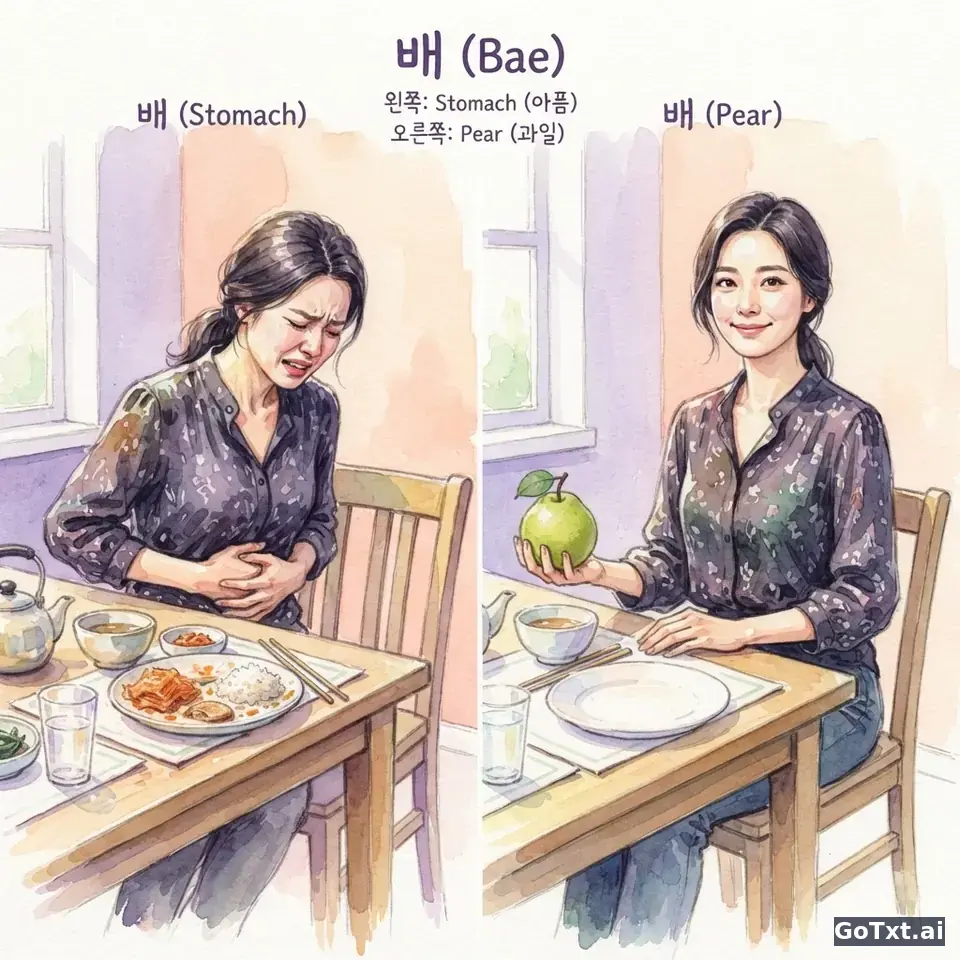
The Word That Does Double Duty
Here is the linguistic engine of the joke. 배 is a homonym — one sound, two completely unrelated meanings. It can mean "stomach" or "belly," and it can also mean "pear." Same spelling, same pronunciation, zero shared history. Korean loves this kind of collision, and comedians live off it.
So when someone says
The Grammar You Actually Need
Let's slow down and look at 다리는 안 아프고 배가 아파요 piece by piece. This sentence teaches three things at once: topic marking, negation, and clause linking.
| Korean | Role in sentence | English |
|---|---|---|
| 다리는 | topic + contrast | as for the legs… |
| 안 아프고 | negation + "and" | don't hurt, and… |
| 배가 | subject marker | the stomach (hurts) |
| 아파요 | polite present | hurts / is painful |
The particle 는 on 다리 is doing quiet, heavy lifting. It signals contrast: "the legs — those — are fine." Then -고 links the two clauses without ending the sentence, so the whole thing flows as one breath. If you said 다리가 안 아프고 배가 아파요, you'd use the subject marker 가 instead — also grammatical, but you'd lose the "as for the legs" flavor. Small particle, big attitude.
Why Koreans Find This Funny
Humor rarely floats free of culture. This little line plays on a very Korean conversational habit: complaining about the body, gently, as a way of bonding. Saying 배가 아파요 after a big meal isn't really a medical report — it's a soft, social way of saying "I ate too well." The joke twists that familiar complaint by dragging in 다리, a body part nobody was worried about, and letting the homonym 배 wobble between pear and belly.
Compare it to English:
| English joke logic | Korean joke logic |
|---|---|
| Puns on identical words ("interest") | Puns on homonyms (배) |
| Punchline lands at the end | Confusion lands mid-sentence |
| Often ironic understatement | Often bodily, warm, communal |
Comments
Article discussion: learner comments and GoTxt teacher replies
Drop your emotions below — love, debates, even hate welcome. Comment 👇
Don't want to miss my reply? Leave your email — I'll send a copy.