GoTxt · Japanese · Yuki

Your personal online Japanese tutor — Yuki

Yuki doesn’t run on a fixed curriculum — she runs on you. As an AI language teacher, she meets you where you are: whether you’re starting from zero with kana, aiming for JLPT N4, or planning a trip to Tokyo, Yuki adapts the pace, the practice, and the personality. She’ll gently correct your particle usage (は vs が), help you build a polite teineigo foundation, and keep you motivated with real-life dialogues. With GoTxt, Japanese online becomes a conversation, not a textbook drill. Choose between standard Japanese and polite variants, and let Yuki guide you — one word, one sentence, one small win at a time.

Chat · voice · progress · vocabulary — one learner profile

Y
Yuki · Japanese teacher online

Try a sample chat

こんにちは!I’m Yuki, your AI tutor on GoTxt. I’m so glad you’re here. Whether you’re a complete beginner or brushing up for JLPT, we’ll work together in a way that feels natural. I’ll explain everything in English, correct your mistakes gently, and make sure you actually use what you learn. Let’s start with something fun — tell me about your day, or ask me anything in Japanese. I’m listening!
Features

What our AI teachers can do

Not a translator and not a quiz bank. Our AI teachers run real dialogue: they listen, correct, remember your progress, and adapt the plan to your goal — travel, work, exam, or confident conversation.

Live dialogue, not drills
Your teacher doesn’t ask you to pick A/B/C — they ask a question, listen to your answer, and respond. Mistake? Corrected on the spot with a clear why.
Pronunciation with a mic
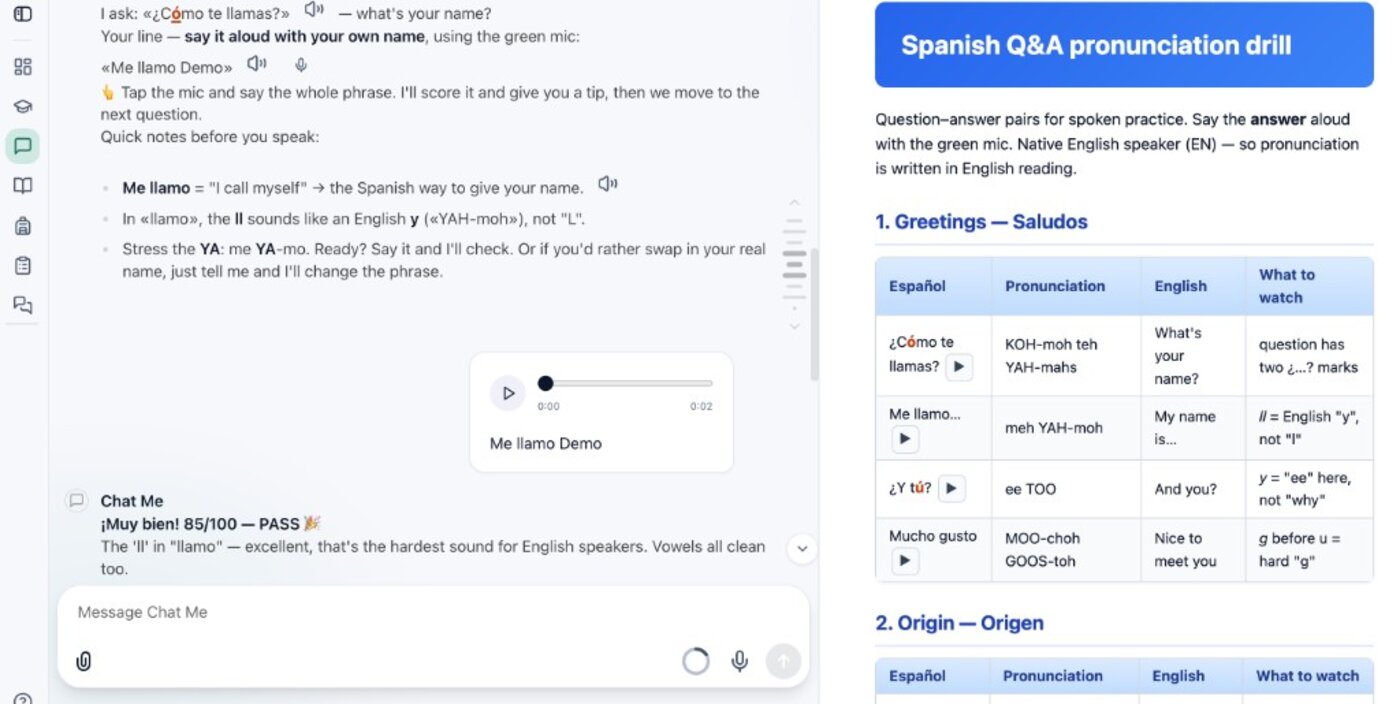
Say a phrase into the mic and get clear feedback. Prefer text-only? That’s fine too.
Live voice call
Speak in realtime — like a private lesson, without a fixed slot. Talk, listen, ask again: your teacher keeps up and guides you.
Level that fits from minute one
Short onboarding, then the teacher knows where to start. Pace adapts: no time wasted on what you already know, no skipped gaps.
Smart spaced vocabulary
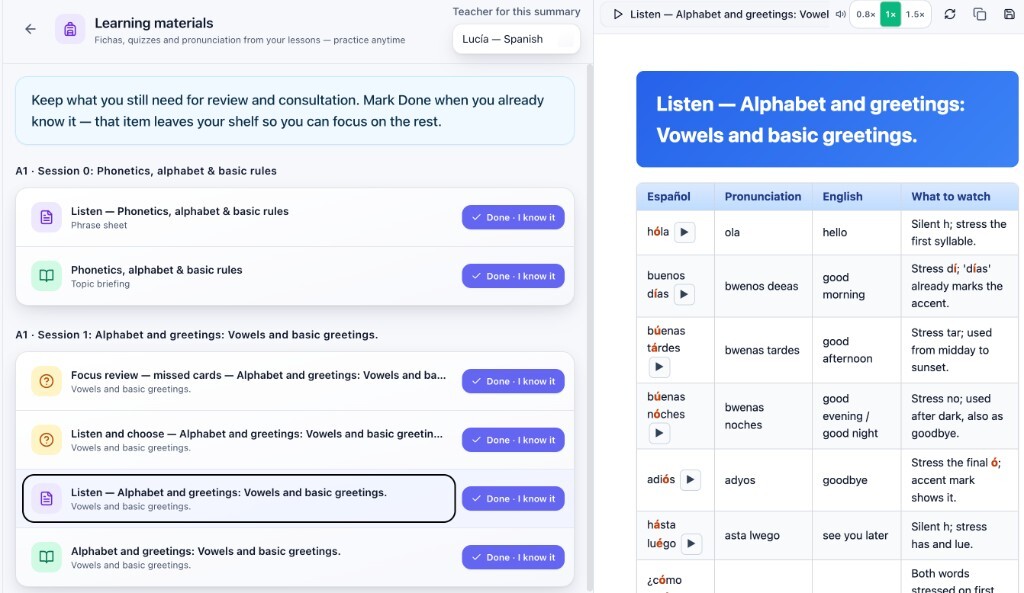
New words land in your dictionary and return just before you’d forget them.
Memory between sessions
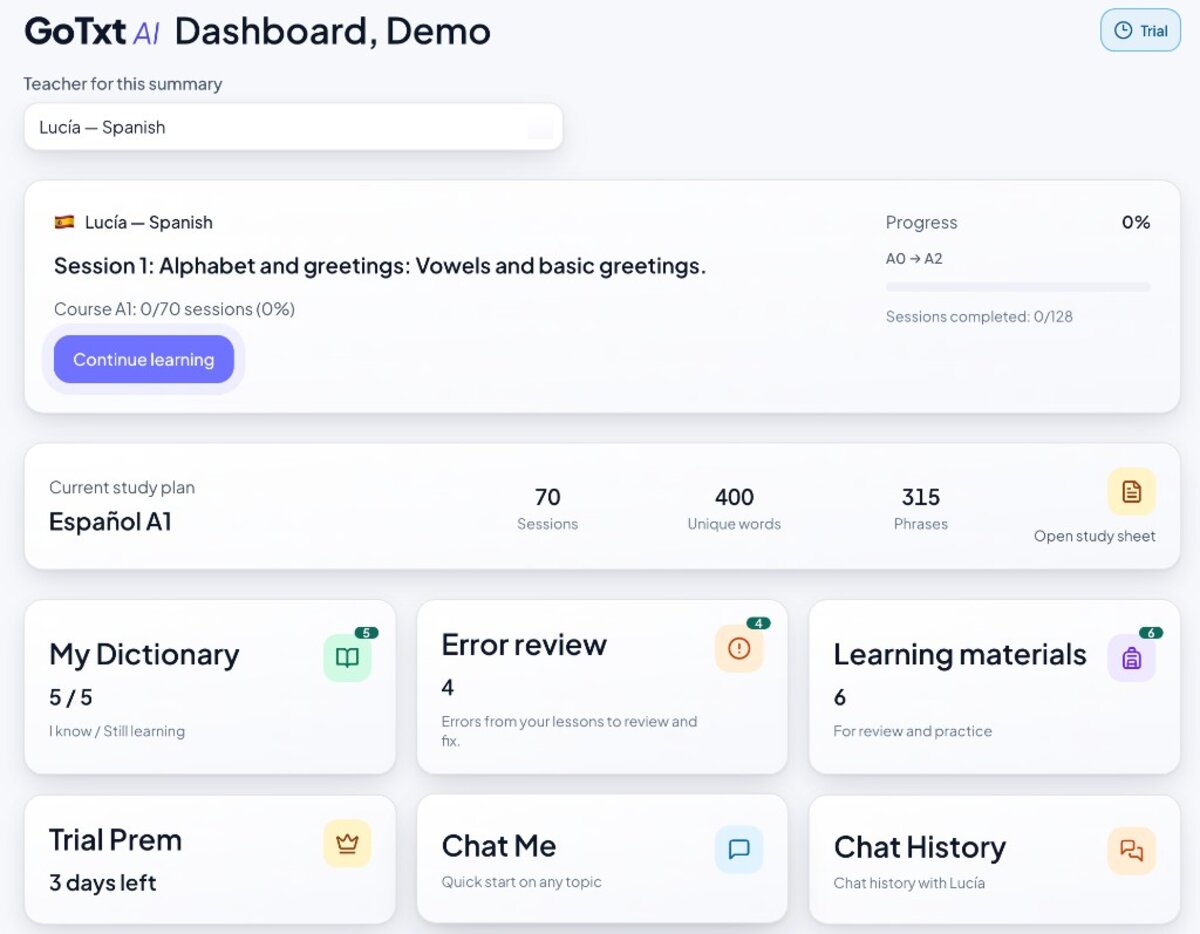
Goals, weak spots, and your current module stay saved. Come back next week — continue where you left off.
Grammar in your language
Hard rules explained in English first — clear, without jargon walls — then practiced in the language you’re learning.
Your rules — “Brains”
Stricter or more supportive? Slang or formal? You set learning rules and change them anytime.
How it works

Start speaking Japanese in 4 simple steps

01

Open the chat

Go to GoTxt and start a conversation with Yuki. No downloads, no setup — just open the app and say hello. The trial is free for 3 days, and you don’t need a credit card.

02

Tell Yuki your goals

Are you learning for travel, JLPT, or just for fun? Let Yuki know your level and what you care about. She’ll ask a few questions and then create a plan that fits you — whether you need to start from kana or already know some phrases.

03

Chat and speak

Begin your first lesson. Yuki will respond in English and Japanese, gradually increasing the Japanese as you progress. Send voice messages to practice pronunciation, and Yuki will give you feedback on your accent and intonation.

04

Practice daily, grow fast

Consistency beats cramming. Even 10 minutes a day with Yuki helps you build a solid foundation. She’ll remind you of past lessons, quiz you on vocabulary, and keep you engaged with new topics. Soon, you’ll notice yourself thinking in Japanese.

Yuki

Your AI tutor

Yuki is more than a grammar drill — she’s your patient, encouraging companion in the maze of Japanese. Born from native-speaker data and trained on real learner struggles, Yuki knows exactly where English speakers trip up: the SOV word order, the maze of particles, the fine line between casual and respectful speech. She’ll never laugh at your mistakes — she’ll turn them into stepping stones. With Yuki, you’ll learn Japanese the way it’s actually spoken in Tokyo, from anime dialogues to polite keigo. She adapts to your pace, your interests, and your goals, making every session feel like a one-on-one lesson with a friend who happens to be a language genius.

  • Patient with beginners — repeats and rephrases without judgment
  • Explains tricky grammar in plain English
  • Corrects pronunciation and intonation in real time
  • Warns you about common English-speaker mistakes
  • Keeps sessions dynamic with cultural tidbits and everyday phrases
Dialogue, not a drill
Yuki doesn’t make you repeat isolated sentences. She chats with you like a real person, responding to your messages and keeping the conversation flowing. You might talk about your weekend, order food in Japanese, or role-play a job interview — all while building practical vocabulary and grammar.
Voice, and you get to choose your tone
Practice speaking with Yuki via voice messages. She’ll understand you and respond, and you can choose between standard Japanese and more polite teineigo. Want to sound like an anime character or a business professional? Yuki adjusts the formality level to your needs.
From zero to your first sentence
No knowledge of kana? No problem. Yuki starts with the very basics — hiragana and katakana — and guides you through the first simple sentences. You’ll be surprised how quickly you can introduce yourself, ask for directions, or express your love for sushi.
Particles made painless
は, が, を, に, で — these little words cause big headaches. Yuki breaks down the logic behind each particle with clear examples and plenty of practice. You’ll stop guessing and start using them naturally, like 私はコーヒーが好きです (I like coffee) without a second thought.
Politeness that feels natural
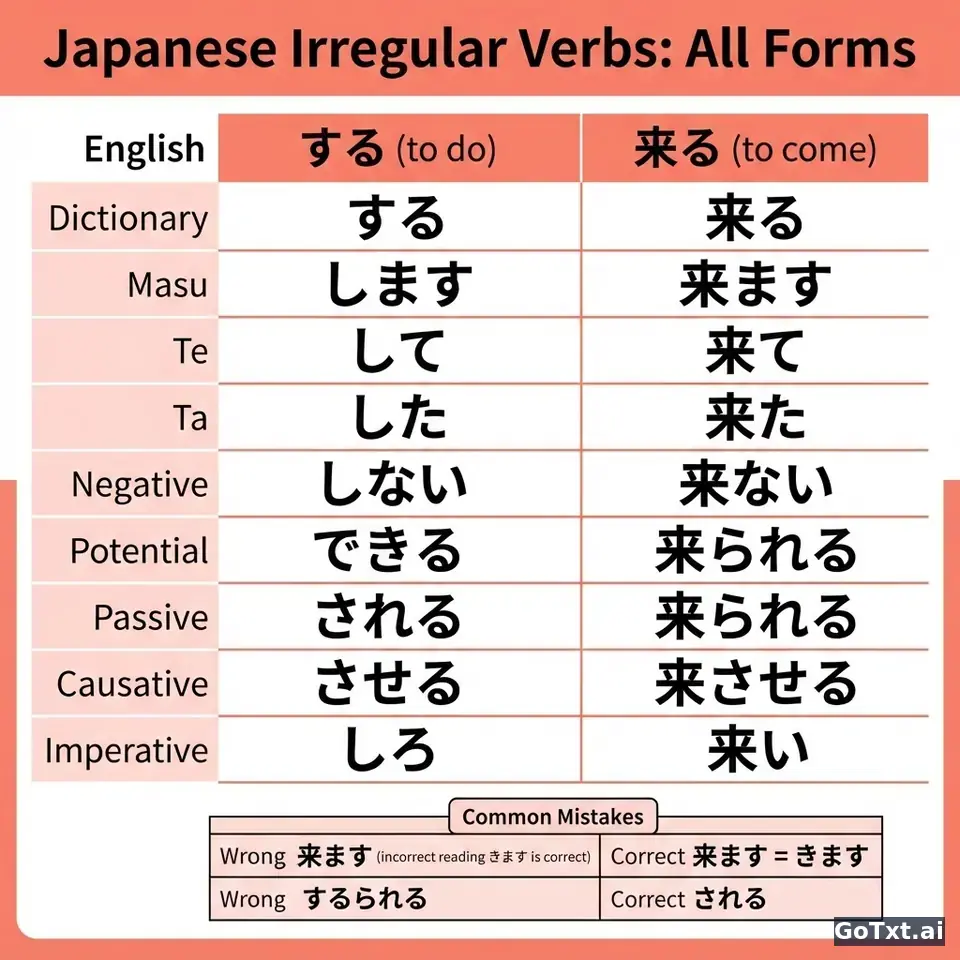
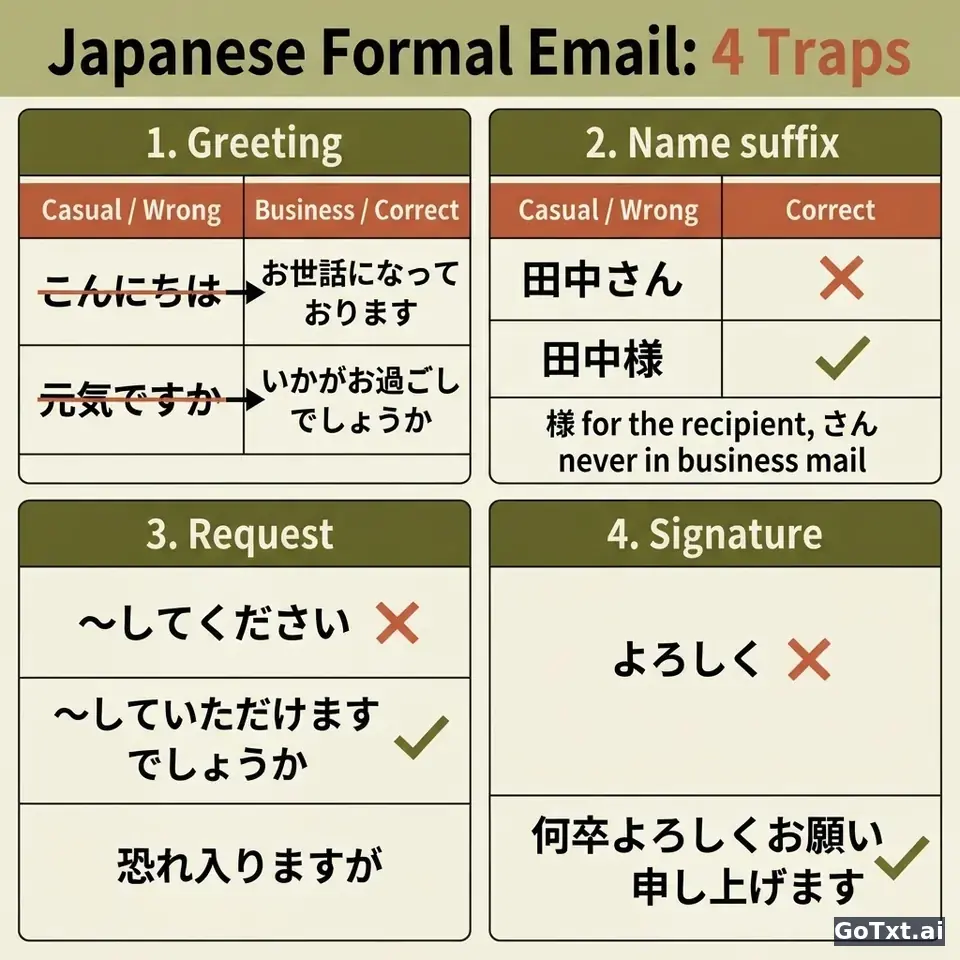
Japanese has a whole ladder of politeness, from casual to humble. Yuki teaches you when and how to switch between them, so you never sound too stiff or too rough. You’ll learn to use です/ます politely, and when it’s okay to drop into casual forms with friends.
Vocabulary that sticks
Yuki uses the VocabEngine to introduce new words in context, not as a list. She’ll weave them into your conversation, repeat them at smart intervals, and bring them back in later sessions. She also highlights loanwords (gairaigo) that English speakers already know, giving you a head start.
Memory that respects your time
Yuki remembers what you’ve learned and what you’ve struggled with. Between sessions, she reviews tricky points and brings back forgotten words. It’s like having a tutor who never forgets your progress, so every minute of practice builds on the last.
JLPT? You’re covered
Aiming for JLPT N5, N4, or beyond? Yuki can tailor your practice to the exam format, drilling you on grammar patterns, reading comprehension, and listening skills. She’ll even mock-interview you for the speaking sections, giving you the confidence to walk into the test.
Grammar that makes sense, even from the start

Bridging English and Japanese

✅ What will feel familiar

Particles are like prepositions — but even simpler in some ways. に and で cover many uses of 'at, in, on', and once you see the pattern, it clicks.
Loanwords (gairaigo) from English are everywhere — コーヒー (coffee), テレビ (TV), コンピューター (computer). You already know hundreds of Japanese words!
Politeness levels are consistent. Once you learn the です/ます form, you can apply it to almost any sentence — no irregular exceptions like in some languages.
SOV order (subject-object-verb) is different from English, but it’s strictly followed, making sentence structure predictable after some practice.

⚠️ What to watch for

Particles: は, が, を, に, で each have multiple uses. You’ll need to practice to avoid mixing them up — Yuki will help you with mnemonics and examples.
SOV order: English speakers tend to put the verb too early. Remember, in Japanese the verb always comes at the end of the sentence.
Teineigo vs casual: Using the wrong politeness level can be awkward. Yuki will teach you when it’s safe to be casual (with friends) and when you must be polite (with strangers or superiors).
Counters: Japanese uses different counters for objects, people, and flat things. It’s a new concept, but Yuki breaks it down into manageable chunks.

💡 Yuki’s golden tip: Start every sentence with the topic, then add the subject, object, and finally the verb. For example: 私は寿司が好きです — I (topic) sushi (subject) like (verb). Once you internalize this rhythm, Japanese becomes way less intimidating.

What learners say about Yuki

What learners say about Yuki

Mike, 34
Chicago · Preparing for JLPT N4

«I’d tried apps before, but they were all about memorizing flashcards. Yuki actually talks to me. She picks up on my mistakes with particles and drills them without making me feel stupid. I passed N4 with 30 points to spare!»

Passed JLPT N4 after 6 months of daily practice
Sarah, 28
London · Travel to Tokyo

«I only had a month before my trip, and Yuki helped me learn essential phrases and polite forms. She even taught me how to ask for directions without sounding like a robot. I felt so confident navigating Tokyo with her help.»

Navigated Tokyo without a phrasebook
Kevin, 22
Sydney · Watching anime without subtitles

«My dream was to watch anime raw. Yuki introduced me to casual speech and common slang, and we practiced with actual anime dialogues. Now I catch myself laughing at jokes without reading the subtitles. It’s amazing.»

Watched a full anime season without subtitles
Pricing

Simple plans,real progress

Get started
Free Trial
3 days
3 days

The perfect taste

Full Premium experience
All 16 AI teachers
Voice calls
No credit card required
Claim your trial
Most popular
Best for casual learners
Standard
29.99
per month
Text chat with AI teachers
Vocabulary trainer
Grammar explanations
Progress tracking
Language selection (up to 2)
No ads
Email support
Spaced repetition
Daily reminders
Priority response
Choose Standard
Best value
For serious fluency
Premium
49.99
per month
Everything in Standard
Voice calls with teachers
All 16 languages
Unlimited chats
Personalized learning path
Priority 24/7 support
Offline mode
Go Premium
FAQ

Your questions, answered

Absolutely. Yuki will start with hiragana and katakana, then move to basic greetings and sentence structure. She explains everything in English, so you’re never lost. You’ll be having simple conversations within a few weeks.
Ordinary smart chat gives you answers but doesn’t teach. Yuki is designed as a language teacher: she corrects your mistakes, explains grammar, tracks your progress, and adapts the difficulty. She also uses spaced repetition to make sure you remember what you learn.
No, but you can use one for voice practice. Yuki accepts both text and voice messages. If you don’t have a mic, you can still practice speaking by typing and reading aloud, and Yuki will give you pronunciation tips.
You can start with a 3-day Premium trial — no credit card required. After that, you can choose a subscription plan that fits your budget. You can also use the free version with limited features, but Premium gives you the full experience with voice and vocabulary tools.
Yes! Just tell Yuki to slow down, and she’ll adjust her pace. She’s also patient with repetition, so you can ask her to say something again as many times as you need.
Definitely. Yuki can tailor your lessons to the JLPT level you’re aiming for. She’ll cover grammar patterns, vocabulary, and reading comprehension, and she’ll quiz you in a way that mirrors the exam format.
Yuki can do that too! She’ll teach you the casual forms and slang you hear in anime, while still giving you a solid foundation. You’ll learn to switch between casual and polite as needed.
As little as 10 minutes a day can make a difference. Yuki is available 24/7, so you can practice whenever you have time. Short, consistent sessions are more effective than long, infrequent ones.
Yes, GoTxt works on your phone, tablet, or computer. You can switch between devices seamlessly, and your progress is always saved.
At registration, choose your native language — the AI teacher explains grammar, gives hints, and corrects mistakes in that language while you practice the language you are learning. Examples: Armenian (Հայերեն), Georgian, Ukrainian, Polish, Hebrew, and all major languages.
  • العربية Arabic
  • বাংলা Bengali
  • 简体中文 Chinese (Simplified)
  • 繁體中文 Chinese (Traditional)
  • English English
  • Français French
  • Deutsch German
  • हिन्दी Hindi
  • Bahasa Indonesia Indonesian
  • Italiano Italian
  • 日本語 Japanese
  • 한국어 Korean
  • Português (Brasil) Portuguese (Brazil)
  • Português (Portugal) Portuguese (Portugal)
  • Русский Russian
  • Español Spanish
  • Türkçe Turkish
  • Tiếng Việt Vietnamese
  • Հայերեն Armenian
  • Bosanski Bosnian
  • Català Catalan
  • Čeština Czech
  • Dansk Danish
  • Nederlands Dutch
  • Eesti Estonian
  • Suomi Finnish
  • ქართული Georgian
  • עברית Hebrew
  • Magyar Hungarian
  • Íslenska Icelandic
  • Latviešu Latvian
  • Lietuvių Lithuanian
  • Norsk bokmål Norwegian (Bokmål)
  • Norsk nynorsk Norwegian (Nynorsk)
  • فارسی Persian
  • Polski Polish
  • Slovenčina Slovak
  • Slovenščina Slovenian
  • Svenska Swedish
  • བོད་ཡིག Tibetan
  • ไทย Thai
  • Українська Ukrainian
  • ئۇيغۇرچە Uyghur