Soo-jin Blog Korean Irregular Verbs: One Verb, All Its Forms, Step by Step
Korean Irregular Verbs: One Verb, All Its Forms, Step by Step
Learn how the Korean irregular verb **돕다** (to help) changes across every tense and politeness level, with a clear conjugation table and the mistakes learners make most.
Every Korean learner eventually meets a verb that refuses to behave. You memorize the polite ending -아요, you feel confident, and then the verb 돕다 (to help) suddenly turns into 도와요 and your confidence evaporates. I get it — I've watched hundreds of students freeze at exactly this moment. The good news: Korean irregular verbs aren't random chaos, they follow rules. Today we take one verb, 돕다, and walk through every form step by step. By the end you'll see the pattern, not just memorize a list.
Why 돕다 Is Irregular
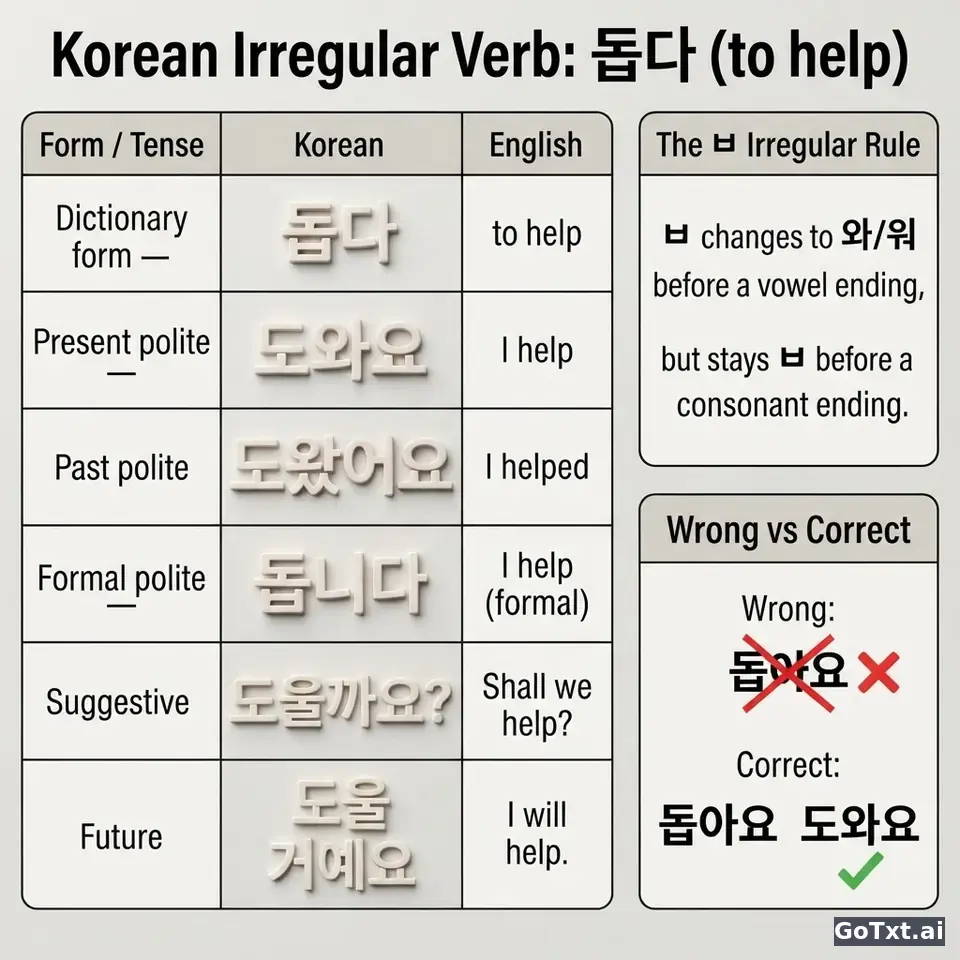
Most Korean verbs ending in -다 simply drop the -다 and attach the ending. But verbs whose stem ends in ㅂ — like 돕다, 춥다 (to be cold), 덥다 (to be hot) — play by different rules. Before a vowel ending, the ㅂ transforms into 와 or 워. Before a consonant ending, it stays put. That single rule unlocks a whole family of verbs.
| English | Form | Korean |
|---|---|---|
| Dictionary | to help | 돕다 |
| Present polite | I help | 도와요 |
| Past polite | I helped | 도왔어요 |
| Formal polite | I help (formal) | 돕니다 |
| Suggestive | Shall we help? | 도울까요? |
Hear the difference between the dictionary form and the everyday polite form:
The Logic Behind the Change
Look closely at the table above. In 도와요, the ㅂ became 와 because the ending -아요 starts with a vowel. In 돕니다, the ending -니다 starts with a consonant, so the ㅂ survives untouched. This is the whole secret. Once you internalize "vowel ending = ㅂ becomes 와/워," you can conjugate 춥다 → 추워요 and 덥다 → 더워요 without a second thought.
The Mistakes I See Every Week
The most common error is treating 돕다 like a regular verb. Students write 돕아요 because it looks logical — and it's wrong. Korean speakers will understand you, but it sounds like a beginner's slip. The second mistake is overcorrecting: applying the 와 change even before consonant endings, producing things like 도왑니다. Keep the two situations separate in your head.
| English | Correct | Wrong |
|---|---|---|
| I help (polite) | 도와요 | 돕아요 |
| I helped | 도왔어요 | 돕았어요 |
| I help (formal) | 돕니다 | 도왑니다 |
| Shall we help? | 도울까요? | 돕을까요? |
Notice that the future form 도울 거예요 also drops the ㅂ — the ㄹ appears because the ending begins with a vowel sound.
Comments
Article discussion: learner comments and GoTxt teacher replies
Drop your emotions below — love, debates, even hate welcome. Comment 👇
Don't want to miss my reply? Leave your email — I'll send a copy.