Dewi Blog Indonesian Verbs: One Verb, All Its Forms, Explained Step by Step
Indonesian Verbs: One Verb, All Its Forms, Explained Step by Step
Learn how one Indonesian verb changes across all its forms — with a clear table, the affix logic, and the mistakes English speakers make most.
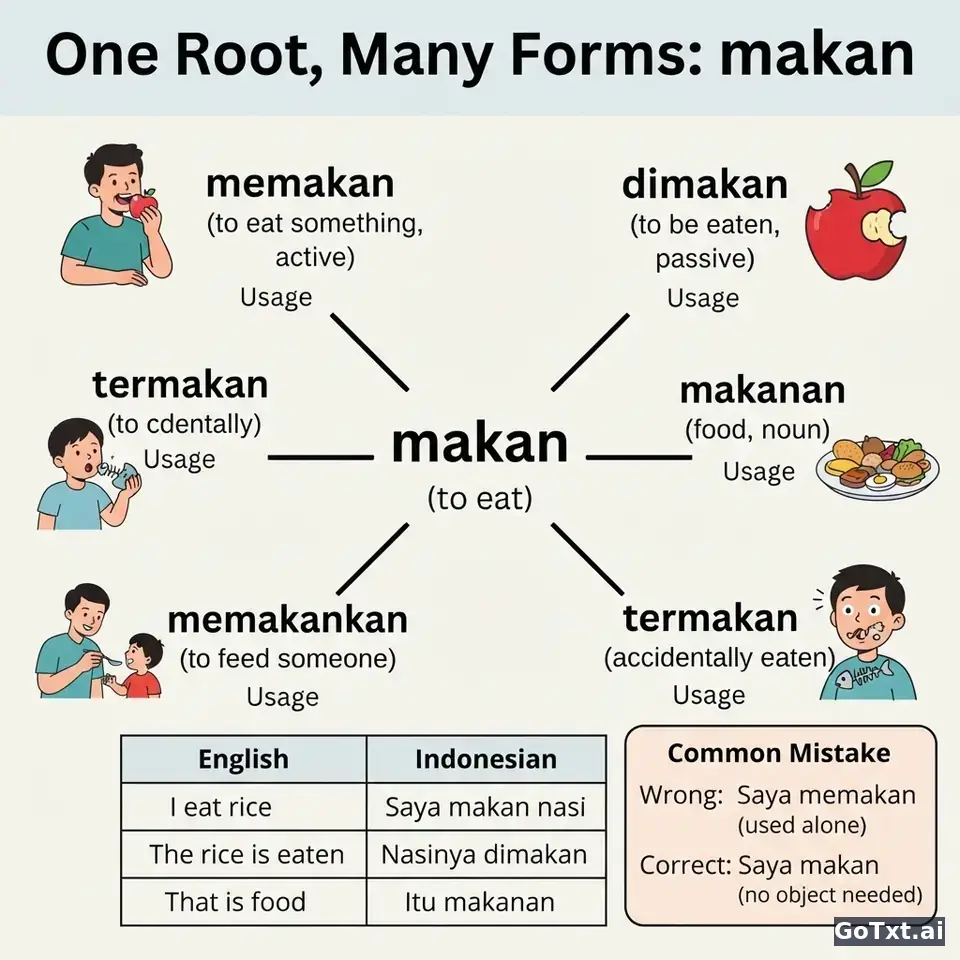
Most learners arrive at Indonesian expecting a verb to behave like an English verb: one base, a handful of tense endings, done. Then they meet makan and discover it can show up as memakan, makanan, dimakan, termakan, and even memakankan — and panic quietly. I get it. But here's the honest truth I tell every class: Indonesian doesn't conjugate for person or tense at all. What it does instead is build meaning around the root with prefixes and suffixes. Once you see the pattern, it stops being a memory game and becomes a machine you can operate.
Start With the Root, Not the Ending
The root makan means "to eat" in its plainest sense. In daily speech, Saya makan nasi ("I eat rice") is perfectly fine — no prefix needed. The trap is thinking the fancy forms are "more correct." They're not. They're just more specific. Use the bare root when the meaning is obvious from context, and reach for affixes when you need to say who does what to whom.
The Affix Map for makan
| English meaning | Indonesian form | What the affix does |
|---|---|---|
| to eat (neutral) | makan | bare root, everyday speech |
| to eat something (active) | memakan | me- marks the doer acting on an object |
| to be eaten (passive) | dimakan | di- flips it: the object becomes the subject |
| food (noun) | makanan | -an turns the verb into a thing |
| to feed someone | memakankan | -kan adds "for/to someone else" |
| accidentally eaten | termakan | ter- signals an unintended result |
The Two Mistakes I Hear Every Week
First: over-using memakan in casual sentences. Saya memakan nasi is grammatically defensible but sounds stiff, like saying "I do consume rice" at a dinner table. Second: forgetting that di- verbs move the object to the front. English speakers say Nasi dimakan saya and expect it to feel like "The rice is eaten by me" — it does, but the word order throws them. Let the passive be your friend: it's everywhere in Indonesian news and formal writing.
| English | Correct | Wrong |
|---|---|---|
| I eat rice | Saya makan nasi | Saya memakan nasi (too formal here) |
| The rice is eaten | Nasinya dimakan | Nasi dimakan oleh saya (clunky) |
| This is food | Ini makanan | Ini makan (missing -an) |
Comments
Article discussion: learner comments and GoTxt teacher replies
Drop your emotions below — love, debates, even hate welcome. Comment 👇
Don't want to miss my reply? Leave your email — I'll send a copy.