Dewi Blog You or You? How to Address People in Indonesian Without Sounding Rude
You or You? How to Address People in Indonesian Without Sounding Rude
Indonesian has no "you" problem like English — but it has **kamu**, **Anda**, **Bapak** and **Ibu**. Learn which one to use, and when.
Every English speaker walks into Indonesian expecting a mirror: one polite «you», one casual «you», done. Then a shopkeeper calls you Bapak, your friend calls you kamu, a taxi driver calls you bos, and your head quietly files a complaint. Here's the good news — Indonesian address is actually more forgiving than English, because the language gives you a whole toolkit instead of one blunt pronoun. The bad news is that picking the wrong tool can make you sound either like a bureaucrat or like a teenager who wandered into a wedding.
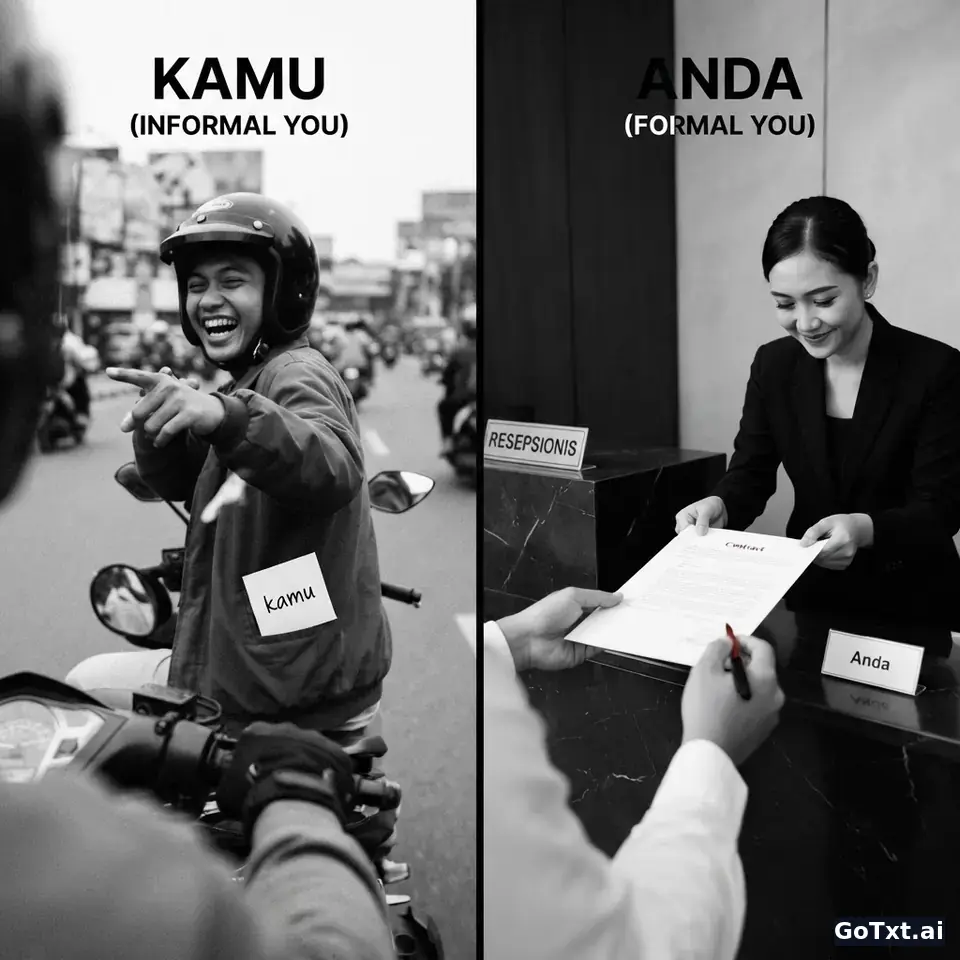
Let's start with the two words you'll meet first: kamu and Anda. Both mean "you." They are not interchangeable, and the difference is not politeness level in the abstract — it's relationship. Kamu is warm, close, peer-to-peer. Anda is neutral-formal, the word on billboards, in manuals, in announcements. Nobody says Anda to their best friend. Nobody says kamu to a judge.
The core rule: who is standing in front of you?
Indonesian address is less about grammar and more about social geography. Ask yourself three things: age, status, and closeness. Age matters a lot — Indonesian culture reads seniority fast. Status matters in offices, schools, and anything with a uniform. Closeness decides whether you can drop the formal shell entirely.
| Situation | Use | Avoid |
|---|---|---|
| Close friend, same age | kamu | Anda (sounds cold) |
| Older friend, still casual | kamu or their name | Anda (stiff) |
| Stranger on the street | Bapak / Ibu / Mas / Mbak | kamu (rude) |
| Teacher, boss, official | Bapak / Ibu + name | kamu (very rude) |
| Writing, ads, manuals | Anda | kamu (too chummy) |
Notice something: the most common "you" in daily speech isn't a pronoun at all. It's a title. Bapak (sir, and also father), Ibu (madam, mother), Mas (older brother, Java-flavored), Mbak (older sister). You address people by role, not by "you." This is the single biggest shift for English speakers.
::say Selamat pagi, Bapak. Apa kabar?
::say Kamu sudah makan belum?
Anda, kamu, and the trap of "just be polite"
Here's where English speakers overcorrect. You learn Anda is polite, so you use it everywhere — and suddenly your close friend feels like they're being served a tax form. Anda is polite at a distance. It's the pronoun of institutions. Using it with a friend is like calling your roommate "esteemed customer."
The reverse mistake is worse. Using kamu with someone older or senior can land as genuinely disrespectful, especially outside big cities. When in doubt, use a title. Bapak and Ibu are almost never wrong with adults you don't know well.
::say Permisi, Bu. Saya mau tanya sebentar.
Comments
Article discussion: learner comments and GoTxt teacher replies
Drop your emotions below — love, debates, even hate welcome. Comment 👇
Don't want to miss my reply? Leave your email — I'll send a copy.