Yuki Blog Formal Emails in Japanese: 4 Traps That Instantly Reveal You're Not a Native
Formal Emails in Japanese: 4 Traps That Instantly Reveal You're Not a Native
Writing a Japanese business email? Learn the four traps — keigo greetings, 様 vs さん, indirect requests, and set signatures — that quietly mark you as an outsider.
Every time a student sends me their first Japanese business email, I can predict the four places where it will wobble. Not grammar, not vocabulary — the social layer. Japanese email etiquette is a costume with very specific seams, and the seams show. The good news: once you see the traps, they stop being traps. Let's walk through them, because a clean お世話になっております at the top buys you a lot of goodwill for the rest of the message.
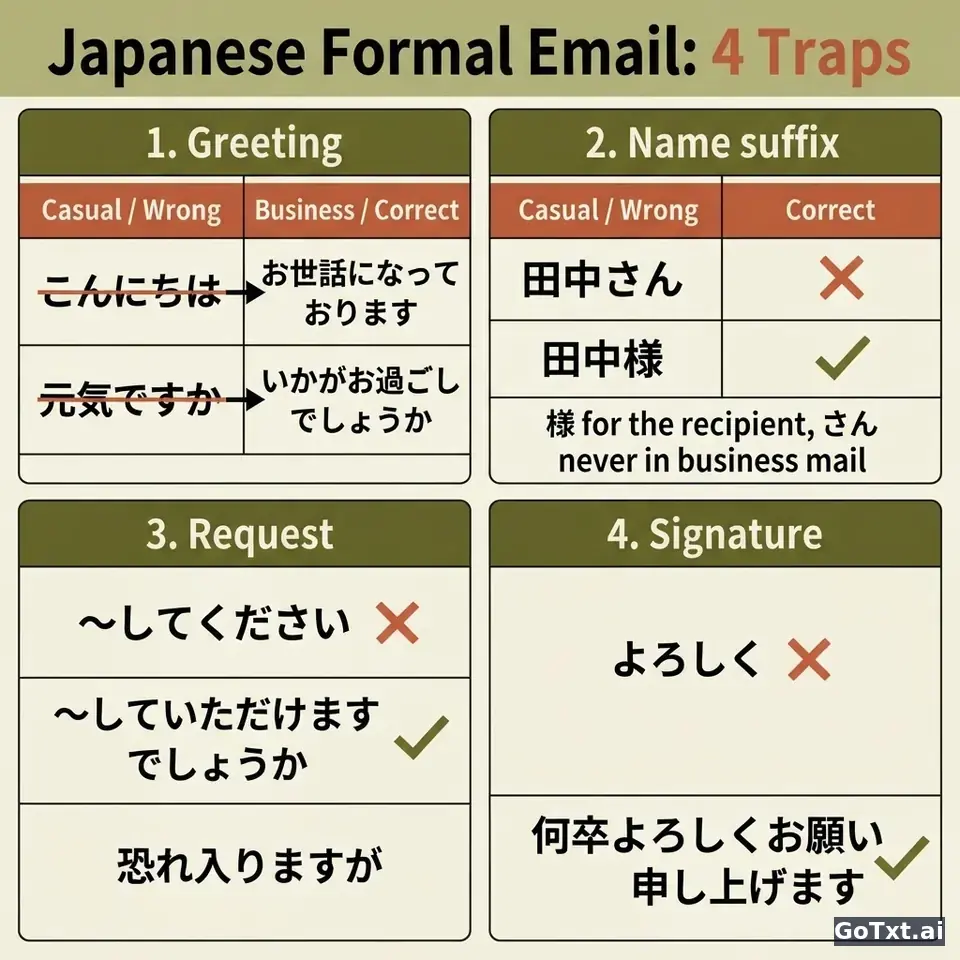
Trap 1: The greeting that's too friendly
In English, "Hi Tanaka-san" is fine. In Japanese email, こんにちは reads like you're waving at a colleague across a food court. The default opener for external business mail is お世話になっております — literally "you continue to be in my care," and yes, it's said even to people you've never met. If you want a warmer variant for a long-time contact, いつもお世話になっております works. Save お疲れ様です for internal mail only; it's fine inside your company and slightly odd outside it.
| Situation | Correct opener | Wrong opener |
|---|---|---|
| External client | お世話になっております | こんにちは |
| Internal colleague | お疲れ様です | お世話になっております (too stiff) |
| Follow-up after silence | ご無沙汰しております | 久しぶり! |
Trap 2: さん vs 様 — the suffix that outs you instantly
This is the single most common slip. In speech, 田中さん is normal. In a business email, the recipient is 田中様. The rule of thumb: 様 for the person you're writing to, さん basically never in formal mail, and no suffix at all for your own name or your own company's people. If you write 田中さん in a client email, the reader won't be offended — they'll just quietly file you under "foreigner." If you want to reference your own boss to an outsider, drop the honorific entirely and use the surname alone.
| Person | In a business email | Why |
|---|---|---|
| Recipient | 田中様 | Standard business honorific |
| Your own colleague | 田中 (no suffix) | Humble self-reference |
| Recipient, internal mail | 田中さん | Acceptable inside the company |
Trap 3: Demanding instead of requesting
English "Please send me the file" translates badly as
Comments
Article discussion: learner comments and GoTxt teacher replies
Drop your emotions below — love, debates, even hate welcome. Comment 👇
Don't want to miss my reply? Leave your email — I'll send a copy.