Yuki Blog Japanese Irregular Verbs: One Verb, All Its Forms, Step by Step
Japanese Irregular Verbs: One Verb, All Its Forms, Step by Step
Confused by Japanese irregular verbs? We break down **する** and **来る** form by form, with a clean table, the logic behind each change, and the mistakes learners keep making.
Most Japanese learners breathe a sigh of relief when they hear there are only two irregular verbs. Then they meet する (to do) and 来る (to come) in the middle of a sentence and realize "only two" doesn't mean "easy." The good news: once you see every form lined up in one place, the chaos turns into a pattern you can actually memorize. Let's take する apart piece by piece, then do the same for 来る, and finish with the three traps that catch almost everyone.
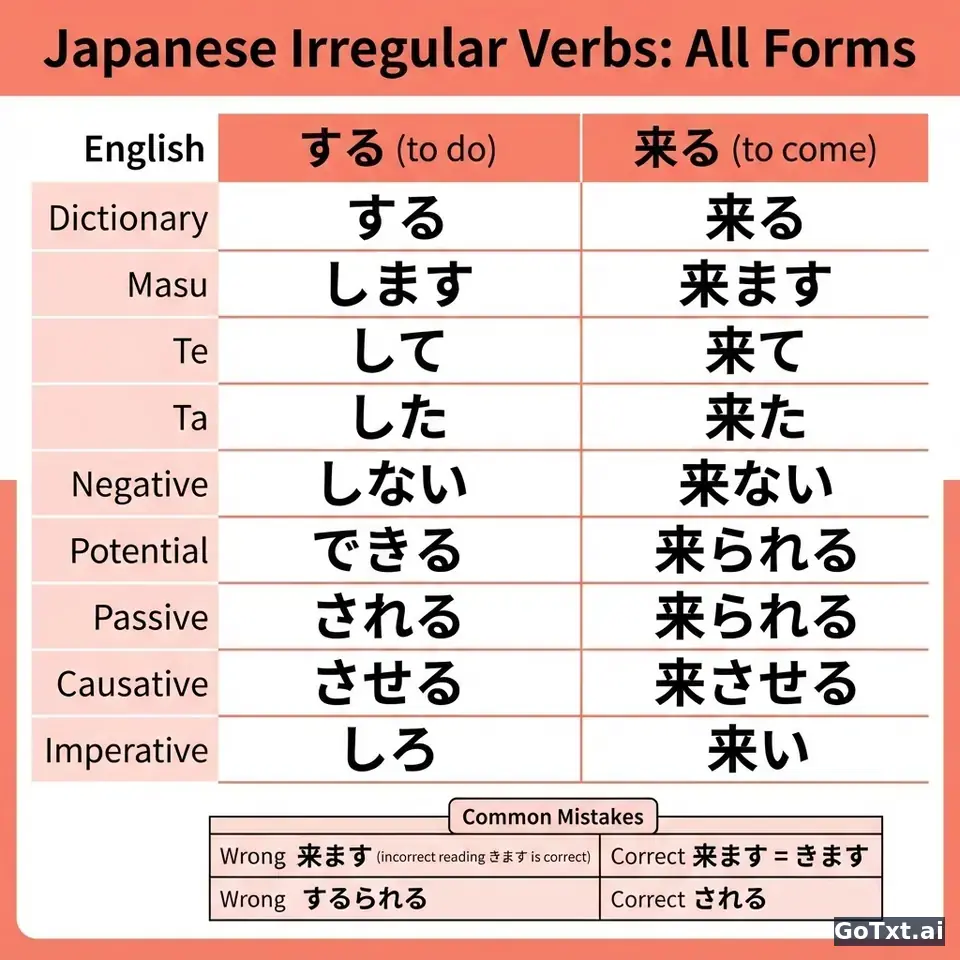
Why only two verbs are irregular
Japanese verbs fall into three groups: godan, ichidan, and the two rebels. Godan verbs shift their final vowel across five sounds, ichidan verbs just drop る and attach endings, and する and 来る do whatever they want. The reason is historical: both verbs were once combinations of a noun plus する, and their stems fused so tightly that the regular rules stopped applying.
That's why する becomes します in polite form, not すります, and why 来る is read くる in the dictionary form but きます in the polite form — the kanji stays the same while the reading changes completely.
する: the verb that builds half of Japanese
The trick with する is that it isn't just "to do." It attaches to nouns to create new verbs: 勉強する (to study), 料理する (to cook), 心配する (to worry). Learn its forms once and you unlock hundreds of verbs for free.
| Form | する (to do) | 来る (to come) |
|---|---|---|
| Dictionary | する | 来る |
| Polite (masu) | します | 来ます |
| Te-form | して | 来て |
| Past (ta) | した | 来た |
| Negative | しない | 来ない |
| Potential | できる | 来られる |
| Passive | される | 来られる |
| Causative | させる | 来させる |
| Imperative | しろ | 来い |
Notice the sneaky one: the potential form of する is できる, a completely different word. There is no すれる. This is the single most common gap in intermediate learners' grammar.
The reading trap in 来る
Here's where 来る punishes people who only memorize kanji. The character 来 is read く in the dictionary form, but き in the masu-stem. So 来ます is きます, never くます. The same split shows up in 来て (きて) and 来ない (こない) — three different readings for one kanji, depending on the form.
| English meaning | Correct | Wrong |
|---|---|---|
| I come (polite) | 来ます (きます) | くます |
| Come! (te-form) | 来て (きて) | くて |
| I don't come | 来ない (こない) | きない |
| I can come | 来られる | これる (casual only) |
Comments
Article discussion: learner comments and GoTxt teacher replies
Drop your emotions below — love, debates, even hate welcome. Comment 👇
Don't want to miss my reply? Leave your email — I'll send a copy.