Yuki Blog You or You? Choosing the Right "You" in Japanese
You or You? Choosing the Right "You" in Japanese
Japanese has many ways to say "you" — and most of them can offend. Learn when to use **kimi**, **anata**, and **omae**, and why the safest choice is often no "you" at all.
Students ask me the same question in the first week: "Yuki, how do I say you in Japanese?" They expect one word. I hand them five, then tell them to use none of them. That's not a joke — it's the single most useful thing I can teach about Japanese address. The truth is that Japanese speakers avoid anata (
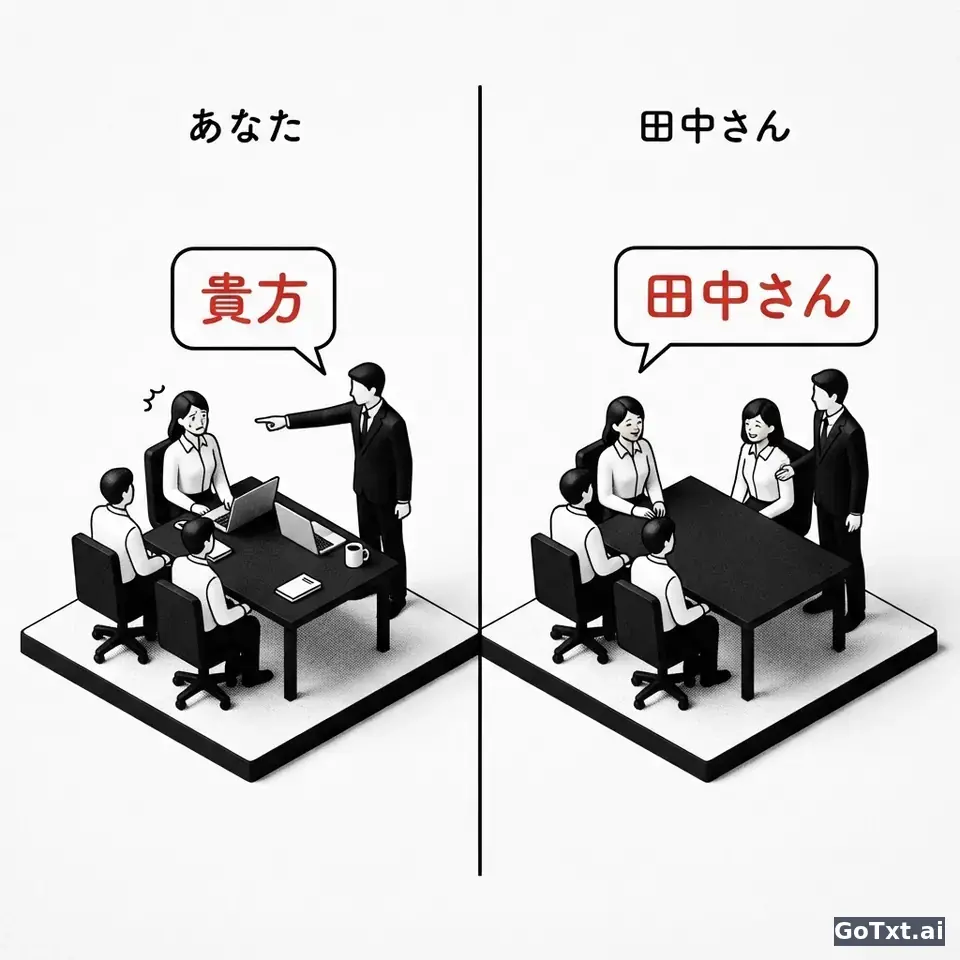
The One Rule That Saves You
Japanese doesn't lean on "you" the way English does. It leans on names, titles, and context. When I talk to my colleague Tanaka, I don't say "you" — I say Tanaka-san (田中さん). When I talk to a customer, I say o-kyakusama (お客様). The pronoun is the fallback, not the default. So the first habit to build: replace you with the person's name plus -san (さん). It sounds repetitive to English ears, but in Japanese it sounds respectful and completely normal.
The Address Words, Ranked by Danger
Here's the honest ladder, from safe to risky. Notice that the "polite" word anata is actually a trap in conversation — it's fine in writing or between spouses, but aimed at a superior it can feel cold or even condescending.
| Word | Register | Use it with… | Danger |
|---|---|---|---|
| あなた (anata) | neutral-polite | spouse, writing, strangers (careful) | sounds distant to superiors |
| 君 (kimi) | casual, slightly superior | close friends, juniors, songs | rude to a boss |
| お前 (omae) | rough, masculine | very close friends, anime | offensive at work |
| あんた (anta) | blunt, dialectal | family, arguments | dismissive |
| そちら (sochira) | polite | businesses, indirect reference | safe but impersonal |
The pattern is clear: the more "you" you push, the more distance or dominance you signal. Japanese often reads direct address as a small power move.
Formal vs Informal: Same Sentence, Two Worlds
Let me show the difference with one request — "please wait a moment." The formal version uses sochira and polite grammar; the casual version drops pronouns entirely and relies on tone.
| English | Formal (敬語) | Casual (タメ口) |
|---|---|---|
| Please wait a moment | 少々お待ちください | ちょっと待って |
| Are you coming? | そちらは来られますか | 来る? |
| What do you want? | 何をお求めですか | 何が欲しい? |
Notice the casual column barely contains a "you" at all. That's the goal: let verbs and context carry the meaning, and use names when you truly must point.
Comments
Article discussion: learner comments and GoTxt teacher replies
Drop your emotions below — love, debates, even hate welcome. Comment 👇
Don't want to miss my reply? Leave your email — I'll send a copy.