 Polish politeness and distance · Zosia · GoTxt
GoTxt Zosia Blog Polish politeness and distance
Politeness Systems: How Polish Encodes Distance and Respect — Polish Course
Polish politeness is a whole machine of forms, titles and particles — not just "ty" versus "pan". A teacher's guide to the patterns and the classic mistakes. Polish Course.
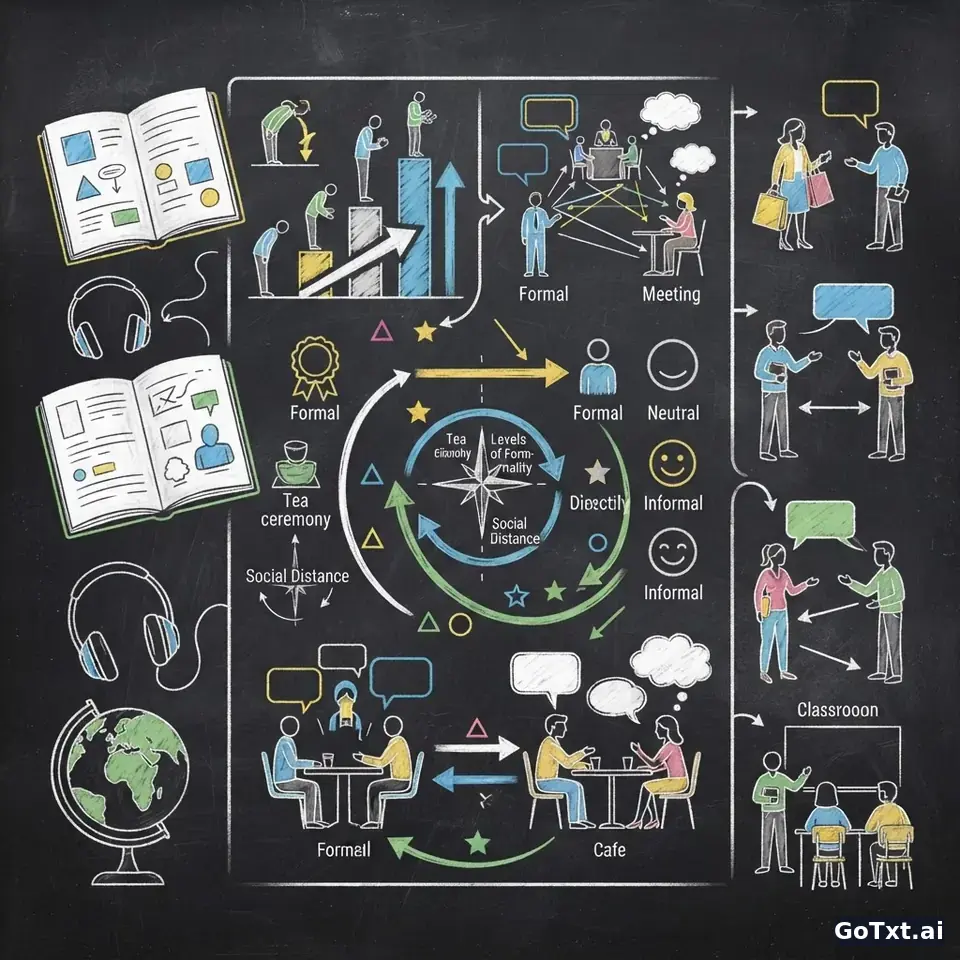
Every language builds a little machine for keeping people at the right distance, and Polish builds a sturdy one. Before you learn a single noun, you meet the fork in the road: ty for friends, family and children, and pan / pani for almost everyone else. But the fork is only the entrance. Polish politeness also lives in verb endings, in the little word proszę, in titles like panie profesorze, and in the way a request gets wrapped in conditionals until it barely sounds like a request at all. Get this system right and Poles relax around you; get it wrong and you sound either rude or oddly stiff.
Polish practice
Pronunciation practice
Listen to the phrase, repeat into the mic — your teacher analyzes the audio and gives a real pronunciation score with corrections and comments.
1 / 3
Cześć, jak się masz?
hello, how are you?
The formal "you" is grammatically a third person — Speak Polish like a local
This is the detail that trips up English speakers most. Pan and pani are not pronouns that behave like "you" — they drag the verb into the third person singular, exactly as if you were talking about someone standing next to them. So the question "Do you speak English?" becomes literally "Does the gentleman speak English?". It feels bizarre for a week and then it feels natural.
| English | Polish form | Note |
|---|---|---|
| Do you speak English? (to a man) | Czy pan mówi po angielsku? | verb in 3rd person |
| Do you speak English? (to a woman) | Czy pani mówi po angielsku? | same pattern |
| Do you have a moment? (formal) | Czy pan ma chwilę? | not masz |
| Do you have a moment? (informal) | Czy masz chwilę? | friends only |
Requests are built, not blurted
English softens with "could" and "would". Polish softens with conditionals, negation and the magic word proszę. The blunt imperative Daj mi... ("Give me...") exists, but in a shop or an office it lands like a slammed door. The polite build is longer and gentler: Czy mógłby pan...? ("Could you, sir...?"), or the beautifully indirect Czy byłby pan uprzejmy...? — "Would you be so kind...". Note that mógłby and byłby carry that conditional -by- inside them; that little chunk is doing the politeness work.
| English | Polite Polish | Blunt / wrong |
|---|---|---|
| Could you help me? | Czy mógłby mi pan pomóc? | Pomóż mi! |
| Please sit down | Proszę usiąść | Siadaj! |
| Excuse me, where is the station? | Przepraszam, gdzie jest dworzec? | (no opener at all) |
Proszę usiąść
Comments
Article discussion: learner comments and GoTxt teacher replies
Drop your emotions below — love, debates, even hate welcome. Comment 👇
Don't want to miss my reply? Leave your email — I'll send a copy.