Lucía Blog Spanish Verb "Ir": One Little Word, Three Big Jobs
Spanish Verb "Ir": One Little Word, Three Big Jobs
Master the irregular Spanish verb **ir** — its five forms, the **ir + a + infinitive** future, and everyday phrases like **ir de compras**. With conjugation tables, common English-speaker mistakes, and a mini-quiz.
Students often tell me that ir looks like the easiest verb in Spanish — just two letters. Then they meet voy, vas, va and panic. Here's the good news: ir is small but incredibly hard-working. It handles movement, the future, and a whole family of idioms. Once you stop expecting it to behave like a regular -ir verb, everything clicks. Today we'll look at its three big jobs, the traps English speakers fall into, and how to drill the forms until they're automatic.
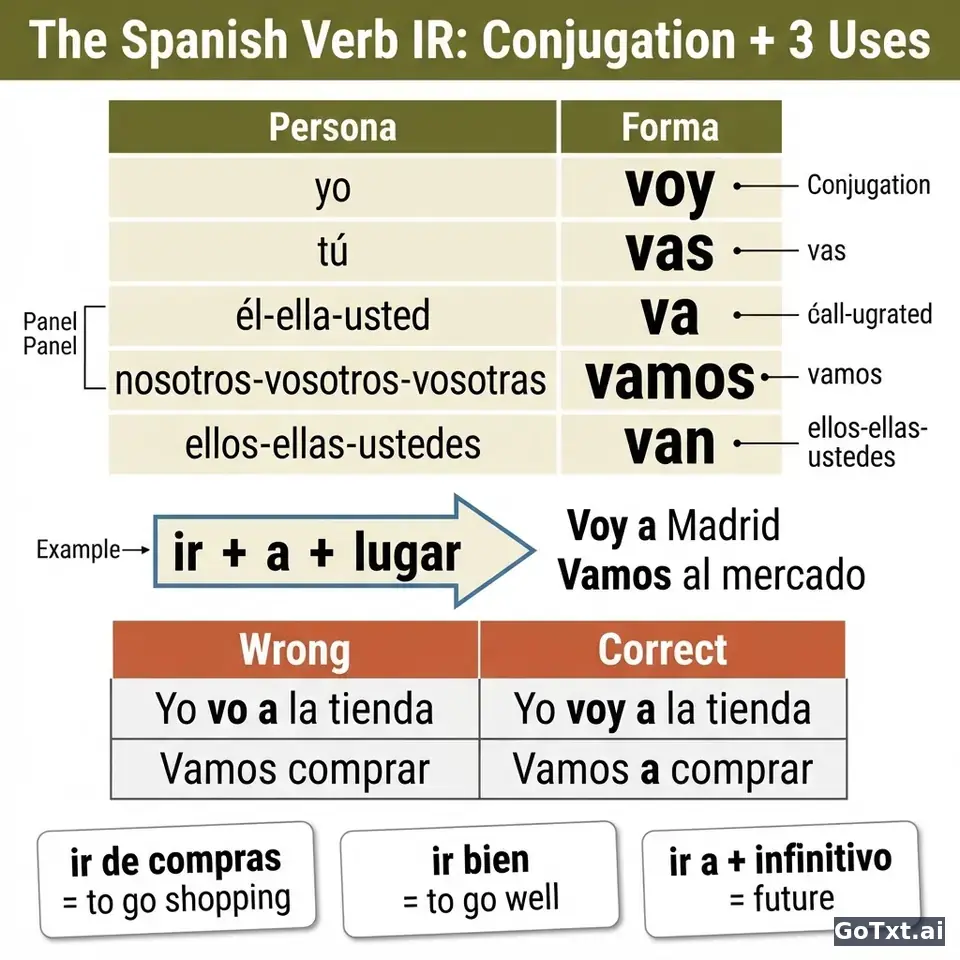
Job 1: Moving from A to B
The core meaning is simply "to go." But the forms are irregular, and there is no way around memorizing them. Notice that vosotros and nosotros share the same shape, which makes them easier than they look.
| Person | Form | Example |
|---|---|---|
| yo | voy | Voy al trabajo. |
| tú | vas | ¿Vas a casa? |
| él / ella / usted | va | Ella va al cine. |
| nosotros | vamos | Vamos juntos. |
| vosotros | vais | ¿Vais a pie? |
| ellos / ellas / ustedes | van | Ellos van en tren. |
One thing to love: ir a contracts with el to make al. So it's Voy al mercado, never "voy a el mercado." Small detail, big impression.
Job 2: The Future You Already Know
Here is the trick that makes Spanish feel generous. You can talk about the future without learning a future tense at all: use ir + a + infinitive. It's the same structure as English "going to."
| English | Spanish | Wrong version |
|---|---|---|
| I'm going to study. | Voy a estudiar. | Voy estudiar. |
| We're going to eat. | Vamos a comer. | Vamos comer. |
| She's going to call. | Va a llamar. | Va llamar. |
The mistake I see most from English speakers is dropping the a. In English, "I'm going to study" hides the preposition inside "to." In Spanish, a is mandatory and separate. If you remember nothing else, remember that a is the bridge between the movement verb and the action.
Job 3: Idioms That Aren't About Going Anywhere
Sometimes ir has nothing to do with movement. These fixed phrases are where learners sound genuinely natural.
| Phrase | Meaning | Example |
|---|---|---|
| ir de compras | to go shopping | Voy de compras el sábado. |
| ir bien | to go well | Todo va bien. |
| ir mal | to go badly | Las cosas van mal. |
| ir a pie | to go on foot | Vamos a pie. |
| ¿Cómo va? | How's it going? | ¿Cómo va todo? |
Todo va bien.
Note that ir bien and ir mal describe how things are going, not how you personally feel. If a colleague asks ¿Cómo va?, they're asking about the project, not your mood.
Comments
Article discussion: learner comments and GoTxt teacher replies
Drop your emotions below — love, debates, even hate welcome. Comment 👇
Don't want to miss my reply? Leave your email — I'll send a copy.