Lucía Blog Spanish Irregular Verbs: One Verb, All Its Forms, Explained Step by Step
Spanish Irregular Verbs: One Verb, All Its Forms, Explained Step by Step
Tired of memorizing endless Spanish verb tables? Let's break down one stubborn irregular verb — **ir** — form by form, with the logic behind every change and the mistakes my students make most.
Every Monday, someone in my class raises a hand and asks the same question: "Lucía, why is it voy and not iro?" And every Monday I smile, because that student has just discovered the beautiful chaos of Spanish irregular verbs. Today we take one verb — ir (to go) — and dissect it like a frog in biology class. No shortcuts, no "just memorize it." We'll see the logic, the patterns, and the traps.
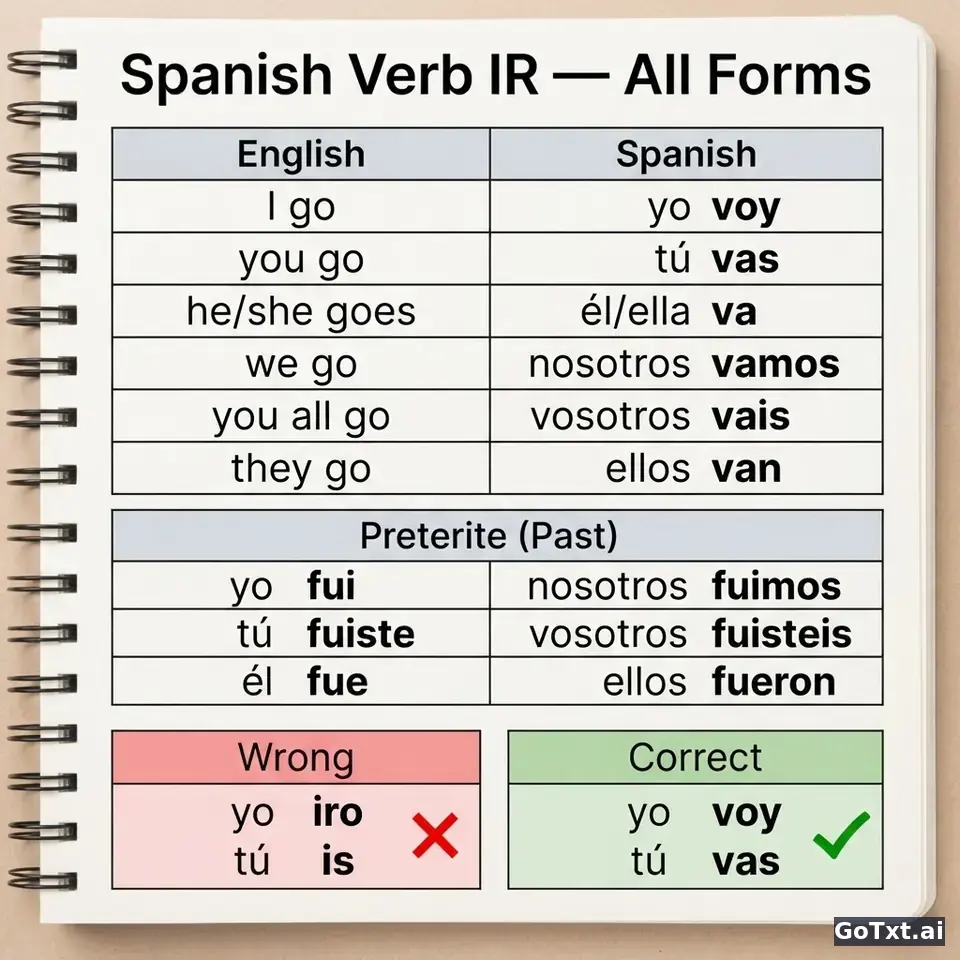
The verb ir is a rebel. In the present tense, it doesn't even look like itself. But once you see all its forms side by side, the chaos turns into a story. Let's start there.
Present Tense: Where Ir Loses Its Mind
Here's the full present conjugation. Notice how only nosotros and vosotros keep a hint of the infinitive:
| English | Spanish | Note |
|---|---|---|
| I go | yo voy | completely irregular stem |
| you go | tú vas | short, no accent |
| he/she goes | él va / ella va | same as tú pattern |
| we go | nosotros vamos | closest to infinitive |
| you all go | vosotros vais | tricky for learners |
| they go | ellos van | no accent needed |
The trap? Beginners write yo iro or
Preterite: The Fui Family
The past tense of ir is famously identical to the past tense of ser (to be). Context saves you — but you must recognize the forms instantly:
| English | Spanish |
|---|---|
| I went | yo fui |
| you went | tú fuiste |
| he/she went | él fue / ella fue |
| we went | nosotros fuimos |
| you all went | vosotros fuisteis |
| they went | ellos fueron |
No accents anywhere in this set — a classic exam trap. Students add a tilde on fui or fue out of habit. Don't.
Future and the "Voy a" Shortcut
Good news: the future of ir is boringly regular — iré, irás, irá, iremos, iréis, irán. But in real conversation, Spaniards almost always use voy a + infinitive: voy a comer, vas a estudiar, vamos a salir. Learn both, but live in the second.
The Three Mistakes I See Every Week
- Saying yo iro instead of yo voy — the regular-verb reflex.
- Confusing fui (I went) with fui (I was) — same word, different verb, context decides.
- Forgetting that vosotros vais exists — textbooks skip it, natives don't.
Comments
Article discussion: learner comments and GoTxt teacher replies
Drop your emotions below — love, debates, even hate welcome. Comment 👇
Don't want to miss my reply? Leave your email — I'll send a copy.