Lucía Blog Ser vs Estar: Why "To Be" Has Two Faces in Spanish
Ser vs Estar: Why "To Be" Has Two Faces in Spanish
Ser and estar both mean "to be," but choosing wrong can flip your meaning completely. Learn the rules, the traps, and the mnemonics that actually stick.
Every English speaker walks into Spanish thinking one verb is enough. Then they meet ser and estar, and suddenly "I am boring" and "I am bored" are two different sentences with two different verbs. I've watched students freeze mid-sentence, hand hovering, brain screaming which one?! The good news: this isn't chaos. It's a system, and once you see it, you can't unsee it.
The core idea: essence vs. state
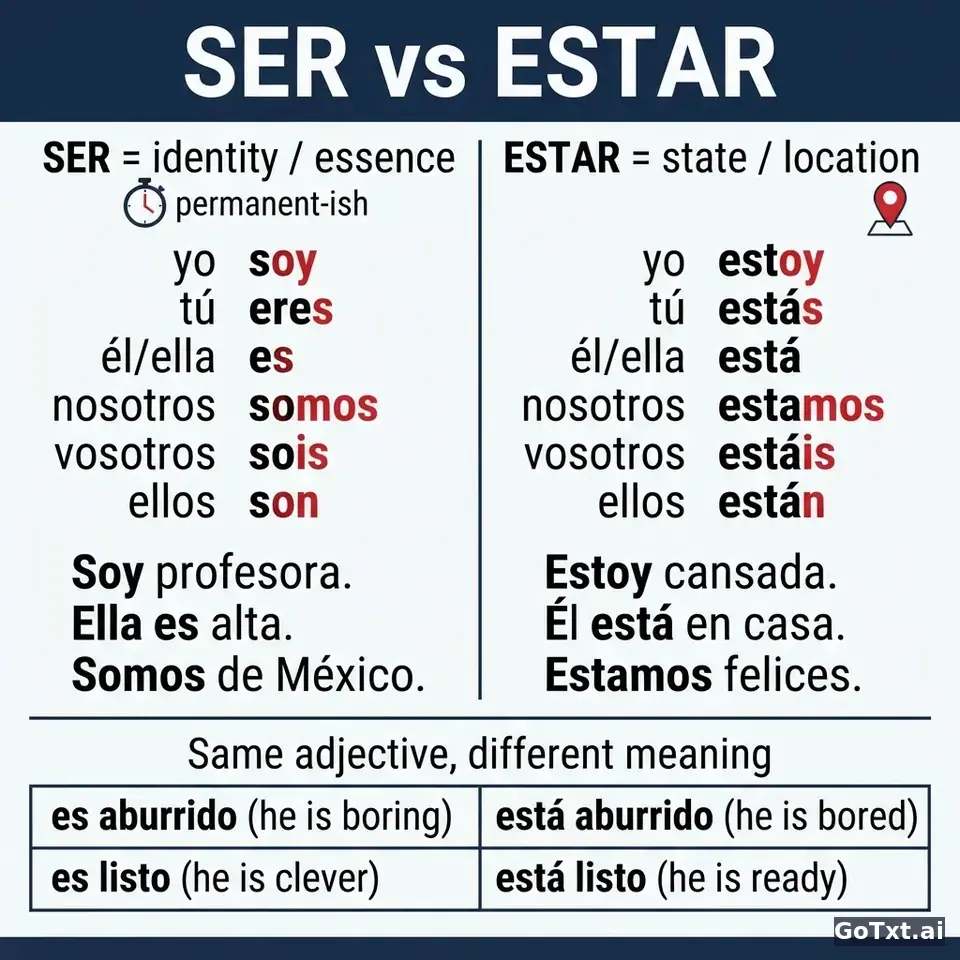
Think of ser as the noun and estar as the adjective-with-a-mood. Ser describes what something is at its core — identity, origin, profession, inherent traits. Estar describes how something is right now — location, emotions, temporary conditions.
| English | Use ser | Use estar |
|---|---|---|
| Identity | Soy estudiante. | — |
| Origin | Ella es de Perú. | — |
| Profession | Es ingeniero. | — |
| Location | — | Estamos en Madrid. |
| Emotion | — | Estoy contenta. |
| Condition | — | La puerta está abierta. |
Notice location lives with estar — even for permanent places. A building doesn't move, but Spanish still says el museo está en el centro. Location is always a state, never an essence.
The trap that changes everything
Some adjectives mean two completely different things depending on the verb. This is where beginners get embarrassed.
| English | With ser | With estar |
|---|---|---|
| boring / bored | Es aburrido (he's a boring person) | Está aburrido (he's bored right now) |
| clever / ready | Es listo (he's smart) | Está listo (he's ready) |
| funny / amused | Es gracioso (he's funny) | Está gracioso (he's being funny today) |
| green / unripe | Es verde (it's green in color) | Está verde (it's unripe) |
Say Mi profesor es aburrido and you've insulted his personality. Say Mi profesor está aburrido and you've noticed he's yawning. Same words, totally different social outcome.
Mnemonics that actually work
Forget the vague "permanent vs temporary" rule — it fails with está muerto (death is permanent!) and es joven (youth is temporary). Try these instead:
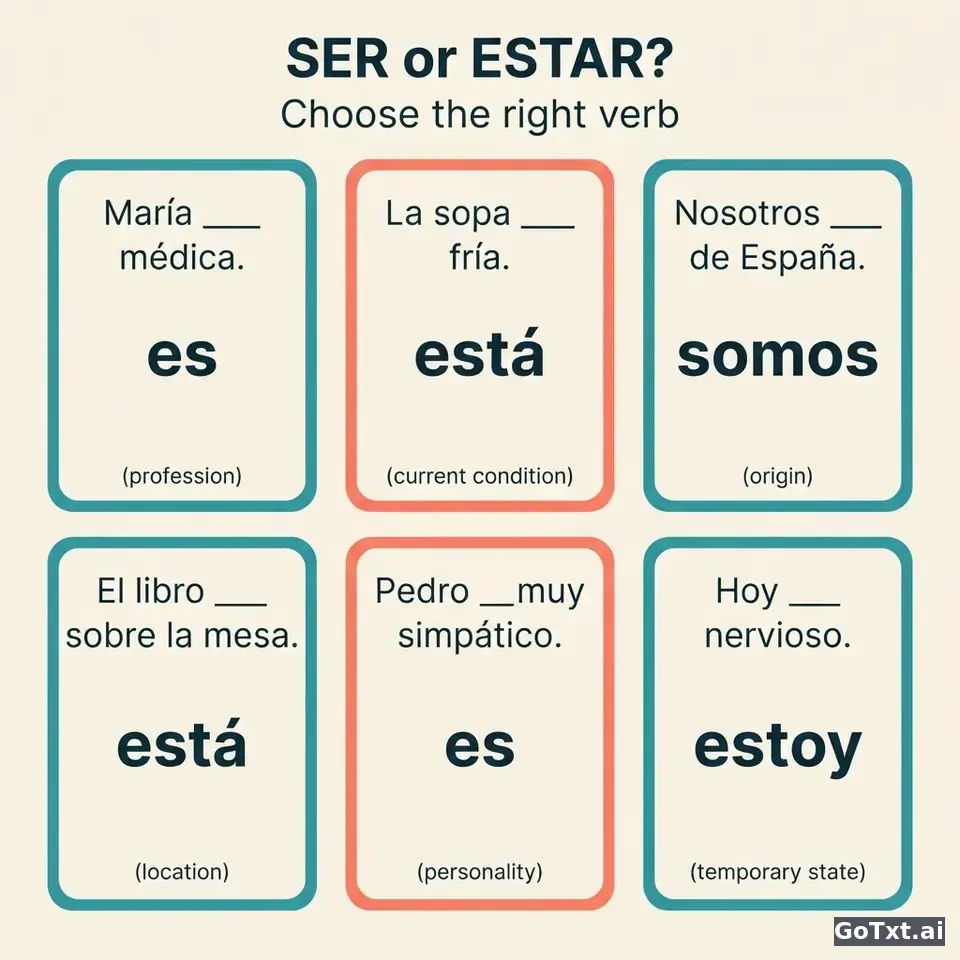
- Ser = description of what: Es un perro. Es alto. Es de Chile.
- Estar = description of how or where: Está enfermo. Está aquí. Está cerrado.
Another trick: if you can imagine the sentence ending with "right now," reach for estar. If you'd add "in general" or "always," reach for ser.
Common mistakes I see every week
English and Russian speakers make predictable errors. English speakers overuse ser because "to be" feels like one word. Russian speakers sometimes drop the verb entirely, since Russian omits the copula in the present tense.
Comments
Article discussion: learner comments and GoTxt teacher replies
Drop your emotions below — love, debates, even hate welcome. Comment 👇
Don't want to miss my reply? Leave your email — I'll send a copy.