Lucía Blog Formal Emails in Spanish: 4 Traps That Reveal You're Not a Native
Formal Emails in Spanish: 4 Traps That Reveal You're Not a Native
Learn the four places where English speakers slip in formal Spanish emails — greetings, titles, requests, and sign-offs — and the exact phrases that make you sound native.
Every week a student sends me a polished business email and asks, "Why did my Spanish colleague answer so briefly?" Usually the grammar is fine. The problem is register. In a formal Spanish email, small choices — Estimado vs Hola, usted vs tú, Le agradezco vs Gracias — decide whether you sound like a serious professional or like someone who translated an English email word by word. Let's walk through the four traps I see most often.
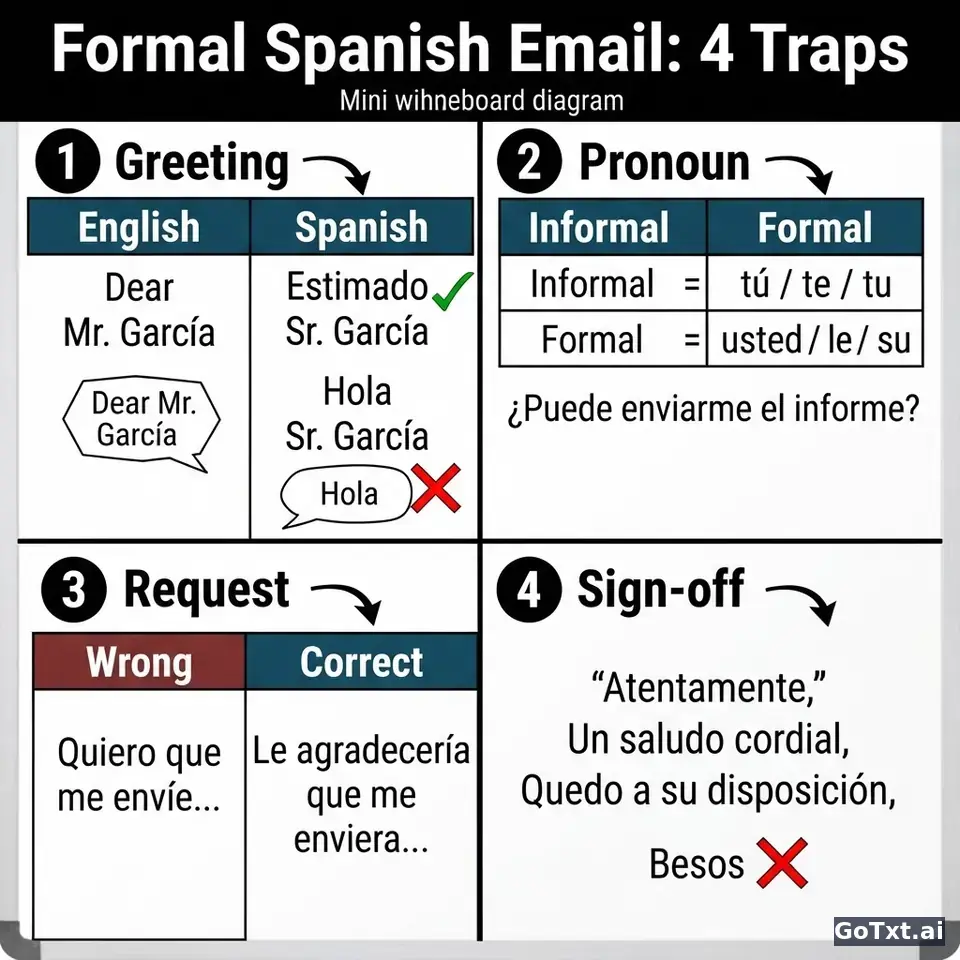
Trap 1: The greeting that's too casual
English "Hi" travels badly. In Spanish, Hola is for people you already treat as tú. To a client, a professor, or anyone older, open with
| English habit | Sounds off in Spanish | Native choice |
|---|---|---|
| Hi Mr. García | Hola Sr. García | Estimado Sr. García |
| Hello team | Hola equipo | Estimados señores |
| To whom it may concern | A quien corresponda (stiff) | Estimados señores |
Trap 2: Mixing tú and usted
This is the trap that betrays non-natives fastest. Pick one register and hold it to the last line. If you start with usted, every verb, pronoun, and possessive must follow: ¿Puede…?, Le agradezco…, su informe. Slipping into tú mid-email — ¿Puedes enviarme…? — reads as if you suddenly got too familiar.
| Person | Informal (tú) | Formal (usted) |
|---|---|---|
| You send | tú envías | usted envía |
| To you | te lo mando | se lo mando |
| Your report | tu informe | su informe |
| Can you…? | ¿Puedes…? | ¿Puede…? |
Trap 3: The request that sounds like a demand
English "I want you to send me…" translates into Quiero que me envíe…, which in Spanish lands as bossy. Soften it with the conditional and gratitude: Le agradecería que me enviara… or ¿Sería tan amable de enviarme…?. The imperfect subjunctive — enviara, confirmara, indicara — is your politeness engine. It costs nothing and buys a lot of goodwill.
Comments
Article discussion: learner comments and GoTxt teacher replies
Drop your emotions below — love, debates, even hate welcome. Comment 👇
Don't want to miss my reply? Leave your email — I'll send a copy.