 Giulia · GoTxt
One Verb, All Forms: How to Say "To Make" in Italian Without Freezing Up — Italian Lessons
Learn Italian online: how **fare** and **rendere** split English "to make", with full conjugations, collocations and the mistakes learners make every day. Italian Lessons.
Students walk into my lessons holding one English verb — "to make" — and expect one Italian verb to come out the other side. It never works that way. Italian takes that neat little word and chops it into fare, rendere, and a pile of idioms where English uses "make" but Italian wouldn't dream of it. The good news: fare is a monster of usefulness once you stop translating word by word — and if you learn Italian online, this is one of the first habits worth building. Let's untangle it.
Italian practice
Pronunciation practice
Listen to the phrase, repeat into the mic — your teacher analyzes the audio and gives a real pronunciation score with corrections and comments.
1 / 3
Ciao, come stai?
hello, how are you?
Fare vs. do: one Italian verb, two English jobs
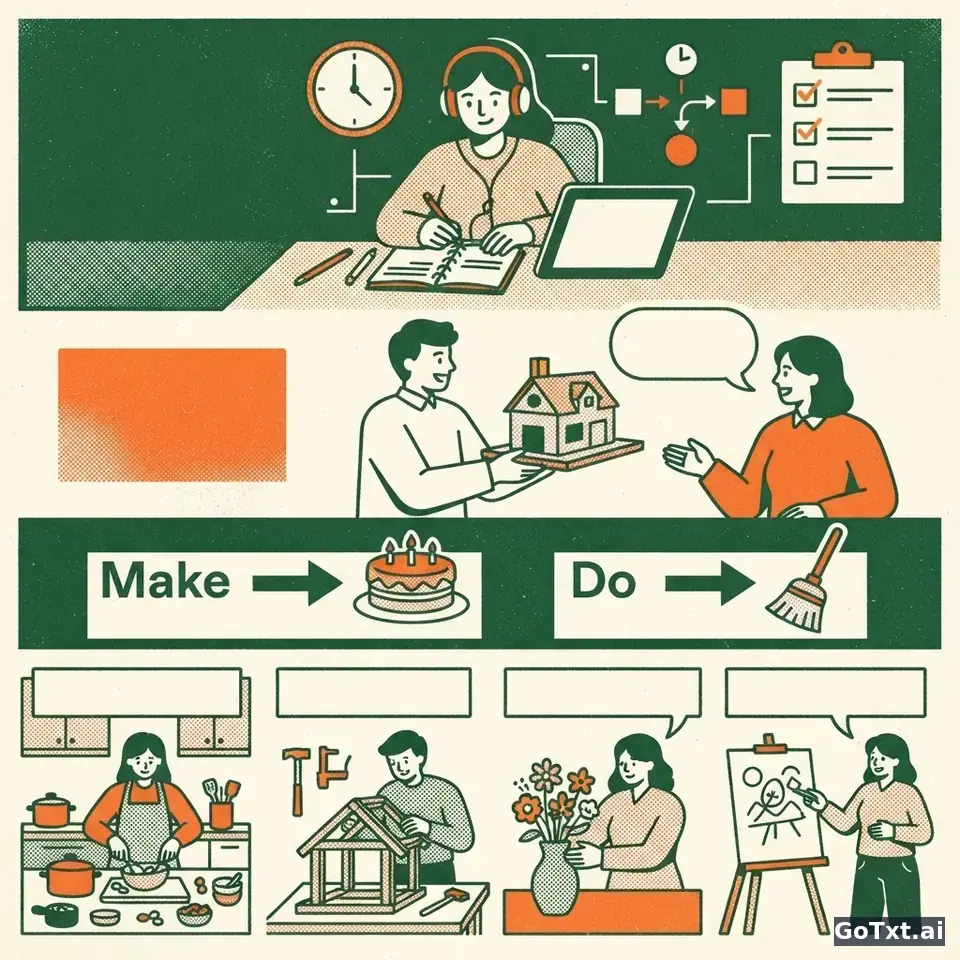
English splits "make" and "do"; Italian mostly shrugs and uses fare for both. You fai colazione (have/make breakfast), you fai i compiti (do homework), you fai una foto (take a photo). Notice that last one — English "take", Italian fare. This is where literal translation betrays you.
| English | Italian | Note |
|---|---|---|
| to make / to do | fare | one verb, both jobs |
| I make, I do | io faccio | irregular, learn it cold |
| you make (informal) | tu fai | |
| he/she makes | lui/lei fa | |
| we make | noi facciamo | |
| you all make | voi fate | |
| they make | loro fanno |
Collocations you should steal outright
Don't build sentences from scratch — steal chunks. Fare un errore (make a mistake), fare una domanda (ask a question), fare una passeggiata (take a walk), fare attenzione (pay attention). And when "make" really means "cause to become", Italian switches to rendere: Questo libro mi rende felice — "This book makes me happy."
The past tense and the classic slip-ups
The passato prossimo is built on the irregular participle fatto: ho fatto, hai fatto, ha fatto. Two traps catch almost everyone. First, learners say «faccio una decisione» — wrong, it's prendo una decisione. Second, they translate "make me laugh" as «farmi ridere» in the wrong order; the natural form is mi fai ridere.
| English | Correct | Wrong |
|---|---|---|
| I made a decision | Ho preso una decisione | ho fatto una decisione |
| You make me laugh | Mi fai ridere | fai mi ridere |
| We made a mistake | Abbiamo fatto un errore | abbiamo preso un errore |
Comments
Article discussion: learner comments and GoTxt teacher replies
Drop your emotions below — love, debates, even hate welcome. Comment 👇
Don't want to miss my reply? Leave your email — I'll send a copy.