Giulia Blog One Italian Irregular Verb, Every Form: A Step-by-Step Breakdown of "Andare"
One Italian Irregular Verb, Every Form: A Step-by-Step Breakdown of "Andare"
A clear, no-nonsense walkthrough of the Italian irregular verb **andare** — all its forms in one table, the logic behind the changes, the traps English speakers fall into, and a quick drill to lock it in.
Every student eventually meets the verb that refuses to behave. In Italian, that verb is often andare — "to go." It looks innocent, then suddenly you're saying io vado instead of the tidy io ando your brain expected. I've watched hundreds of learners freeze mid-sentence because they tried to conjugate it like a regular -are verb. The good news: once you see all its forms side by side, the chaos turns into a pattern you can actually remember.
The Present Tense: Where the Trouble Lives
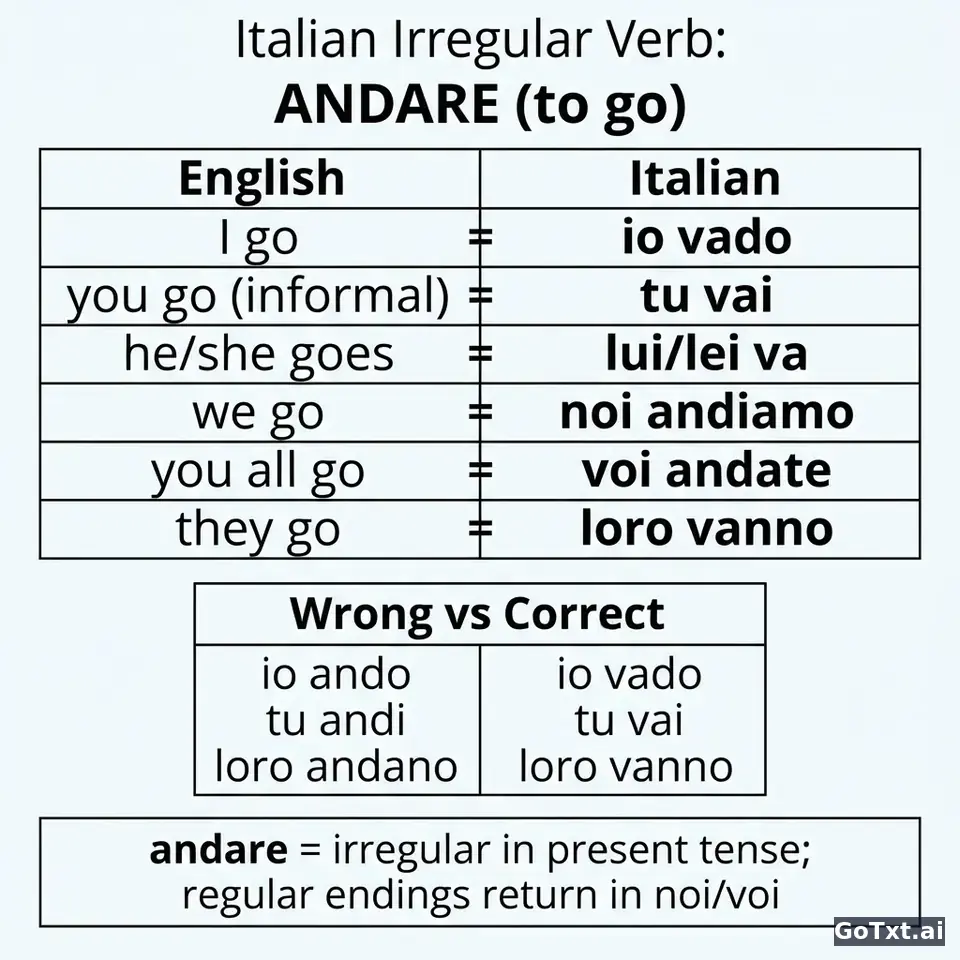
Here's the full present-tense picture. Notice that only noi and voi keep the regular -are endings — the rest go rogue.
| English | Italian |
|---|---|
| I go | io vado |
| you go (informal) | tu vai |
| he/she goes | lui/lei va |
| we go | noi andiamo |
| you all go | voi andate |
| they go | loro vanno |
The logic? The stressed forms (vado, vai, va, vanno) all share a v- stem, while the unstressed ones (andiamo, andate) keep the original and-. Linguists call this suppletion; I call it "the verb splits in half." Say it out loud until it stops feeling weird:
Common Traps for English Speakers
The biggest mistake is over-regularizing. Your brain sees andare and produces ando, andi, andano. Nope. The second trap is forgetting that andare takes a before a destination: vado a Roma, andiamo al cinema. English says "I go to Rome" — Italian agrees, but the preposition contracts with articles (al, alla, allo).
A third trap: using andare where English uses "to be." You don't say sono a casa to mean "I'm going home" — you say vado a casa. And "how are you?" is come va?, literally "how does it go?" — same verb, idiomatic meaning.
| English | Correct | Wrong |
|---|---|---|
| I go to the cinema | vado al cinema | ando al cinema |
| we go to Rome | andiamo a Roma | vadiamo a Roma |
| they go home | vanno a casa | andano a casa |
| how's it going? | come va? | come anda? |
A Quick Drill (Do It Now)
Cover the Italian column and translate from English. Then reverse it. Then say all six forms out loud without looking. The goal isn't perfection — it's speed. When io vado comes out before you consciously think it, you've won.
Comments
Article discussion: learner comments and GoTxt teacher replies
Drop your emotions below — love, debates, even hate welcome. Comment 👇
Don't want to miss my reply? Leave your email — I'll send a copy.