Giulia Blog Formal Emails in Italian: 4 Traps That Instantly Reveal You're Not a Native
Formal Emails in Italian: 4 Traps That Instantly Reveal You're Not a Native
Writing a formal email in Italian? Learn the four traps in greetings, address, requests and sign-offs that expose a non-native — and how to fix them with **Gentile**, **Egr. Sig.** and **La ringrazio**.
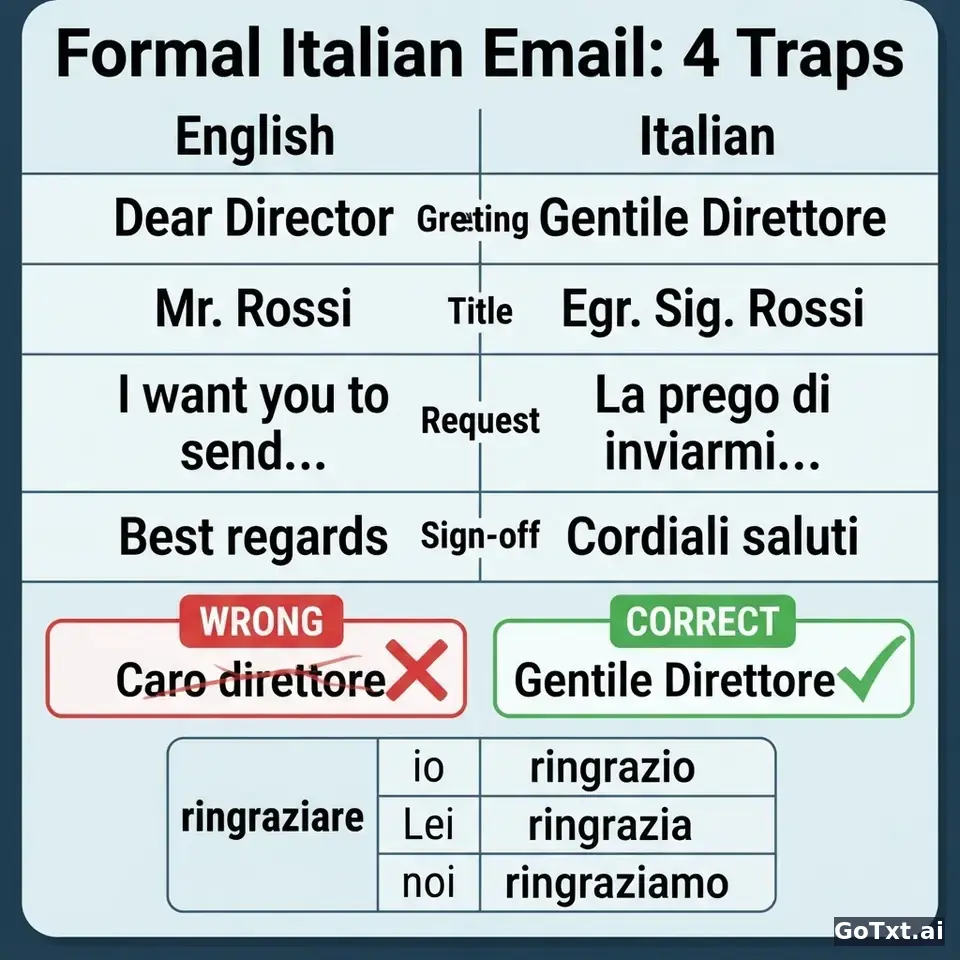
I still remember the email that made me wince. A student of mine, a smart guy, opened his message to a Milanese HR director with Caro direttore — friendly, warm, and completely wrong. In English, "Dear Director" works everywhere. In Italian, that Caro sounds like you're writing to your uncle. The director never replied. So let's walk through the four traps that quietly mark you as a foreigner, and how to sound like you actually belong in that inbox.
Trap 1: The greeting that's too warm
English "Dear" is neutral. Italian splits it by gender, number and formality, and getting it wrong is instantly audible.
| English | Correct (formal) | Wrong |
|---|---|---|
| Dear Director | Gentile Direttore | Caro direttore |
| Dear Mrs. Bianchi | Gentile Dott.ssa Bianchi | Cara Bianchi |
| Dear Sirs | Gentili Signori | Cari signori |
Gentile works for men and women — it's the safe, universal opener. Save Caro and Cara for people you actually know. And note the double consonant: Dott.ssa for a woman, Dott. for a man.
Trap 2: Titles you drop, titles they keep
In English you'd write "Mr. Rossi" and move on. Italian business culture clings to titles — academic, professional, honorific. Drop them and you sound casual; overuse them and you sound sarcastic. The middle path:
- Egr. Sig. Rossi — for a formal external contact
- Gentile Ing. Ferrari — for an engineer
- Gentile Avv. Conti — for a lawyer
When in doubt, Gentile + surname is never embarrassing.
Trap 3: Requests that sound like orders
Here's the trap that bites hardest. English "Please send me the file" is polite. Translated literally — Per favore mandami il file — it sounds like you're scolding a child. Italian formality lives in the conditional and the Lei form.
| English | Correct (formal) | Wrong |
|---|---|---|
| Please send me... | La prego di inviarmi... | Per favore mandami... |
| Could you confirm? | Potrebbe confermarmi? | Puoi confermare? |
| I would like to know | Vorrei sapere | Voglio sapere |
Notice the pattern: La prego di, Potrebbe, Vorrei. The conditional softens everything. Voglio sapere ("I want to know") is a demand, not a request.
Comments
Article discussion: learner comments and GoTxt teacher replies
Drop your emotions below — love, debates, even hate welcome. Comment 👇
Don't want to miss my reply? Leave your email — I'll send a copy.