Giulia Blog Decoding Italian Humor: What "Piacere, mi chiamo..." Really Means When the Joke Turns
Decoding Italian Humor: What "Piacere, mi chiamo..." Really Means When the Joke Turns
Unpack a classic Italian joke about first impressions, learn the grammar and culture behind it, and see why the punchline only works in Italian.
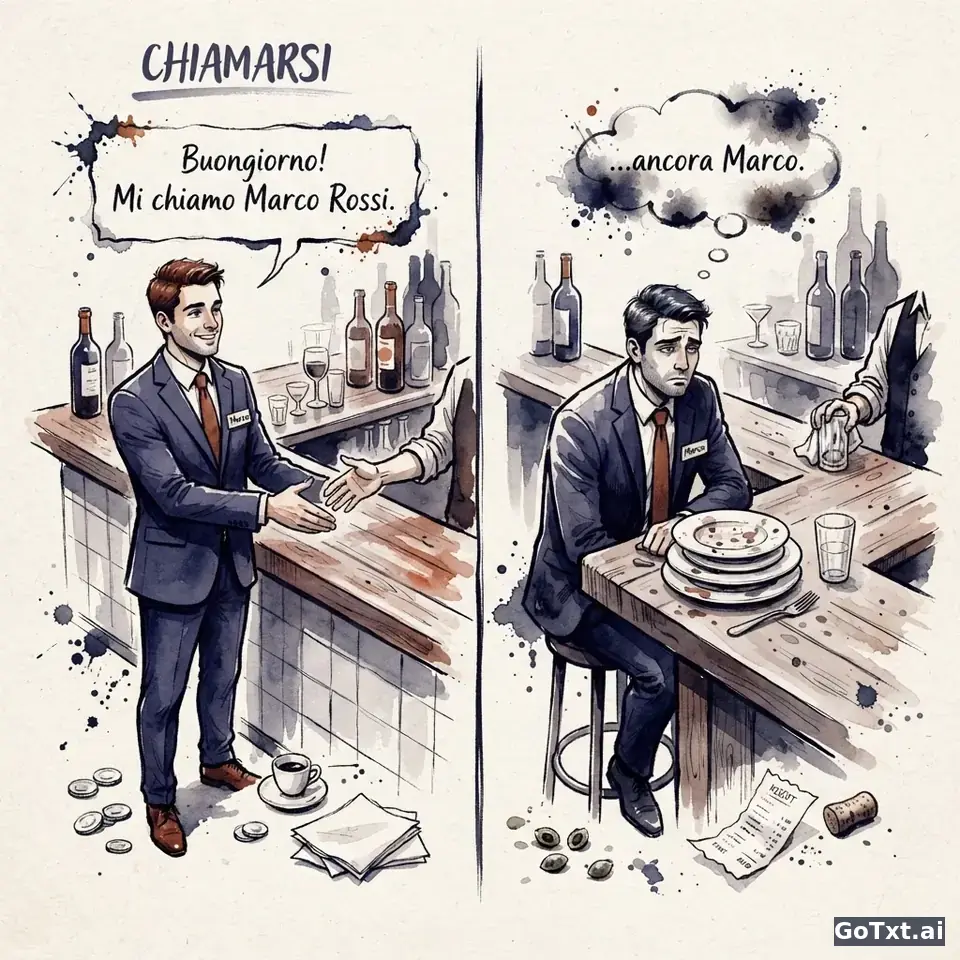
Every language hides its sense of humor in grammar. My students learn quickly that Italians don't just tell jokes — they perform them, and the performance lives inside verb choices. One of my favorite examples is a tiny joke that circulates at dinners and in WhatsApp groups. A man walks into a bar and announces, Piacere, mi chiamo Marco. Everyone nods. Then he adds, E ho fame da tre giorni. The room laughs — but my English-speaking students usually stare at me, waiting for the punchline. So let's unpack it. The humor isn't in the words, it's in the collision between mi chiamo (literally "I call myself") and the absurd confession that follows. You introduce yourself politely, then admit you haven't eaten in three days. The joke is the gap between social ritual and raw reality.
Why Mi Chiamo Isn't Just "My Name Is"
The reflexive verb chiamarsi trips up almost everyone. In English, you have a name. In Italian, you call yourself something — the action belongs to you. That reflexive particle mi is doing quiet cultural work: it signals that identity is something you perform, not something you own. When Marco says mi chiamo Marco, he's literally saying "I call myself Marco." The joke exploits this: he calls himself Marco, then calls himself hungry, then calls himself desperate. Same structure, escalating content.
| English instinct | Italian reality | Trap |
|---|---|---|
| I have a name | Mi chiamo | Reflexive, not possessive |
| You have a name | Ti chiami | The ti can't be dropped |
| He has a name | Si chiama | Third person uses si |
| We have names | Ci chiamiamo | Plural reflexives shift |
| They have names | Si chiamano | Same si, different ending |
Notice how the joke would collapse if you translated it literally. "Pleased, I call myself Marco" sounds absurd in English. In Italian, it's just... Tuesday.
The Cultural Logic of Fame
The second half of the joke leans on fame — hunger — but not the polite kind. Ho fame is standard. Ho fame da tre giorni is a confession. Italians use hunger as a social barometer: Che fame! at lunch, muoio di fame when dinner is late, non ho fame when you're being polite at someone's house even though you're starving. The joke works because Marco skips the ritual. He doesn't say Ho un po' di fame (I'm a little hungry). He goes straight to the extreme. The humor is the violation of understatement.
Where English Jokes Would Land Differently
English humor often punches with wordplay or absurdity. Italian humor frequently punches with register — the gap between formal and casual, between what you say and what you mean. A British joke might rely on sarcasm; an Italian one often relies on figura — the image you project. Marco projects a gentleman, then drops the mask. That's the whole gag.
Comments
Article discussion: learner comments and GoTxt teacher replies
Drop your emotions below — love, debates, even hate welcome. Comment 👇
Don't want to miss my reply? Leave your email — I'll send a copy.