Ananya Blog Formal Emails in Bengali: 4 Traps That Instantly Reveal You're Not a Native
Formal Emails in Bengali: 4 Traps That Instantly Reveal You're Not a Native
Learn the four spots where English speakers slip in formal Bengali emails — greetings, address, requests, and sign-offs — with real phrases you can copy today.
Every week a student sends me a "perfect" formal email in Bengali, and every week I can spot the English skeleton underneath it. It is never grammar. It is the four soft spots where English habits leak through: the greeting, the way you address the person, how you ask for something, and how you sign off. Get these right and your Bengali sounds like it was written by someone who actually lives in the language, not someone translating line by line. Today we fix all four.
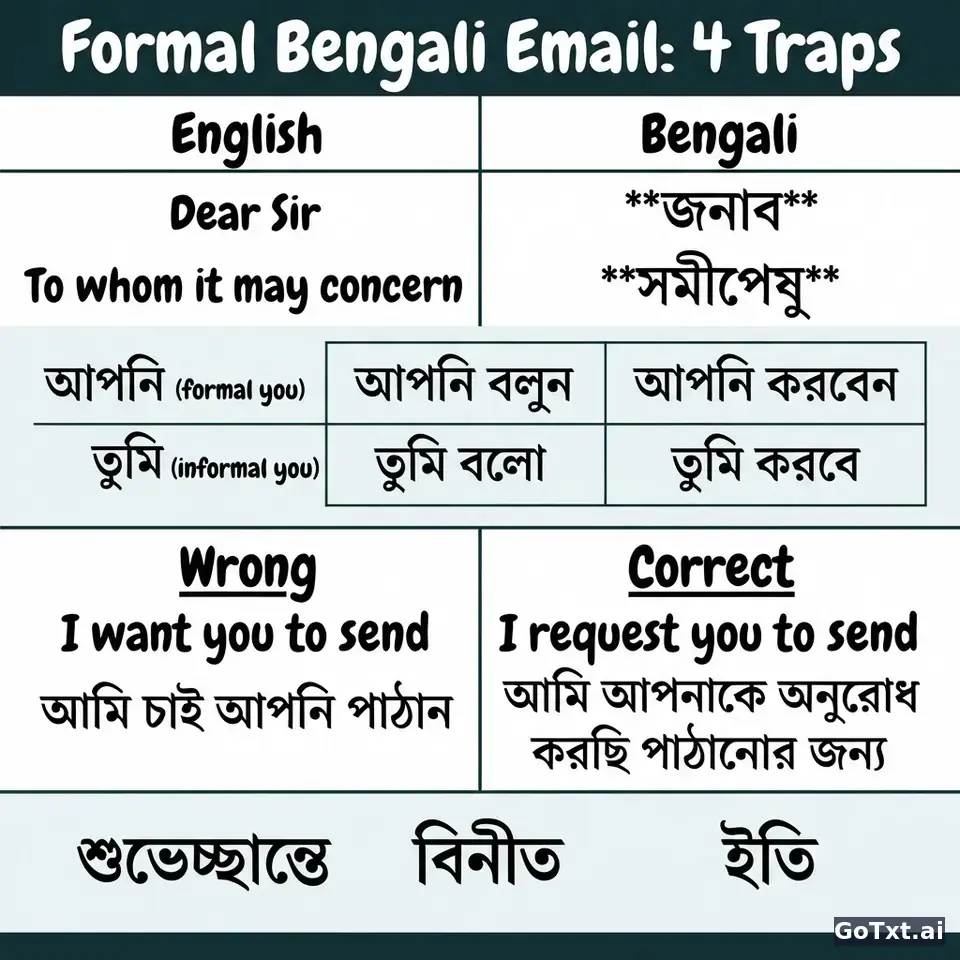
Trap 1: The greeting that sounds like a translation
English lets you open with almost anything — "Hi", "Hello", "Dear Sir/Madam". Bengali formal writing is narrower and more ceremonial. If you write
| English habit | Bengali that fits | Bengali that feels off |
|---|---|---|
| Dear Sir | জনাব | প্রিয় স্যার |
| Dear Madam | জনাবা | প্রিয় ম্যাডাম |
| To whom it may concern | সমীপেষু | — |
Notice I never mix the greeting with a first name. In Bengali formality, the title carries the respect, not the name.
Trap 2: আপনি is not optional — and the verb must agree
This is the trap that exposes people fastest. English has one "you". Bengali has তুমি, আপনি, and তুই, and formal email lives almost entirely in আপনি. The catch: choosing আপনি forces the verb into its polite form. Students write the pronoun correctly and then attach an informal verb, and the whole sentence collapses.
| Pronoun | Verb form | Meaning |
|---|---|---|
| তুমি | তুমি বলো | you say (informal) |
| আপনি | আপনি বলুন | you say (formal) |
| আপনি | আপনি করবেন | you will do (formal) |
If you remember nothing else: আপনি always drags a polite verb behind it. Never let them separate.
Trap 3: The request that sounds like a command
In English, "Please send me the file" is polite enough. Translate it word for word into Bengali and you get something blunt, almost rude. Formal Bengali requests wrap the ask in a softener. Instead of a bare imperative, use অনুরোধ করছি (I am requesting) or দয়া করে (please, kindly).
Comments
Article discussion: learner comments and GoTxt teacher replies
Drop your emotions below — love, debates, even hate welcome. Comment 👇
Don't want to miss my reply? Leave your email — I'll send a copy.