 Conjugación del verbo hacer · Ananya · GoTxt
GoTxt Ananya Blog Conjugación del verbo hacer
One Verb, All Forms: Breaking Down "To Do" in Bengali — Bangla Lessons
Learn how the verb "to do" works in a Bangla course — every form of **kora**, its past and present conjugations, and the mistakes English speakers make most. Bangla Lessons.
The verb "to do" is the workhorse of Bengali. If you can handle kora, you can build half your daily sentences — asking what someone does, saying what you did, and even turning nouns into verbs. That is exactly why a Bangla course starts here: one verb, all forms, and the patterns repeat everywhere. The good news: Bengali verbs don't change for gender, and they don't change for "he/she/it" the way English does. The tricky part is that the ending shifts with who is doing the action and how politely you're speaking. Let's untangle it with one verb, all forms.
Bengali practice
Pronunciation practice
Listen to the phrase, repeat into the mic — your teacher analyzes the audio and gives a real pronunciation score with corrections and comments.
1 / 3
নমস্কার, কেমন আছেন?
hello, how are you?
The core meaning and the noun trick — Bangla basics
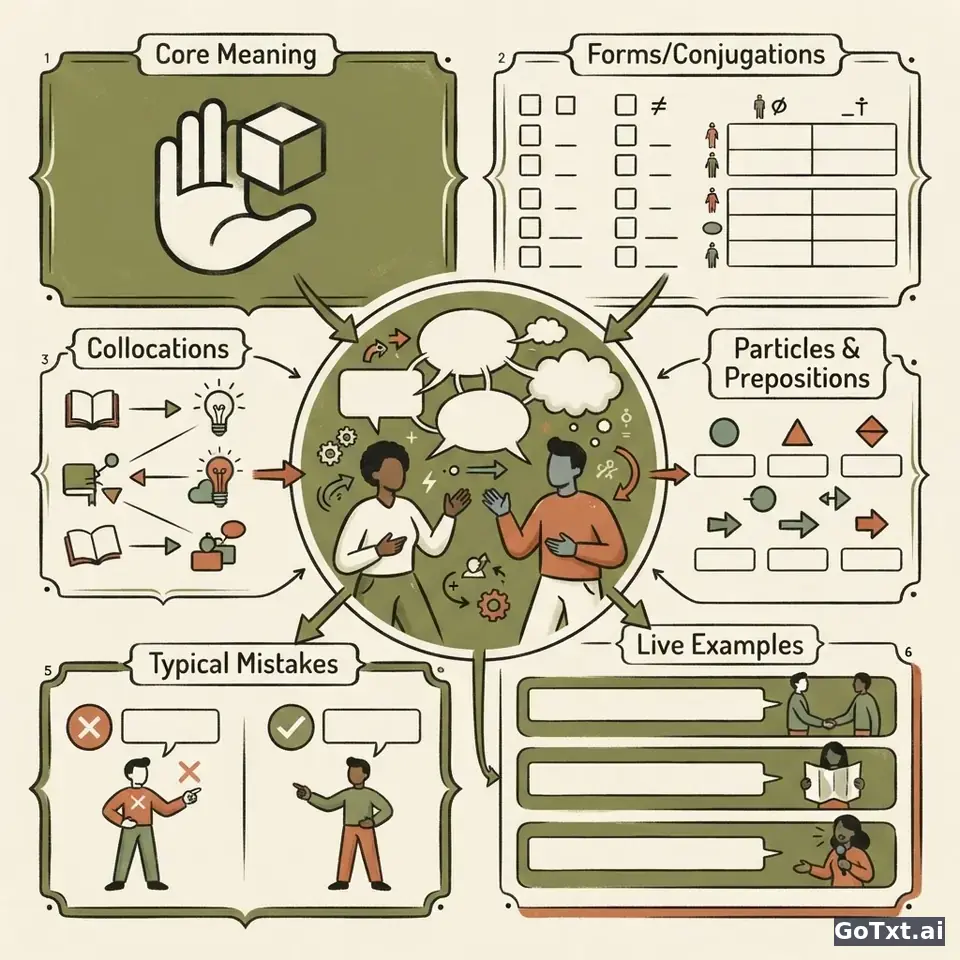
Kora means "to do" or "to make." But its real superpower is that it attaches to nouns to create new verbs. Take kaj (work) — add kora and you get kaj kora, "to work." Same with gan (song): gan kora means "to sing." English says "to work" as one word; Bengali often splits it into noun + kora. Once you spot this pattern, your vocabulary doubles overnight.
Present tense: who is doing it?
The ending tells you the subject, so you can often drop the pronoun. Notice how apni (polite "you") takes a different ending than tumi (familiar "you") — this is the politeness ladder English lost centuries ago.
| English | Bangla | Note |
|---|---|---|
| I do | ami kori | plain |
| you do (familiar) | tumi koro | to friends |
| you do (polite) | apni koren | to elders |
| he/she does | she kore | no gender change |
| we do | amra kori | same as "I" |
| they do | tara kore | same as "he/she" |
ami kori apni koren
Past tense: the endings you'll actually use
Past tense is where learners relax, because the forms are more distinct and easier to hear. The polite apni form ends in -len, and the familiar tumi form ends in -le.
| English | Bangla | Note |
|---|---|---|
| I did | ami korlam | -lam |
| you did (familiar) | tumi korle | -le |
| you did (polite) | apni korlen | -len |
| he/she did | she korlo | -lo |
| we did | amra korlam | same as "I" |
| they did | tara korlo | same as "he/she" |
ami korlam she korlo
Comments
Article discussion: learner comments and GoTxt teacher replies
Drop your emotions below — love, debates, even hate welcome. Comment 👇
Don't want to miss my reply? Leave your email — I'll send a copy.