Ananya Blog Bengali Irregular Verbs: One Verb, All Its Forms, Explained Step by Step
Bengali Irregular Verbs: One Verb, All Its Forms, Explained Step by Step
Confused by Bengali irregular verbs? We break down **যাওয়া** (to go) form by form, with a clear table, common mistakes, and a mini drill you can do in five minutes.
Every Bengali learner hits the same wall: the textbook shows you যাওয়া (to go) in the present tense, then quietly hopes you'll figure out the rest. You won't — not by guessing. Bengali verbs change shape for person, tense, and politeness, and যাওয়া is the perfect troublemaker to study because it's irregular enough to hurt and common enough that you can't avoid it. In this post I'm pulling one verb apart, form by form, so you stop memorizing random chunks and start seeing the pattern. By the end you'll be able to say আমি যাই without hesitating, and you'll know exactly why it's যাই and not something else.
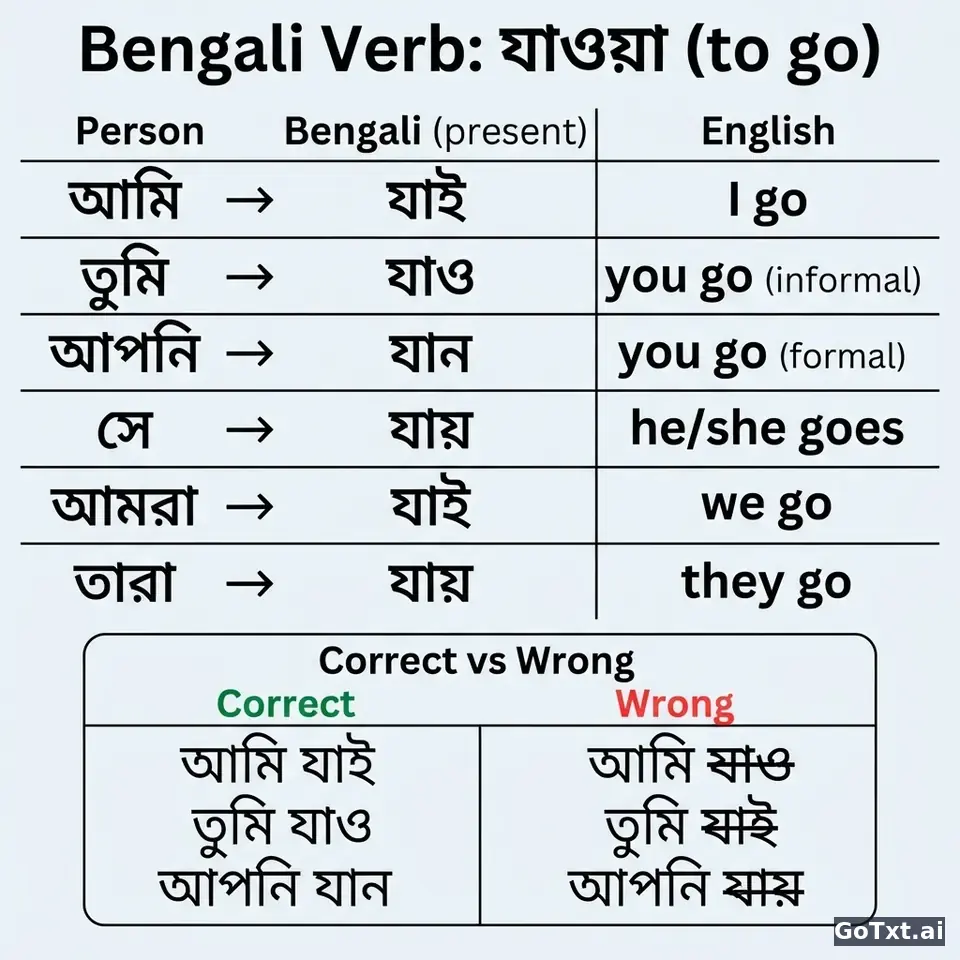
The Present Tense: Where Politeness Changes Everything
Bengali doesn't just track who does the action — it tracks how politely you're speaking to them. That's why তুমি যাও (you go, to a friend) and আপনি যান (you go, to an elder or stranger) are different words for the same idea. Get this wrong and you sound either rude or weirdly stiff.
| English | Bengali | Note |
|---|---|---|
| I go | আমি যাই | first person, no politeness choice |
| you go (informal) | তুমি যাও | friends, family, kids |
| you go (formal) | আপনি যান | elders, strangers, respect |
| he/she goes | সে যায় | third person, one form |
| we go | আমরা যাই | matches আমি |
| they go | তারা যায় | matches সে |
Notice the shortcut: আমি and আমরা share যাই; সে and তারা share যায়. Only the "you" row splits into two, and that split is about respect, not grammar logic.
Past and Future: The Verb Keeps Moving
The present is the easy part. In the past, যাওয়া turns into গেলাম for "I went" — yes, the root changes completely, which is exactly why this verb is called irregular. The future is friendlier: it builds on যাব, so আমি যাব means "I will go."
| English | Bengali | Tense |
|---|---|---|
| I went | আমি গেলাম | past |
| you went (informal) | তুমি গেলে | past |
| he/she went | সে গেল | past |
| I will go | আমি যাব | future |
| you will go (informal) | তুমি যাবে | future |
| he/she will go | সে যাবে | future |
The trap: learners see যা- in the present and future and assume the past must start with যা- too. It doesn't. গেলাম shares nothing with যাই on the surface — that's the irregularity you simply have to own.
Comments
Article discussion: learner comments and GoTxt teacher replies
Drop your emotions below — love, debates, even hate welcome. Comment 👇
Don't want to miss my reply? Leave your email — I'll send a copy.