Ananya Blog Bengali Grammar Traps: Why Your "Correct" Sentences Sound Foreign
Bengali Grammar Traps: Why Your "Correct" Sentences Sound Foreign
Four Bengali grammar traps that make textbook-correct sentences sound odd to native ears, with examples, tables, and a mini drill to fix them.
Every week a student sends me a sentence that is grammatically flawless and still makes my ears twitch. This is the quiet heartbreak of learning Bengali: you can conjugate perfectly and still sound like a phrasebook. Bengali carries a lot of meaning in word order, in the little particles glued to verbs, and in how you choose between
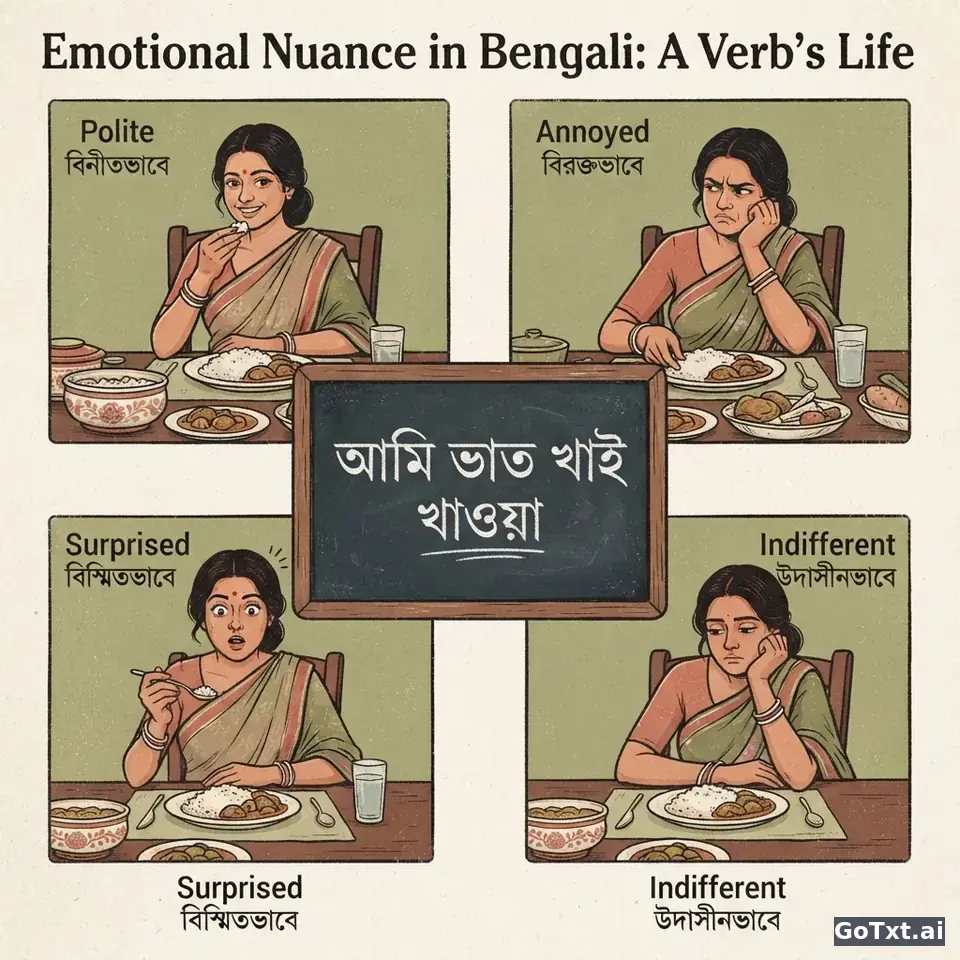
I tell my students the same thing I tell myself when I fumble a language: grammar is the skeleton, but rhythm is the skin. A sentence like আমি ভাত খাই is textbook clean. Say it in the wrong context and a native speaker hears a robot. So let's walk through the four traps I see most often with English speakers, and how to sound less like a textbook and more like a person.
1. Why "Correct" Isn't "Natural"
English leans hard on intonation and auxiliary verbs. Bengali leans on word order and verb endings. When you translate word-for-word, you keep English rhythm inside Bengali words. That mismatch is what people mean when they say you "sound foreign."
Take the verb খাওয়া (to eat). English says "I have eaten." A beginner writes আমি খেয়েছি and stops. But Bengali often wants a completion marker or a different word order depending on what you're emphasizing. The words are right; the shape is off.
| English intent | Textbook Bengali | What sounds natural |
|---|---|---|
| I already ate | আমি খেয়েছি | আমি খেয়ে নিয়েছি (finished, done with it) |
| I'm eating now | আমি খাচ্ছি | আমি এখন খাচ্ছি (time marker helps) |
| I don't eat that | আমি ওটা খাই না | আমি ওটা খাই না (order matters less here, but stress does) |
2. The Four Traps
Trap one: dropping the continuous. English says "I am going." Bengali has যাচ্ছি, but beginners often forget that আমি যাচ্ছি already means "I am going" — adding এখন everywhere sounds nervous. Use time words only when you actually mean "right now."
Trap two: the wrong "to be." This is the big one. Bengali splits "to be" into হয় (becomes/is generally) and আছে (exists/is located). Saying সে ভালো হয় when you mean "she is well" sounds like you're predicting her future. You want সে ভালো আছে.
Trap three: honorifics as afterthoughts. Bengali bakes respect into the verb. তুমি খাও, আপনি খান, তুই খা — same meaning, three social worlds. English speakers pick one and use it everywhere, which reads as either rude or weirdly stiff.
Trap four: question particles. English flips word order. Bengali often keeps order and adds কি or a rising tone. তুমি খেয়েছ কি? is fine, but learners overuse কি and lose the natural rising intonation.
Comments
Article discussion: learner comments and GoTxt teacher replies
Drop your emotions below — love, debates, even hate welcome. Comment 👇
Don't want to miss my reply? Leave your email — I'll send a copy.