Linh Blog Vietnamese Irregular Verbs: One Verb, All Its Forms, Step by Step
Vietnamese Irregular Verbs: One Verb, All Its Forms, Step by Step
Master the Vietnamese verb **đi** — its base form, past markers, and polite variants — with clear tables, common traps, and a quick mini-drill.
Most learners breathe a sigh of relief when they hear "Vietnamese has no verb conjugation." True — you don't memorize six endings like in Spanish. But that doesn't mean verbs sit still. Vietnamese verbs change shape depending on time markers, politeness, and whether the action is finished or ongoing. Today we take one workhorse verb — đi (to go) — and pull it apart piece by piece. By the end you'll be comfortable with đi,
Why "Irregular" Is the Wrong Word Here
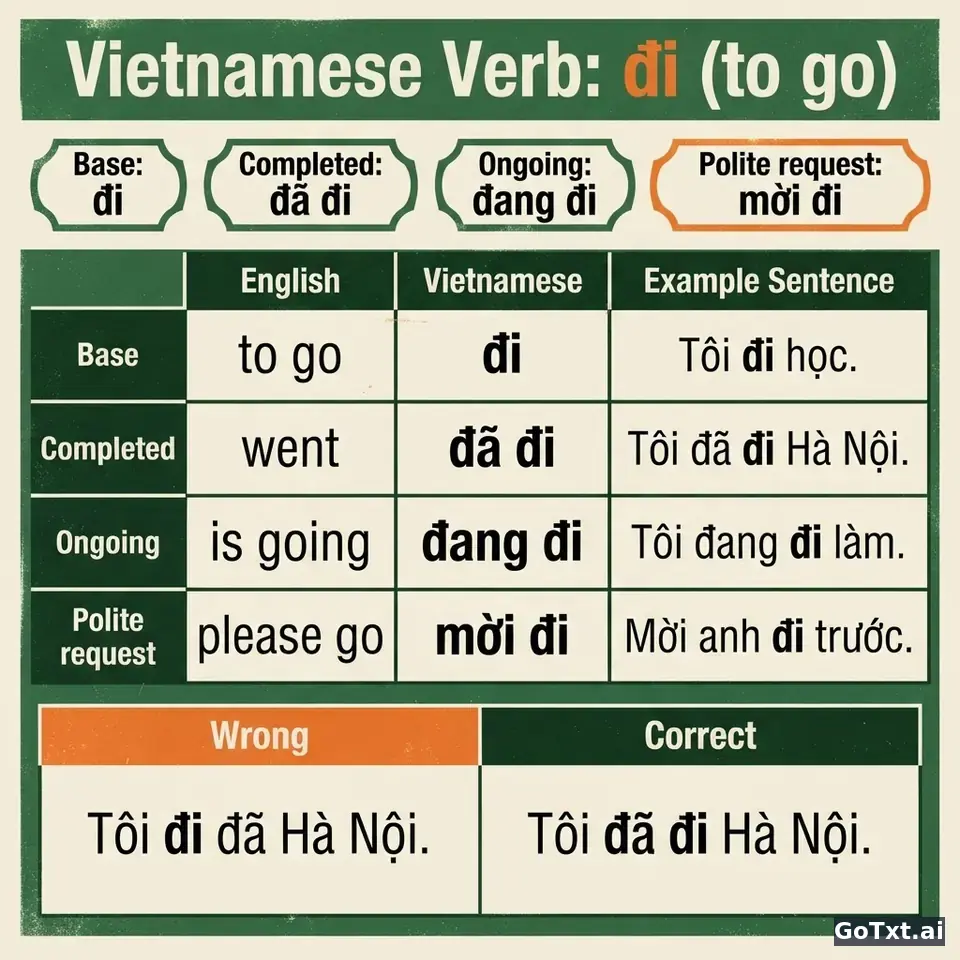
Vietnamese doesn't inflect verbs for tense. Instead, it stacks time markers in front of the verb. Think of đi as a Lego brick, and đã, đang, sẽ as colored blocks you snap in front of it. The verb itself never changes spelling — but the meaning shifts completely.
| English | Vietnamese | Notes |
|---|---|---|
| to go | đi | base form, no marker |
| went / already went | đã đi | đã = completed action |
| is going | đang đi | đang = in progress |
| will go | sẽ đi | sẽ = future |
Notice the verb đi stays put. The marker does all the heavy lifting. This is why teachers call Vietnamese "isolating" — every word keeps its shape.
The Trap: Marker Placement
The single biggest mistake I see is putting the time marker after the verb, copying English word order. In English you'd say "I went already" — verb first. In Vietnamese the marker comes first, always.
| English | Correct | Wrong |
|---|---|---|
| I already went to Hanoi. | Tôi đã đi Hà Nội. | Tôi đi đã Hà Nội. |
| I am going to work. | Tôi đang đi làm. | Tôi đi đang làm. |
| I will go tomorrow. | Tôi sẽ đi ngày mai. | Tôi đi sẽ ngày mai. |
Read the wrong column out loud once, laugh, and never write it again. Your ear will start catching the order naturally after a week of practice.
Politeness and Direction: When đi Grows Wings
Đi also teams up with other words to soften commands or show direction. Mời (to invite) plus đi turns a blunt order into a warm invitation. And đi after another verb often means "go and do" something.
| English | Vietnamese | When to use |
|---|---|---|
| Please go ahead. | Mời anh đi trước. | polite, to an elder or guest |
| Go and eat. | Đi ăn đi. | casual, friends or family |
| Let's go! | Đi thôi! | rallying a group |
Comments
Article discussion: learner comments and GoTxt teacher replies
Drop your emotions below — love, debates, even hate welcome. Comment 👇
Don't want to miss my reply? Leave your email — I'll send a copy.