Linh Blog Formal Emails in Vietnamese: 4 Traps That Reveal You're Not a Native
Formal Emails in Vietnamese: 4 Traps That Reveal You're Not a Native
Writing a formal Vietnamese email? Learn the four traps in greetings, address terms, requests, and sign-offs — with real phrases like **Kính gửi** and **Trân trọng** — so you sound polite, not foreign.
I've read hundreds of Vietnamese business emails written by learners, and the same four mistakes show up again and again. They're not grammar mistakes — the grammar is usually fine. They're register mistakes: the sentence is correct but the politeness level is off, and a Vietnamese reader notices it in the first line. The good news? Four fixes and your email goes from "clearly a foreigner" to "safe to send to a partner." Let's go through them with real phrases: Kính gửi, Trân trọng, Xin vui lòng, and Kính thư.
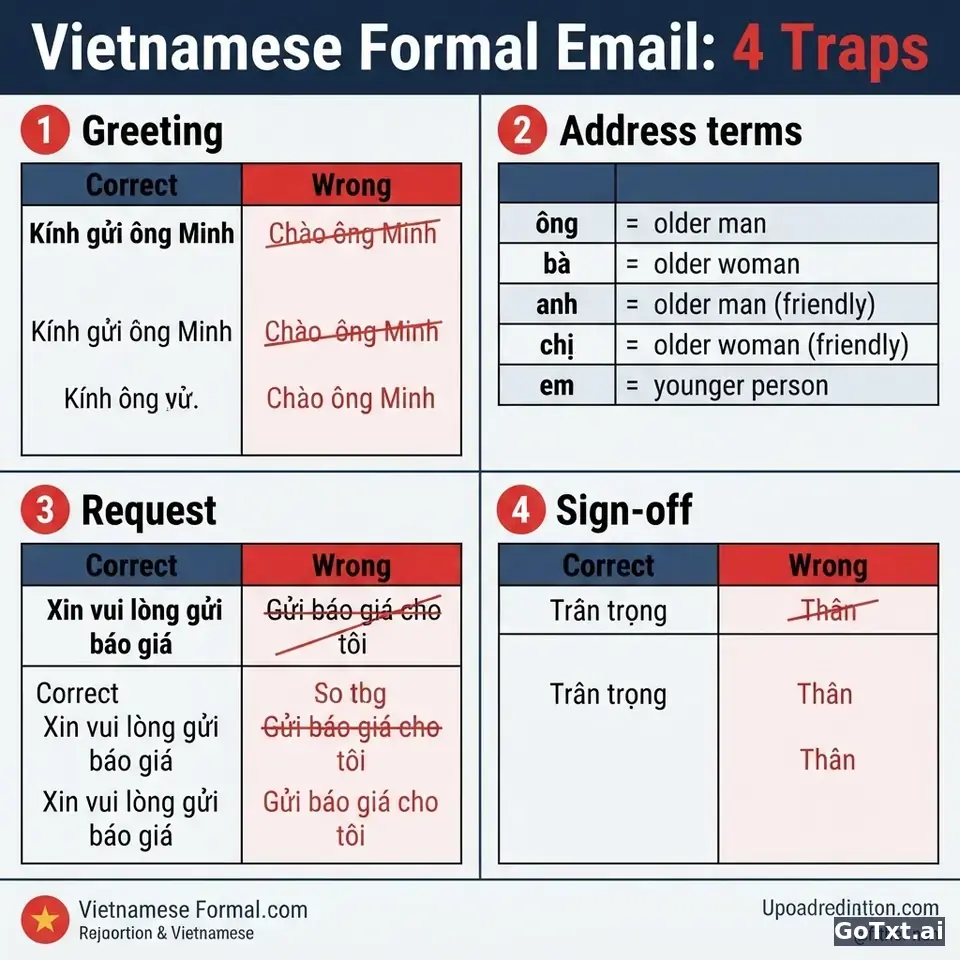
Trap 1: The greeting is too casual
In English, "Dear Mr. Minh" and "Hi Minh" are both acceptable openers depending on the relationship. In Vietnamese, Kính gửi ("respectfully sent to") is the standard formal opener, and Chào is what you say to a friend or a colleague you chat with daily. Using Chào ông Minh in a first business email reads like you're already buddies — or worse, like you didn't bother.
| English intent | Correct | Wrong |
|---|---|---|
| First contact, formal | Kính gửi ông Minh | Chào ông Minh |
| Known colleague | Kính gửi anh Minh | Hey Minh |
| Company, no name | Kính gửi Quý công ty | Gửi công ty |
Trap 2: You pick the wrong address term
English has one "you." Vietnamese has a whole shelf of address words, and they encode age, gender, and relationship. This is the trap that reveals a non-native fastest, because the wrong word isn't rude — it's just weird, like calling your boss "kiddo."
| Vietnamese | Use for | English gloss |
|---|---|---|
| ông | older man, formal | Mr. / sir |
| bà | older woman, formal | Mrs. / madam |
| anh | man a bit older, friendly-formal | Mr. (warm) |
| chị | woman a bit older, friendly-formal | Ms. (warm) |
| em | someone younger than you | you (junior) |
If you don't know the person's age, Quý ông / Quý bà or the company name is the safe route. Guessing em for a 50-year-old director is the classic disaster.
Trap 3: The request sounds like a command
English business writing loves the bare imperative: "Please send the quote." Translated word-for-word, Gửi báo giá cho tôi sounds like an order from a boss to a subordinate. The polite fix is Xin vui lòng ("please kindly") or a softening frame like Rất mong ("we would very much hope").
Comments
Article discussion: learner comments and GoTxt teacher replies
Drop your emotions below — love, debates, even hate welcome. Comment 👇
Don't want to miss my reply? Leave your email — I'll send a copy.