Aylin Blog Decoding Turkish Humor: The "Nasreddin Hoca" Joke That Teaches You Grammar
Decoding Turkish Humor: The "Nasreddin Hoca" Joke That Teaches You Grammar
Learn Turkish through a classic Nasreddin Hoca joke. We break down the grammar, the cultural logic, and why the punchline works — with translations and tables.
Every language hides its soul in its jokes. In Turkish, one figure towers above all others: Nasreddin Hoca, the wise fool of Akşehir whose stories have been told for over 600 years. My students always ask me why Turks laugh so hard at these tales. The answer isn't just the punchline — it's the grammar. Let me show you a famous one and unpack it word by word, because once you see the structure, you'll hear the humor everywhere.
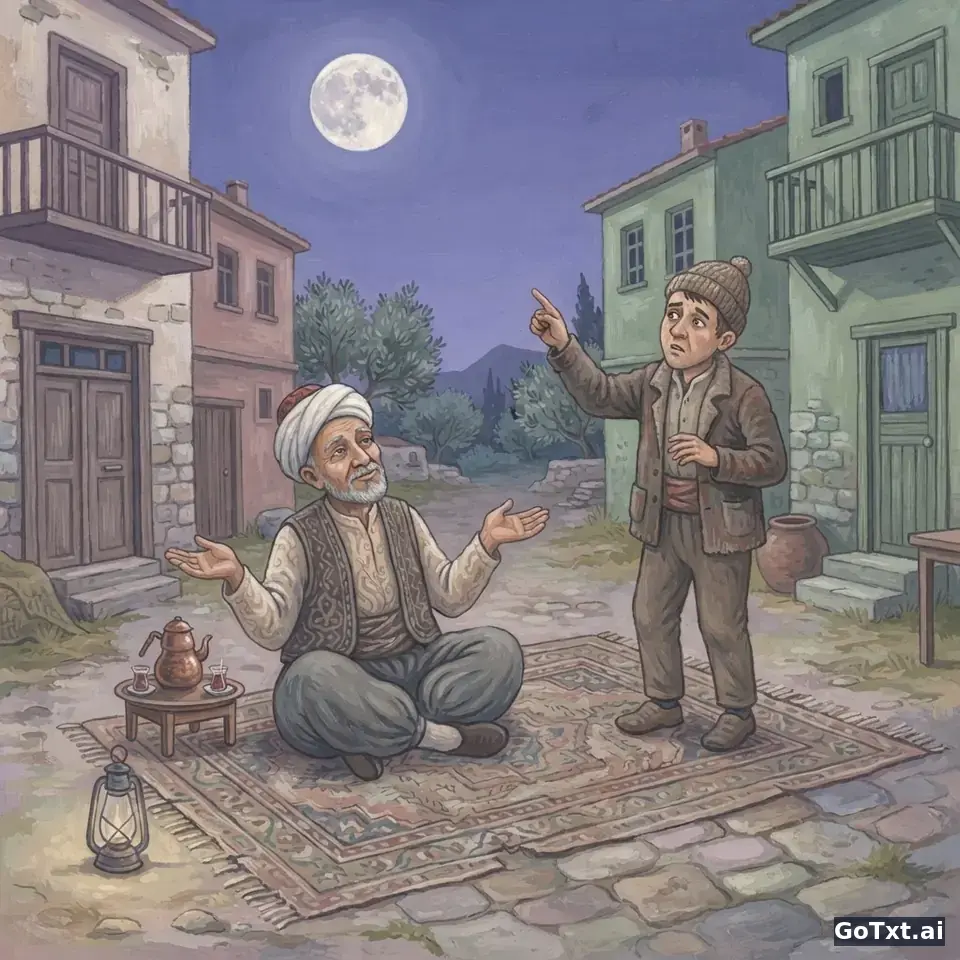
The joke goes like this: A neighbor asks the Hoca,
That's it. That's the joke. And it's brilliant.
Why This Joke Works: The Grammar Trap
The humor lives in a pun that only Turkish grammar makes possible. Look closely at the two key words.
| Turkish | Literal English | What It Really Means |
|---|---|---|
| ayın on dördü | the moon's fourteenth | the 14th day of the month |
| buradanım | I am from here | I am a local / I belong here |
The neighbor means "the fourteenth day of the month." But ay means both "moon" and "month" in Turkish. The Hoca hears "the moon's fourteenth" and answers as if asked about location — buradanım, "I'm from here," as if the moon were a place he lives in.
The suffix -dan/-den ("from") plus the personal ending -ım creates buradanım — a single word meaning "I am from here." English needs four words. Turkish does it in one. That compression is where the comedy hides.
The Cultural Layer: Wisdom Through Foolishness
Nasreddin Hoca isn't just a comedian. He's a philosopher who pretends to be stupid to expose how stupid the question was. When the neighbor asks about a calendar date, he's asking something the Hoca genuinely cannot know — nobody can predict the sky's answer. So the Hoca answers a different question entirely, and in doing so, he says: "Why are you asking me something so obvious?"
This is the Turkish art of laf sokmak — "inserting a word," a polite dagger. Turks don't always say "you're being ridiculous." They make you laugh until you realize you were.
Comparing the Humor: English vs. Turkish Logic
English jokes often build to a punchline that breaks expectations through absurdity. Turkish Hoca jokes work differently — they break expectations through logic taken too literally.
| Element | English-style joke | Turkish Hoca joke |
|---|---|---|
| Setup | A situation | A simple question |
| Twist | Absurd escalation | Literal misreading |
| Punchline | Surprise | Deadpan calm |
| Lesson | Usually none | Often moral or social |
Notice the Hoca never raises his voice. The comedy is in the soğukkanlılık — the cool-headedness. He answers a nonsense question with a nonsense answer, and somehow he's the wise one.
The Suffix That Makes It Funny
Let's zoom in on buradanım one more time, because it's a grammar lesson disguised as a joke.
Comments
Article discussion: learner comments and GoTxt teacher replies
Drop your emotions below — love, debates, even hate welcome. Comment 👇
Don't want to miss my reply? Leave your email — I'll send a copy.