Aylin Blog Turkish Irregular Verbs: One Verb, All Its Forms, Explained Step by Step
Turkish Irregular Verbs: One Verb, All Its Forms, Explained Step by Step
Learn how Turkish irregular verbs actually work by breaking down one tricky verb into every form. Clear tables, common mistakes, and a mini drill to lock it in.
Most learners arrive at Turkish expecting a giant list of irregular verbs, the way Spanish or French torture you with them. Here's the honest truth I tell every new student: Turkish barely has irregular verbs in that sense. What it has instead is one verb that behaves strangely in almost every tense, and that verb is etmek — "to do, to make." Once you understand etmek fully, you understand the whole logic of Turkish verb building. So today we take one verb, pull it apart, and look at every form step by step.
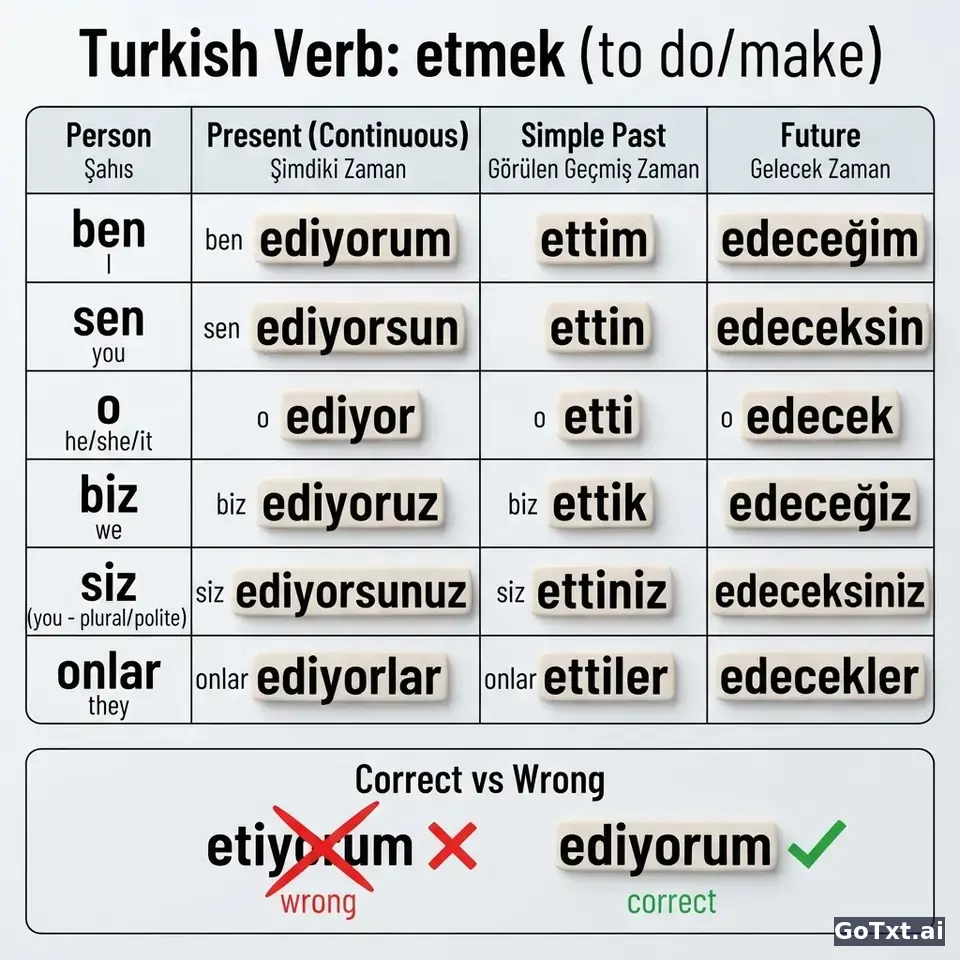
Why "etmek" looks broken (and why it isn't)
The root is et-. In the present continuous, Turkish normally inserts -iyor and keeps the stem intact. But et- has a soft final consonant, so it shifts: et- + -iyor becomes ediyor. The t turns into d between two vowels. That's it. That's the "irregularity."
| English | Correct | Wrong |
|---|---|---|
| I am doing | ben ediyorum | ben etiyorum |
| You are doing | sen ediyorsun | sen etiyorsun |
| He/she is doing | o ediyor | o etiyor |
| We are doing | biz ediyoruz | biz etiyoruz |
The same softening happens in the future: et- + -ecek becomes edecek. So "I will do" is ben edeceğim, not eticeğim.
The past tense: where learners slip
In the simple past, et- stays hard. So you get ettim, ettin, etti. Notice the double t — that's the giveaway that this is etmek and not some other verb.
| English | Turkish | Note |
|---|---|---|
| I did | ettim | double t |
| You did | ettin | double t |
| He/she did | etti | double t |
| We did | ettik | double t |
The trap: students who learn ediyorum first try to write eddim in the past. Wrong. Present softens, past doesn't. Say it out loud a few times: ettim, ettim, ettim.
ettim etti
The real reason "etmek" matters
Etmek is a helper verb. It teams up with nouns to build hundreds of everyday expressions: yardım etmek (to help), teşekkür etmek (to thank), dikkat etmek (to pay attention). When you conjugate etmek, you conjugate the whole phrase. So yardım ediyorum means "I am helping," and yardım ettim means "I helped."
That's why getting this one verb right pays off everywhere. You're not memorizing a weird exception — you're unlocking a pattern you'll use daily.
Mini drill
Cover the right column and produce the Turkish yourself. Then check.
Comments
Article discussion: learner comments and GoTxt teacher replies
Drop your emotions below — love, debates, even hate welcome. Comment 👇
Don't want to miss my reply? Leave your email — I'll send a copy.