Aylin Blog Grammar That Sounds Off: 4 Turkish Traps That Mark You as a Foreigner
Grammar That Sounds Off: 4 Turkish Traps That Mark You as a Foreigner
You can conjugate Turkish perfectly and still sound foreign. Here are four grammar traps that give English speakers away — and how to fix each one.
I've taught Turkish to English speakers for eleven years, and I can spot one in a conversation within about thirty seconds. Not because of vocabulary — most of my students have great vocabularies. It's the grammar. Perfectly correct grammar that still sounds like a translation. You say
Why "Correct" Isn't "Natural"
English and Turkish solve the same problems with completely different tools. English leans on word order and pronouns: I am a teacher, I am going, I did it. Turkish leans on suffixes and drops what it considers obvious. When you carry English habits into Turkish, you don't produce errors — you produce something that sounds like a textbook written by a robot. Natives don't hear a mistake. They hear distance. And distance is what makes them switch to English on you.
That's the whole sentence. No ben, no bir. The suffix -im already says "I am."
Trap 1: Overusing Pronouns
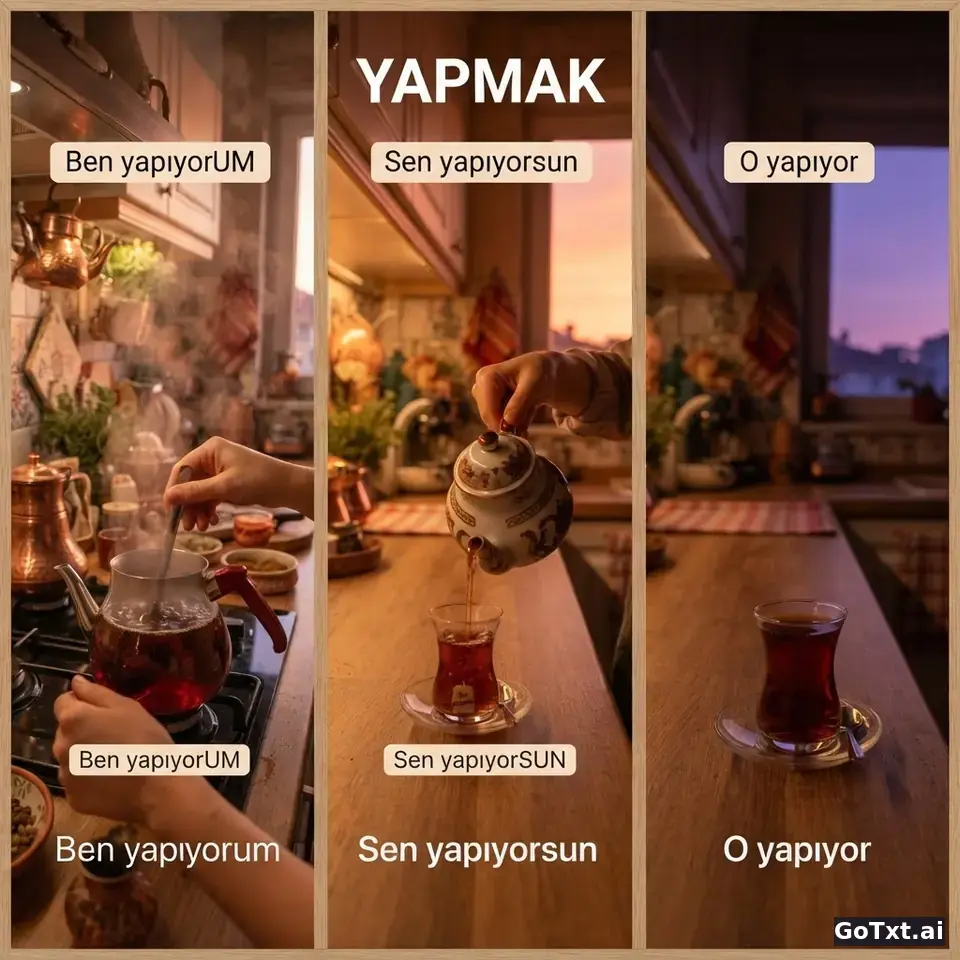
Turkish verbs carry the subject in the ending. Adding ben, sen, o is not wrong, but it's emphatic — like saying I myself am a teacher in English. Use it constantly and you sound like you're arguing with someone who never spoke.
| English habit | Sounds foreign | Sounds native |
|---|---|---|
| I am a teacher | Ben bir öğretmenim | Öğretmenim |
| You are coming | Sen geliyorsun | Geliyorsun |
| I don't know | Ben bilmiyorum | Bilmiyorum |
Keep the pronoun only when you're contrasting: Ben geliyorum, o gelmiyor.
Trap 2: The Missing "-dir" Instinct
English speakers love the copula. Turkish often doesn't need one, and when you force -dir into casual speech, you sound like a news anchor. Bu bir kitaptır is fine in a written report. In a kitchen, it's weird. Just say Bu bir kitap.
| Context | Overly formal | Everyday |
|---|---|---|
| Pointing at a book | Bu bir kitaptır | Bu bir kitap |
| Stating a fact | Su hayattır | Su hayat |
Trap 3: Word Order That Betrays You
Turkish is subject-object-verb. English is subject-verb-object. When you keep English order, the sentence is understandable but the rhythm is off — the verb lands too early and the listener waits for something that never comes.
| English order | Turkish order |
|---|---|
| Ben kitabı okuyorum (I book read) | Kitabı okuyorum |
| Yarın sinemaya gidiyorum | Yarın sinemaya gidiyorum ✓ |
Comments
Article discussion: learner comments and GoTxt teacher replies
Drop your emotions below — love, debates, even hate welcome. Comment 👇
Don't want to miss my reply? Leave your email — I'll send a copy.