Галина Blog "Ты" or "Вы"? How to Address People in Russian Without Sounding Rude
"Ты" or "Вы"? How to Address People in Russian Without Sounding Rude
Learn when to use **ты** and **вы** in Russian, why the capital **Вы** matters, and the mistakes English speakers make when addressing strangers, bosses, and friends.
Every English speaker starts Russian with a comfortable illusion: "you" is "you", one word, done. Then someone hisses at you in a shop because you asked
The basic rule (and why it's not really about politeness)
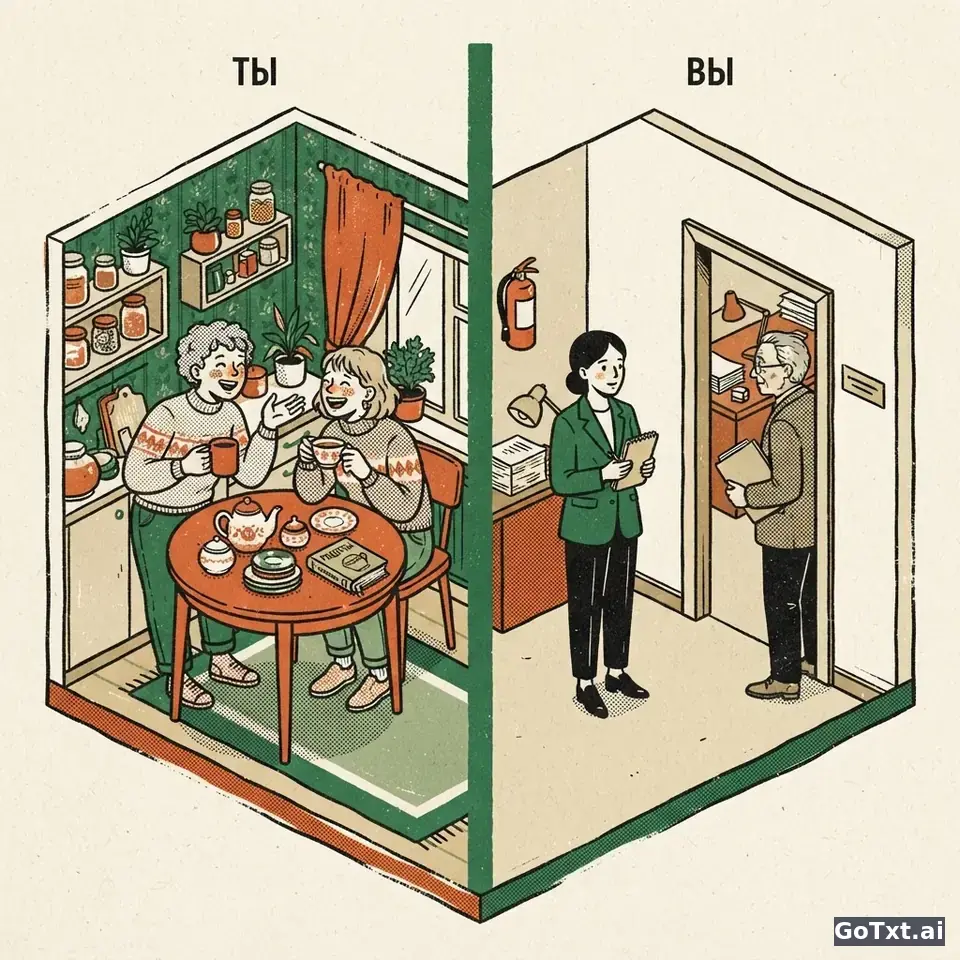
Вы is the default for strangers, older people, officials, and anyone you'd call by first name plus patronymic. Ты is for friends, family, children, close colleagues, and anyone who has explicitly invited you to switch. The trap: English "you" is neutral, so your brain treats Russian ты as the neutral one too. It isn't. Ты to a stranger reads as either childish or deliberately rude — like calling your bank manager "buddy."
| Situation | Use | Why |
|---|---|---|
| Stranger on the street | вы | No relationship yet |
| Your close friend | ты | Established intimacy |
| A child | ты | Age hierarchy |
| Your boss (usually) | вы | Status + distance |
| A colleague your age, after a while | ты, by agreement | Mutual invitation |
Formal vs informal: the verb changes too
This is where beginners get lazy. It's not just the pronoun — the verb ending follows. With ты you use the second-person singular; with вы you use the plural form even when speaking to one person.
| English | ты (informal) | вы (formal) |
|---|---|---|
| You are reading | Ты читаешь | Вы читаете |
| You know | Ты знаешь | Вы знаете |
| You said | Ты сказал | Вы сказали |
| You will come | Ты придёшь | Вы придёте |
So Вы читаете to a single person is not a mistake — it's the whole point. Mixing them, like Вы читаешь, is the classic tell that you learned from a phrasebook.
The capital Вы and other cultural landmines
In writing, a capital Вы is used to show extra respect to one specific person — in letters, emails, official requests. In ordinary text to a group, it stays lowercase. Russians also switch ты → вы far less often than the reverse: an older person may use ты toward a younger one while receiving вы back. That asymmetry is normal, not an insult. And never rush the switch — jumping to ты with a new acquaintance feels pushy. Wait for the other person to say something like Давай на ты or Можно на ты?.
Mini-practice: pick the right form
Try these out loud. If you're unsure, default to вы — you can almost never go wrong being slightly too formal, but being too familiar is hard to undo.
Comments
Article discussion: learner comments and GoTxt teacher replies
Drop your emotions below — love, debates, even hate welcome. Comment 👇
Don't want to miss my reply? Leave your email — I'll send a copy.