Галина Blog Formal Emails in Russian: 4 Traps That Instantly Reveal You're Not a Native
Formal Emails in Russian: 4 Traps That Instantly Reveal You're Not a Native
Writing a formal email in Russian? Learn the greeting, address, request and sign-off formulas that make you sound polite — and the four traps that instantly mark you as a foreigner.
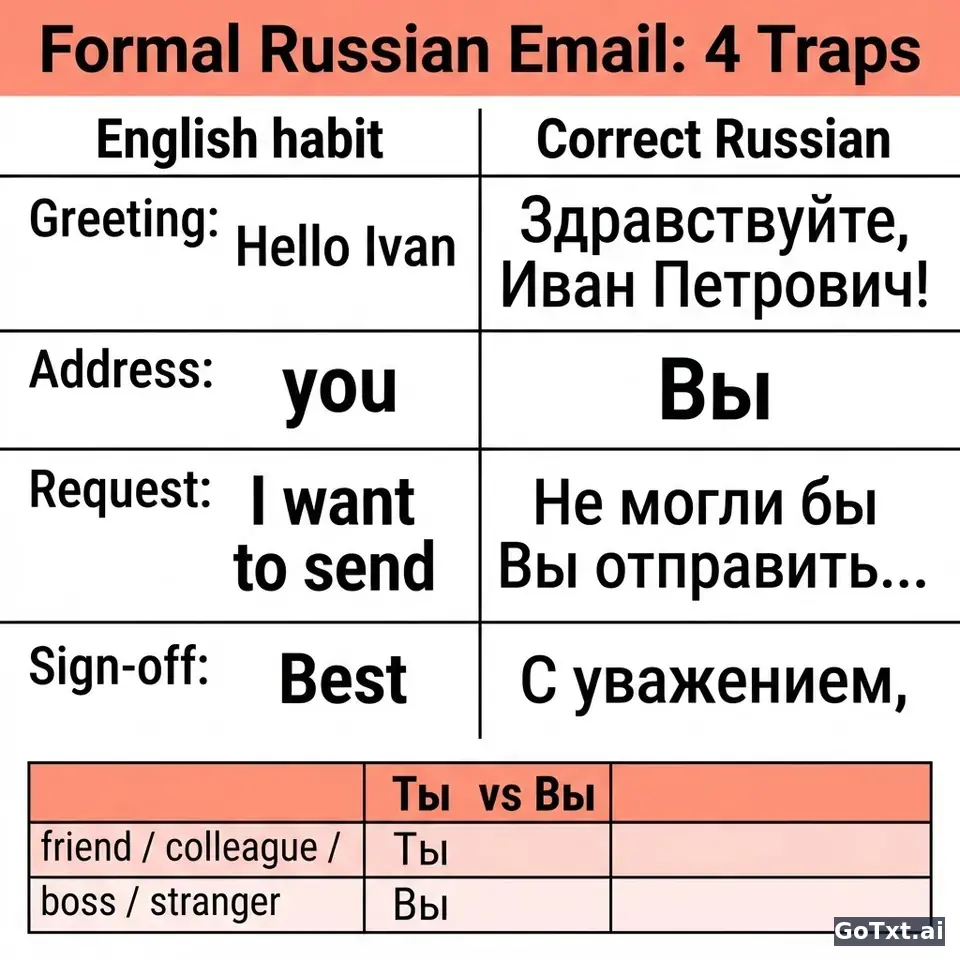
Every week a student sends me a beautiful Russian email and asks, "Galina, why did nobody answer?" The grammar is fine. The problem is the tone. Russian business writing has its own etiquette, and it is not a translation of English politeness. You can write a perfectly correct sentence like Я хочу спросить вас о проекте and still sound like you are giving orders. Let's fix the four places where foreigners slip: the greeting, the address, the request, and the signature.
Trap 1: The greeting that is too casual
In English, "Hi Ivan" is normal even with a new business contact. In Russian, Привет is for friends. A stranger or a senior colleague gets Здравствуйте — always with the full name and patronymic: Здравствуйте, Иван Петрович! The patronymic is not decoration; skipping it can read as disrespect. If you don't know it, use Здравствуйте! plus the first name, and never Привет in a first email.
| Situation | Correct | Wrong |
|---|---|---|
| Friend | Привет, Иван! | Здравствуйте, Иван Петрович! |
| New business contact | Здравствуйте, Иван Петрович! | Привет, Иван! |
| Unknown recipient | Здравствуйте! | Привет! |
Trap 2: Ты or Вы — the pronoun that decides everything
English has one "you", so learners flatten Russian. But ты and Вы carry a whole social map. With a boss, a client, or anyone older, it is Вы — capitalized in letters, and the verb is plural: Вы пишете, Вы можете, Вы хотите. With a close colleague you may use ты: ты пишешь, ты можешь. Mixing them mid-email is the fastest way to look careless.
| Person | Pronoun | Verb form |
|---|---|---|
| Boss / client | Вы | Вы пишете |
| Older colleague | Вы | Вы можете |
| Close friend | ты | ты пишешь |
Trap 3: The request that sounds like a command
This is the trap that hurts most. English softens with "Could you please send…". A literal Russian Я хочу, чтобы вы отправили… sounds like a demand. The polite formula is conditional: Не могли бы Вы отправить… or Будьте добры, отправьте…. Add пожалуйста and you are safe.
| English | Correct | Wrong |
|---|---|---|
| Could you send the file? | Не могли бы Вы отправить файл? | Я хочу, чтобы вы отправили файл. |
| Please reply today | Будьте добры, ответьте сегодня. | Ответьте сегодня. |
Comments
Article discussion: learner comments and GoTxt teacher replies
Drop your emotions below — love, debates, even hate welcome. Comment 👇
Don't want to miss my reply? Leave your email — I'll send a copy.