Ana Blog Irregular Verbs: One Verb, All Its Forms, Explained Step by Step
Irregular Verbs: One Verb, All Its Forms, Explained Step by Step
Take one messy Portuguese irregular verb and break it down form by form — full conjugation table, the logic behind each change, and the traps English speakers fall into.
Every student eventually meets the verb that refuses to behave. In Portuguese, my favourite troublemaker is fazer — "to do, to make." It looks innocent in the dictionary, then shows up as faço, fiz, farei, feito, and suddenly nobody recognizes it. I tell my students the same thing every term: don't memorize the whole verb at once. Learn one verb, all its forms, and the pattern starts to feel logical instead of random. So today we're doing exactly that with fazer, step by step.
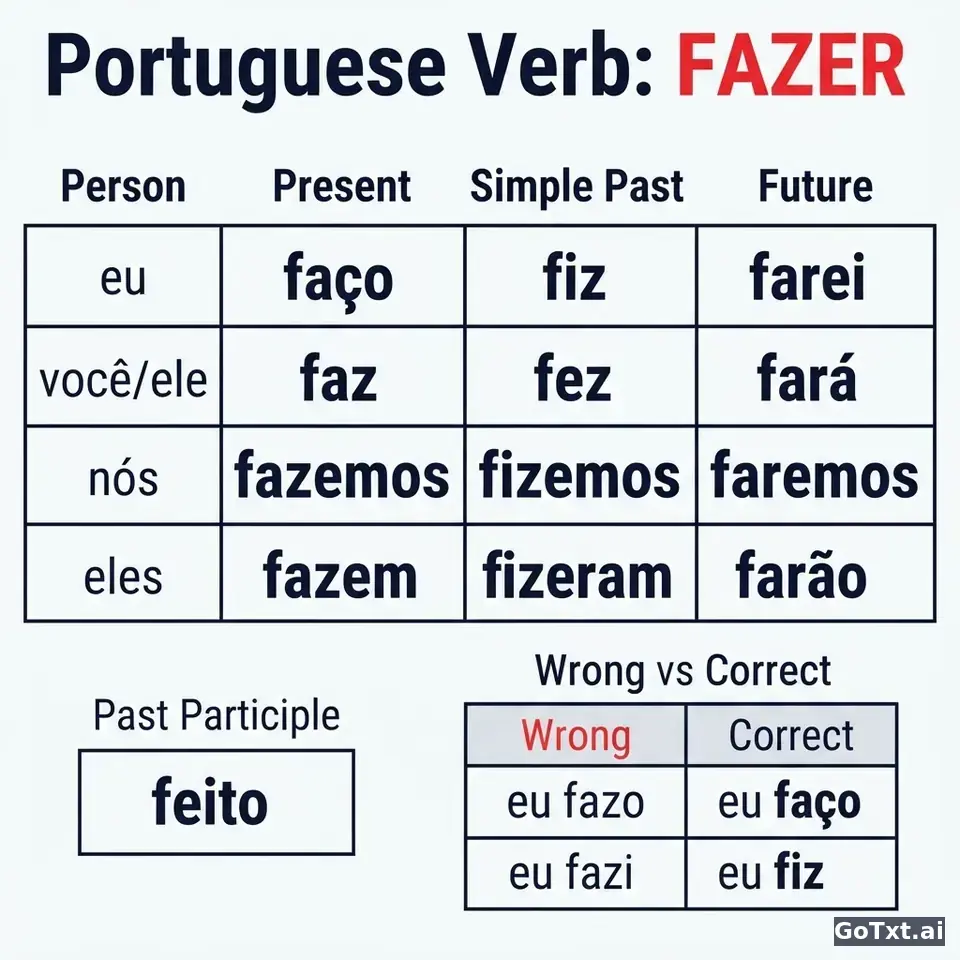
Why "fazer" breaks the rules
Regular verbs keep a stable stem, but fazer changes its whole body depending on tense. In the present, the stem shifts to faç- for "I": eu faço. In the simple past, it collapses to fiz-: eu fiz. In the future, it grows into far-: eu farei. Three different stems, one verb. That's not chaos — it's history. This verb comes from Latin facere, and Portuguese kept several of its old shapes instead of smoothing them into one.
Here's the full picture in one table:
| Person | Present | Simple Past | Future |
|---|---|---|---|
| eu | faço | fiz | farei |
| você / ele / ela | faz | fez | fará |
| nós | fazemos | fizemos | faremos |
| eles / elas | fazem | fizeram | farão |
The participle trap: "feito", not "fazido"
Here's where English speakers get lazy. You know falar → falado, comer → comido, so your brain whispers "fazer → fazido." Wrong. The past participle is feito — irregular to its core. You'll hear it constantly: está feito, bem-feito, tenho feito. Compare the two languages side by side:
| English | Correct Portuguese | Wrong (common mistake) |
|---|---|---|
| I do | eu faço | eu fazo |
| I did | eu fiz | eu fazi |
| I will do | eu farei | eu fazerei |
| done | feito | fazido |
Notice the pattern: the third-person singular faz and fez drop the final vowel sound you might expect, while nós and eles stay closer to the regular rhythm. If you can hear faz / fez / fará as a family, the rest falls into place.
Mini-training: say it out loud
Reading a table is passive. Speaking it is what sticks. Take these three sentences and change only the subject — keep the verb form correct each time. Start with eu faço, move to nós fazemos, then push to eles fizeram. Say each version out loud, slowly, twice. Your mouth needs the repetition more than your eyes do.
Comments
Article discussion: learner comments and GoTxt teacher replies
Drop your emotions below — love, debates, even hate welcome. Comment 👇
Don't want to miss my reply? Leave your email — I'll send a copy.