Ana Blog Formal Emails in Portuguese: 4 Traps That Reveal You're Not a Native
Formal Emails in Portuguese: 4 Traps That Reveal You're Not a Native
Writing a formal email in Portuguese? Learn the greeting, address, request and sign-off traps that instantly mark you as a foreigner — with real examples.
Every time a student sends me their first business email in Portuguese, the same thing happens: the grammar is fine, the vocabulary is fine, and yet the message screams "I learned this from a textbook." The culprits are almost never verbs — they are the little social formulas that Brazilians absorb without thinking: Prezado Senhor, Atenciosamente, Venho por meio desta solicitar. Get them wrong and you sound stiff, rude, or simply foreign. Let's fix the four traps I see most often.
Trap 1: The greeting that's too warm or too cold
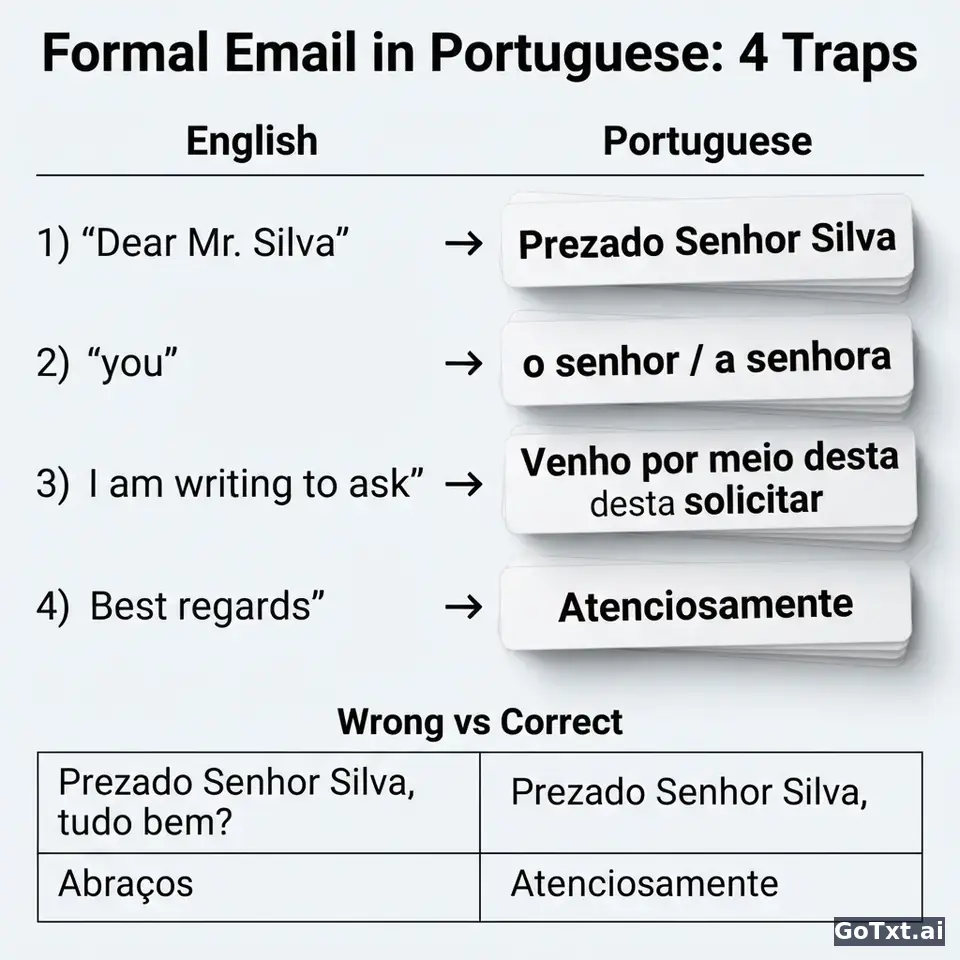
English lets you open with "Hi" and still be professional. Portuguese splits the world in two: Olá is friendly and fine for colleagues, while Prezado Senhor / Prezada Senhora is the formal door. The trap? Mixing them. Prezado Senhor Silva, tudo bem? sounds like wearing a tuxedo to a beach. Pick a register and stay in it.
| English | Portuguese | Register |
|---|---|---|
| Dear Mr. Silva | Prezado Senhor Silva | formal |
| Hello Ana | Olá, Ana | neutral |
| Hi team | Olá, pessoal | informal |
Prezado Senhor Silva,
Trap 2: "You" is a minefield
In English, "you" is one word. In Portuguese you must choose: você, o senhor, a senhora. In a formal email, você can feel too familiar, and dropping the pronoun entirely can feel cold. The safe move is o senhor / a senhora with third-person verbs — yes, you address one person as if talking about them.
| English | Portuguese | Note |
|---|---|---|
| Can you send it? | O senhor pode enviar? | formal |
| Can you send it? | Você pode enviar? | neutral |
| Can you send it? | Pode enviar? | direct, can sound curt |
Trap 3: The request that sounds like a demand
English "I would like to ask" translates badly word-for-word. Brazilians open formal requests with a ritual phrase: Venho por meio desta solicitar — literally "I come by means of this to request." It sounds archaic in English but perfectly normal and polite in Portuguese. Skip it and your request can read as blunt.
Trap 4: The sign-off that betrays you
This is where foreigners fall hardest. Abraços ("hugs") is warm and common between friends — but in a formal email it's a red flag. Atenciosamente is the neutral, safe closing for almost any professional context. Cordialmente works too, slightly cooler.
Comments
Article discussion: learner comments and GoTxt teacher replies
Drop your emotions below — love, debates, even hate welcome. Comment 👇
Don't want to miss my reply? Leave your email — I'll send a copy.