Priya Blog Hindi Irregular Verbs: One Verb, Every Form, Finally Decoded
Hindi Irregular Verbs: One Verb, Every Form, Finally Decoded
Hindi verbs don't "irregular" the way English does — they change by gender, respect, and tense. Let's break down **karnā** (to do) form by form, with the traps that trip up every learner.
Every Hindi learner hits the same wall: you learn karnā (to do), feel proud, then meet kartā hoon, kiyā, kījiye, karūṅgā — and suddenly it's a different verb. It isn't. Hindi doesn't have "irregular verbs" in the English sense; it has verbs that bend to gender, respect level, and tense all at once. Once you see the pattern, karnā stops being scary. Let me walk you through it the way I do with my students: one verb, every form, no magic.
The Two Stems You Must Memorize
Karnā lives on two stems. The first is kar- — used for present, future, and habitual. The second is ki- — used for the simple past. That's it. Every form below is just a stem plus an ending.
| Tense | Stem | Example (main / I) |
|---|---|---|
| Present habitual | kar- | main kartā hoon |
| Future | kar- | main karūṅgā |
| Simple past | ki- | main ne kiyā |
| Imperative (formal) | kī- | āp kījiye |
Notice the past needs ne with main — a small word that marks the subject as having done something. Miss it and the sentence sounds broken to native ears.
main kartā hoon main ne kiyā
Gender and Respect: The Real Trap
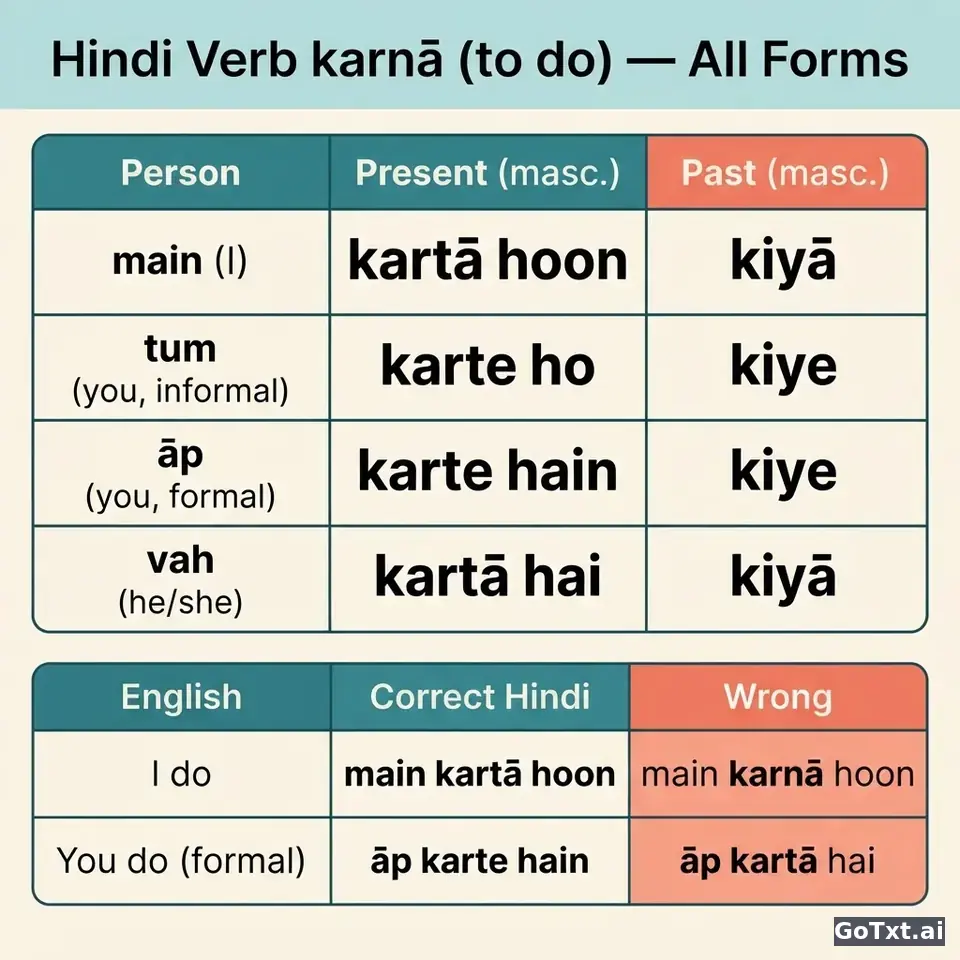
Here's where English speakers stumble. The present-tense ending agrees with the subject's gender — but only in singular. Watch kartā (masc.) versus kartī (fem.).
| Subject | Masculine | Feminine |
|---|---|---|
| main (I) | main kartā hoon | main kartī hoon |
| tum (you, informal) | tum karte ho | tum kartī ho |
| vah (he/she) | vah kartā hai | vah kartī hai |
| āp (you, formal) | āp karte hain | āp kartī hain |
Two things to burn in: āp always takes hain, never hai — that's respect grammar, not plural. And tum takes ho, which is neither hoon nor hai. Mixing these is the single most common beginner error.
āp karte hain vah kartī hai
Correct vs. Wrong: The Classic Mistakes
| English | Correct | Wrong |
|---|---|---|
| I did it | main ne kiyā | main kiyā |
| You (formal) do | āp karte hain | āp kartā hai |
| She does | vah kartī hai | vah kartā hai |
| Please do | kījiye | karo (to a boss) |
That last one is social, not grammatical. Kījiye is the respectful imperative — use it with elders, bosses, strangers. Karo is for friends and kids. Same verb, different room.
Comments
Article discussion: learner comments and GoTxt teacher replies
Drop your emotions below — love, debates, even hate welcome. Comment 👇
Don't want to miss my reply? Leave your email — I'll send a copy.