Priya Blog Tu or Aap? How to Address People in Hindi Without Sounding Rude
Tu or Aap? How to Address People in Hindi Without Sounding Rude
Hindi has three ways to say "you" — and picking the wrong one can sound rude or oddly distant. Here's how **tum**, **aap**, and **tu** actually work, with audio practice.
When I moved to Jaipur, I made the classic beginner mistake: I used tum with my landlord's sixty-year-old mother. Her eyebrows did the talking. In English, "you" is a friendly democracy — one word for everyone. Hindi is not a democracy. It's a careful hierarchy of
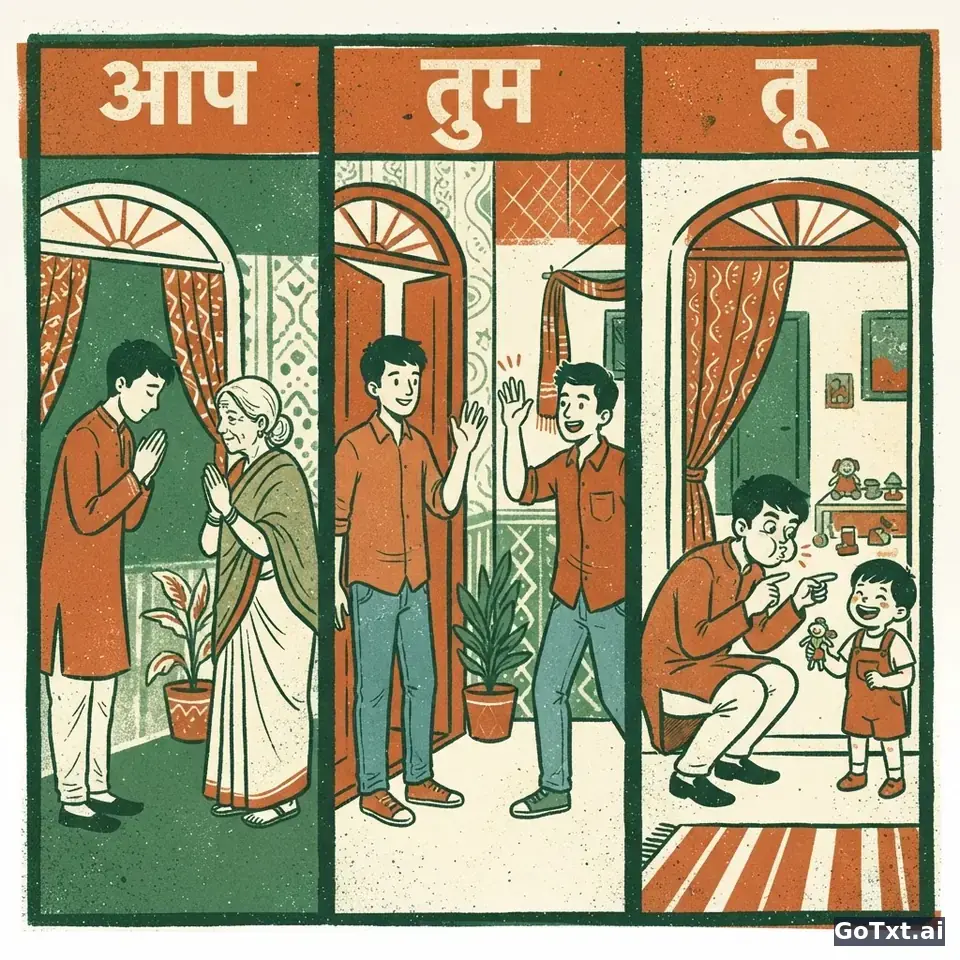
The Three Gears of "You"
Think of it as a volume dial, not a switch. आप (aap) is the formal, respectful setting — for elders, strangers, teachers, officials, and anyone you want to impress. तुम (tum) is the friendly, informal middle — close friends, siblings, people your own age you're comfortable with. तू (tu) is the intimate or rough setting — very close friends, children, God in prayer, or someone you're deliberately disrespecting. Yes, it can be affectionate and insulting. Context is everything.
| Register | Hindi | Use with | Verb form |
|---|---|---|---|
| Formal | आप | elders, strangers, bosses | plural verb |
| Informal | तुम | friends, peers, siblings | singular verb |
| Intimate | तू | kids, best friends, prayer | singular verb |
The Trap: Verbs Change Too
Here's what trips up English speakers. In English, "you are" never changes. In Hindi, the verb bends to match your choice. Say "you are" three ways and watch it shift:
| English | Hindi | Register |
|---|---|---|
| You are (formal) | आप हैं | polite |
| You are (informal) | तुम हो | friendly |
| You are (intimate) | तू है | close/rough |
So आप कैसे हैं? is a respectful "How are you?" — perfect for a new colleague. तुम कैसे हो? is what you'd text a buddy. And तू कैसा है? belongs in a Bollywood fight scene or between brothers. Get the verb wrong and you'll sound like you're mocking someone.
Common Mistakes English Speakers Make
The biggest one: defaulting to तुम because it feels "normal." In English, casual is safe. In Hindi, casual with a stranger reads as disrespect. When in doubt, go formal — आप is never wrong, just occasionally stiff. The second mistake is mixing registers in one sentence, like आप कैसे हो? — polite pronoun, informal verb. It sounds broken. Third: using तू with an elder because a movie did it. Movies are not your landlord's mother.
| Situation | Correct | Wrong |
|---|---|---|
| Greeting your boss | आप कैसे हैं? | तू कैसा है? |
| Chatting with a close friend | तुम कैसे हो? | आप कैसे हैं? (too stiff) |
| Talking to a child | तू कैसा है? | आप कैसे हैं? (too formal) |
Comments
Article discussion: learner comments and GoTxt teacher replies
Drop your emotions below — love, debates, even hate welcome. Comment 👇
Don't want to miss my reply? Leave your email — I'll send a copy.