Anna Blog German Irregular Verbs: One Verb, All Its Forms, Explained Step by Step
German Irregular Verbs: One Verb, All Its Forms, Explained Step by Step
Take the German verb **nehmen** apart form by form — present, past, perfect — with clear tables, the logic behind the vowel changes, and the mistakes English speakers keep making.
Most learners treat irregular verbs as a list to memorise and hope for the best. I get it — but there is a better way. Take one verb and pull it apart until you can see the machinery, and suddenly the whole category gets lighter. My favourite victim for this exercise is nehmen — "to take". It is short, it is everywhere, and it betrays you in almost every tense. By the end of this post you will know ich nehme, du nimmst, er nahm, and ich habe genommen without flinching — and, more importantly, you will know why they look the way they do.
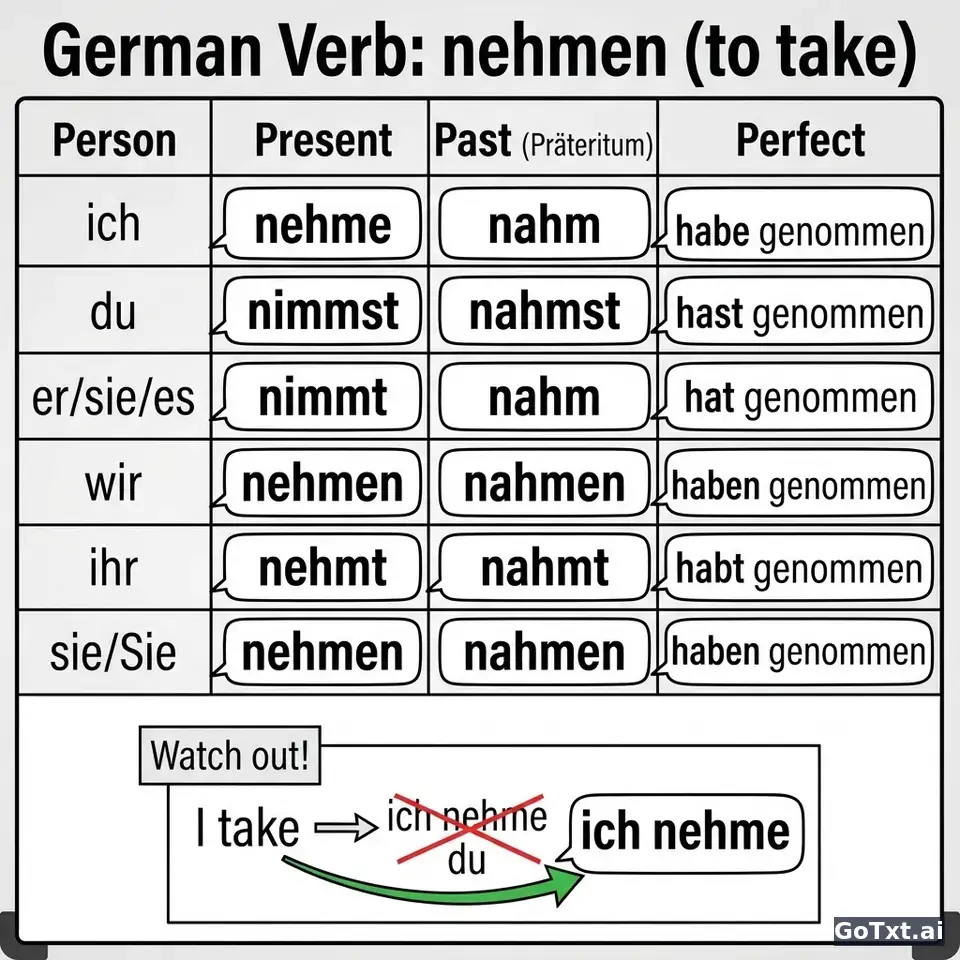
The present tense: where the first trap hides
In the present, nehmen behaves like a normal verb for ich, wir, sie/Sie — no surprises. The trouble starts in the second and third person singular, where two things happen at once: the stem vowel e turns into i, and the ending shifts.
| Person | Form | Note |
|---|---|---|
| ich | nehme | regular ending |
| du | nimmst | stem change e → i |
| er/sie/es | nimmt | stem change + -t |
| wir | nehmen | no change |
| ihr | nehmt | no change |
| sie/Sie | nehmen | no change |
Notice that the du and er forms are the only rebels. That is a pattern, not a coincidence — German loves to mark the second and third person singular with a vowel change. Once you spot it in nehmen, you will spot it in geben, sprechen, and treffen too.
Past and perfect: the two faces of the past
Here is where English speakers relax too early. English has one simple past ("I took") and one perfect ("I have taken"). German has the same split, but the forms look nothing alike, and mixing them up is the single most common mistake I see.
| English | German | Tense |
|---|---|---|
| I took | ich nahm | Präteritum |
| I have taken | ich habe genommen | Perfekt |
| you took | du nahmst | Präteritum |
| you have taken | du hast genommen | Perfekt |
| he took | er nahm | Präteritum |
| he has taken | er hat genommen | Perfekt |
Two things worth burning into memory. First, the Präteritum of nehmen is nahm — a long a, no -e- in the middle. Second, the Perfekt is built with haben plus the participle genommen, and that participle has a doubled m and an -o- that appears out of nowhere. Irregular verbs do this: they change the vowel and reshape the stem.
The mistakes I see every single week
Let me be blunt about the errors that keep showing up in homework:
Comments
Article discussion: learner comments and GoTxt teacher replies
Drop your emotions below — love, debates, even hate welcome. Comment 👇
Don't want to miss my reply? Leave your email — I'll send a copy.