Anna Blog Formal Emails in German: 4 Traps That Instantly Reveal You're Not a Native
Formal Emails in German: 4 Traps That Instantly Reveal You're Not a Native
Writing a business email in German? Learn the four traps in greetings, address, requests and sign-offs that instantly mark you as a non-native — and how to fix them.
Every week a student shows me a "perfect" German business email, and every week I find the same four landmines. The grammar is fine, the vocabulary is fine — and yet the recipient in Munich reads two lines and thinks: this person is not from here. The culprits are almost always the same: a greeting that's too casual, a du where a Sie belongs, a request that sounds like a command, and a sign-off copied straight from English.
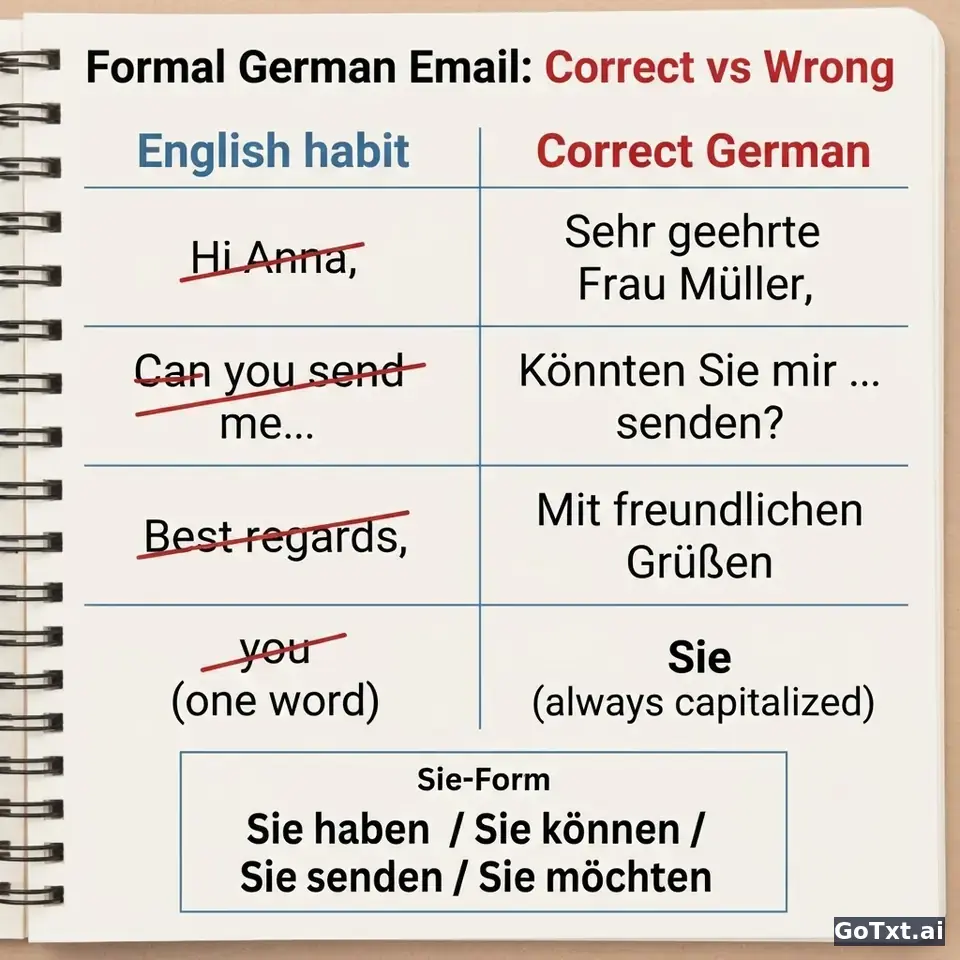
Let's defuse them one by one. In German, formality isn't decoration — it's the load-bearing wall of the whole message.
Trap 1: The greeting decides everything
English lets you open with "Hi" or "Hello" and nobody blinks. German splits the world in two: Hallo is for people you already du-zen, and
| Situation | Correct German | Wrong |
|---|---|---|
| Unknown recipient | Sehr geehrte Frau Müller, | Hallo Frau Müller, |
| Known colleague, formal | Guten Tag Herr Schmidt, | Hi Schmidt, |
| First contact, no name | Sehr geehrte Damen und Herren, | Hallo zusammen, |
Trap 2: du or Sie — the pronoun that outs you
This is the trap that hurts most, because it's invisible to English speakers. English "you" is one word; German forces a choice every single time. In a formal email, Sie is always capitalized — even mid-sentence. Writing sie (lowercase) can accidentally mean "she" or "they", and the reader will notice.
The verb form also shifts. Compare:
| English | Formal German (Sie) | Informal German (du) |
|---|---|---|
| you have | Sie haben | du hast |
| you can | Sie können | du kannst |
| you would like | Sie möchten | du möchtest |
Trap 3: Requests that sound like orders
English softens requests with "Could you possibly…". German does the same trick — but with different machinery. A bare imperative (Senden Sie mir den Bericht.) is grammatically correct and socially cold. The polite version uses Könnten Sie or Würden Sie plus bitte, and often the little word mir to keep it personal.
Comments
Article discussion: learner comments and GoTxt teacher replies
Drop your emotions below — love, debates, even hate welcome. Comment 👇
Don't want to miss my reply? Leave your email — I'll send a copy.