Sophie Blog The One French Verb That Breaks English Speakers: Mastering "Prendre"
The One French Verb That Breaks English Speakers: Mastering "Prendre"
A deep dive into the French verb "prendre" — all its forms, the traps English speakers fall into, and memory tricks to finally make it stick.
Every English speaker learning French eventually hits the same wall, and its name is prendre. It looks friendly enough — "to take" — but the moment you try to say "I took" or "we will take," it morphs into something that looks nothing like its infinitive. I've watched students handle
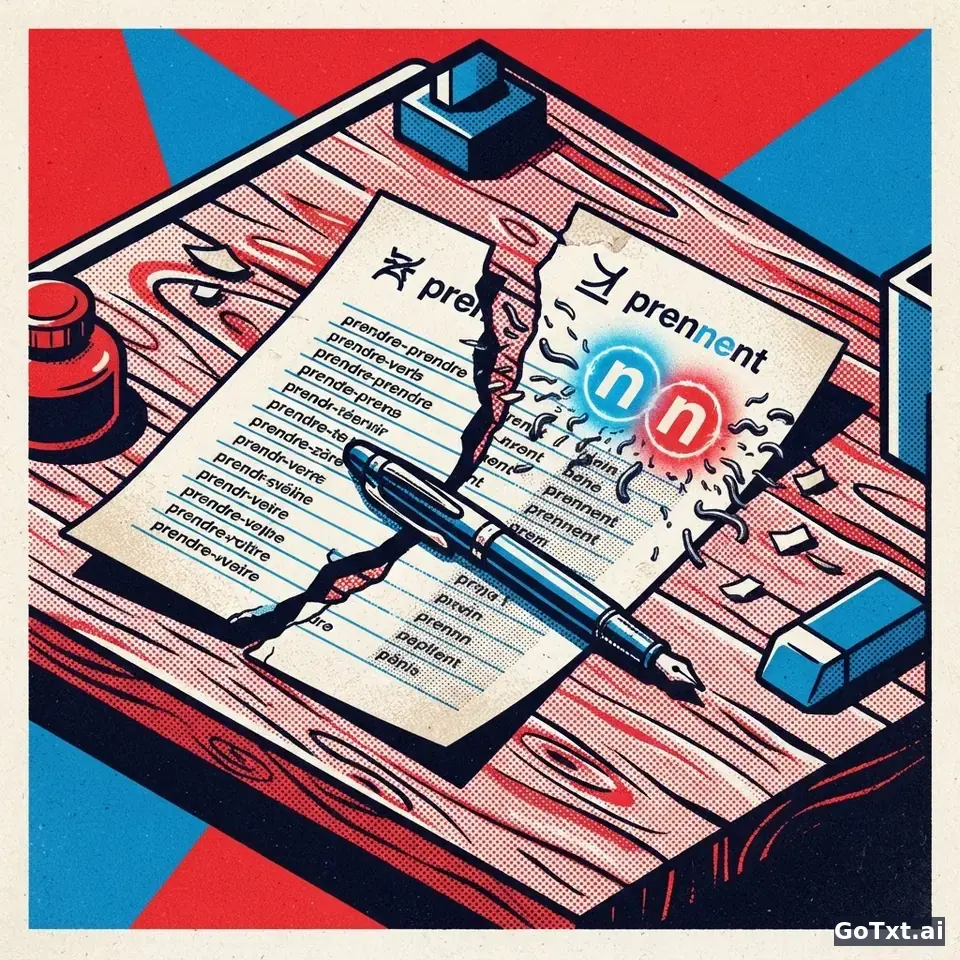
The first thing to accept: prendre is irregular, and it's irregular everywhere — present, past, future, participles. There's no shortcut around memorizing the core forms. But once you see the pattern hiding inside the chaos, it stops feeling random. Think of prendre as a family with a very recognizable last name: pren- shows up almost everywhere, sometimes with a doubled n, sometimes with a nn, and once you spot that, the verb starts behaving.
The Present Tense: Where the Doubling Begins
Here's the full present conjugation. Notice where the n doubles — it's not random, it follows the stress pattern.
| Pronoun | Form | English |
|---|---|---|
| je | prends | I take |
| tu | prends | you take |
| il/elle | prend | he/she takes |
| nous | prenons | we take |
| vous | prenez | you take |
| ils/elles | prennent | they take |
The rule: the n doubles only for ils/elles — prennent. Why? Because the ending -ent is silent, so French keeps the sound stable by doubling the consonant. Say it out loud and you'll hear it: je prends, tu prends, il prend all sound nearly identical, and ils prennent sounds exactly like il prend. That's the trick — the doubling is invisible to the ear but essential to the spelling.
Past Tense: Choosing Your Auxiliary Wisely
In the passé composé, prendre takes avoir as its auxiliary, and its past participle is pris — yes, completely different from the infinitive. This is the part that trips people up most.
| Person | Passé composé | English |
|---|---|---|
| j' | ai pris | I took |
| tu | as pris | you took |
| il/elle | a pris | he/she took |
| nous | avons pris | we took |
| vous | avez pris | you took |
| ils/elles | ont pris | they took |
A common mistake: English speakers often try j'ai prendu or
Future and Conditional: The Double-R Secret
Here's where prendre gets generous. The future stem is prendr-, and it stays consistent across all persons.
| Pronoun | Future | English |
|---|---|---|
| je | prendrai | I will take |
| tu | prendras | you will take |
| il/elle | prendra | he/she will take |
| nous | prendrons | we will take |
| vous | prendrez | you will take |
| ils/elles | prendront | they will take |
Comments
Article discussion: learner comments and GoTxt teacher replies
Drop your emotions below — love, debates, even hate welcome. Comment 👇
Don't want to miss my reply? Leave your email — I'll send a copy.