Sophie Blog Tu or Vous? How to Address People in French Without Sounding Rude
Tu or Vous? How to Address People in French Without Sounding Rude
Learn the real rule behind French **tu** and **vous**, the register traps English speakers fall into, and how to switch forms gracefully. Includes a conjugation table and audio practice.
Every English speaker walks into French with one huge advantage and on
e huge blind spot. The advantage: English dropped its informal pronoun centuries ago, so we never have to think about it. The blind spot: French never did. So the first time a French colleague looks at you sideways after you greet them with
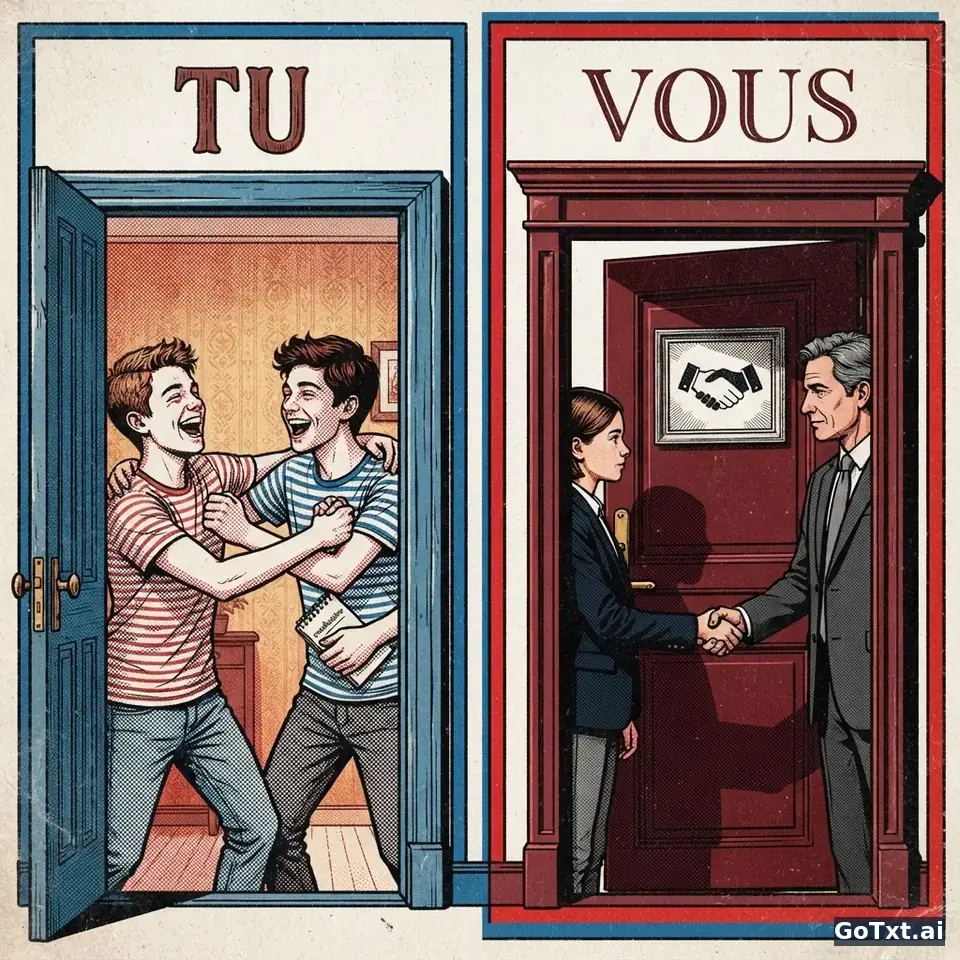
Here's the honest version of the rule. Vous is the default with strangers, elders, shopkeepers, doctors, and anyone you'd call "sir" or "ma'am" in English. Tu is for friends, family, kids, pets, and — this is the part that surprises people — the same age group in casual settings. The tricky bit isn't knowing the rule. It's knowing when the French person across from you decides the rule has changed.
The verb doesn't just change — the whole sentence does
This is where English speakers get lazy. We think tu and vous are interchangeable labels. They aren't. The pronoun drags the verb, the possessives, and sometimes the whole tone along with it.
| English | Informal (tu) | Formal (vous) |
|---|---|---|
| you are | tu es | vous êtes |
| you have | tu as | vous avez |
| you can | tu peux | vous pouvez |
| your book | ton livre | votre livre |
| sit down! | assieds-toi | asseyez-vous |
| what's your name? | comment tu t'appelles ? | comment vous appelez-vous ? |
Notice the last row. In real conversation, French people often say Comment vous vous appelez ? instead of the textbook inversion. Both are correct; the inverted one just sounds a touch more polished. Pick one and stay consistent — mixing them mid-sentence is what makes you sound like a phrasebook.
The three mistakes English speakers make on repeat
First, over-formality with peers. If you're 25 and you meet another 25-year-old at a party, leading with vous can feel cold, almost like you're keeping a distance on purpose. The safe move is to let them offer tu first, or to ask: On peut se tutoyer ? — "Can we use tu with each other?" That sentence is your get-out-of-jail card.
Second, under-formality with service staff. In France, a waiter, a pharmacist, or a train conductor gets vous, full stop, even if they look younger than you. Using tu there reads as condescending.
Third, forgetting that vous is also plural. If you're talking to two friends, you use vous even though you'd use tu with each of them alone. This trips up everyone at least once.
| Situation | Wrong | Right |
|---|---|---|
| Meeting your partner's grandmother | Salut, tu vas bien ? | Bonjour, comment allez-vous ? |
| Two close friends | Vous venez ce soir ? | Vous venez ce soir ? (plural, correct) |
| Asking a stranger for directions | Tu peux m'aider ? | Pouvez-vous m'aider ? |
| Your best friend's little brother (age 8) | Comment allez-vous ? | Comment tu t'appelles ? |
Comments
Article discussion: learner comments and GoTxt teacher replies
Drop your emotions below — love, debates, even hate welcome. Comment 👇
Don't want to miss my reply? Leave your email — I'll send a copy.