Sophie Blog Formal Emails in French: 4 Traps That Instantly Reveal You're Not a Native
Formal Emails in French: 4 Traps That Instantly Reveal You're Not a Native
Writing a formal French email? Avoid these four classic traps in greetings, address, requests and sign-offs — and learn the phrases that make you sound genuinely polite.
I've read thousands of learner emails over the years, and the same four traps show up almost every time. The grammar is fine, the vocabulary is fine — and yet the message screams "foreigner". Why? Because French business writing has its own etiquette, and it lives in the small phrases: Madame, Monsieur,
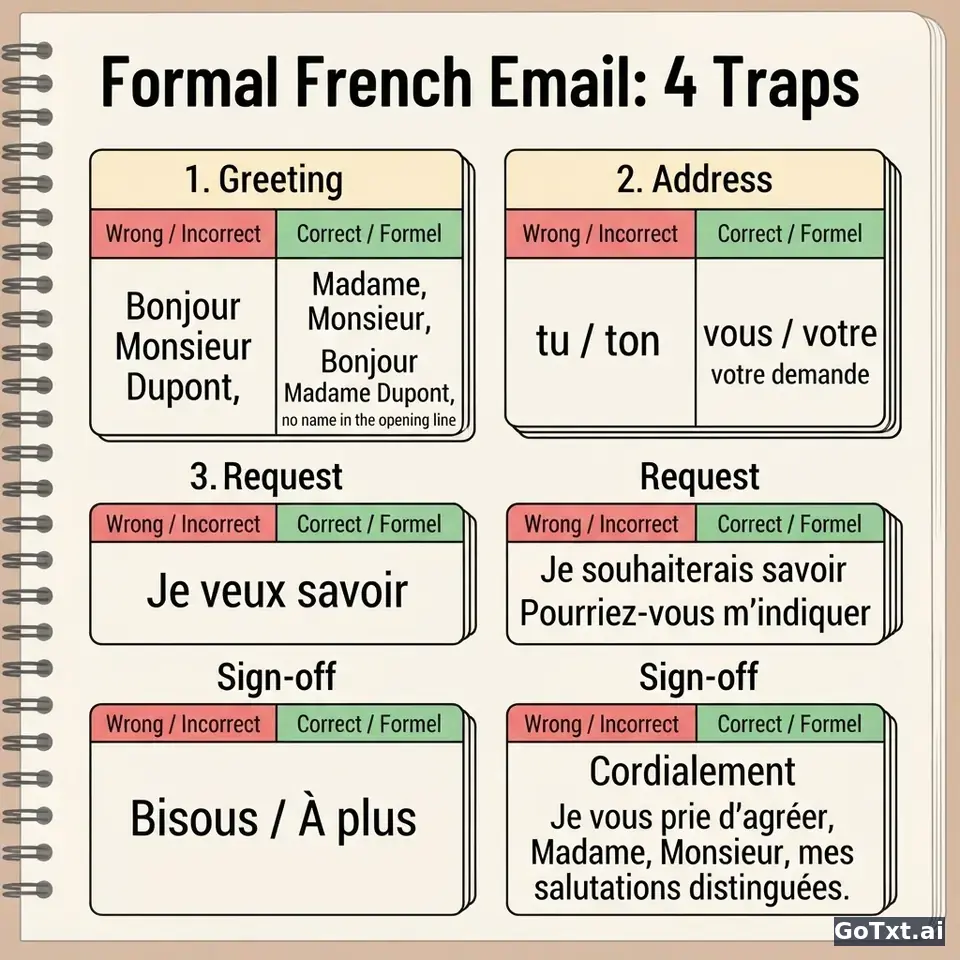
Trap 1: The greeting that's too friendly
In English we happily open with "Hi Sarah,". In French, dropping a first name into a formal opening is a red flag. The safe, native default is Madame, Monsieur, — no name, a comma, then a new line. If you know the person's title, Madame or Monsieur alone works. Save Bonjour for people you actually know.
| English habit | French formal | Why |
|---|---|---|
| Hi Sarah, | Madame, Monsieur, | Neutral, respectful, never wrong |
| Dear Mr Dupont, | Monsieur, | Title only, no surname needed |
| Hello team, | Madame, Monsieur, | No collective "Hi all" |
Madame, Monsieur,
Bonjour Madame Dupont,
Trap 2: Tu or vous — pick one and stay there
This is the trap that catches even advanced learners. In a formal email you use vous for one person, and every possessive follows: votre demande,
| English | Correct | Wrong |
|---|---|---|
| your request | votre demande | ton demande |
| you have sent | vous avez envoyé | vous as envoyé |
| could you tell me | pourriez-vous m'indiquer | peux-tu me dire |
votre demande
pourriez-vous m'indiquer
Trap 3: Requests that sound like orders
English "I want to know" translates badly as Je veux savoir — it lands like a demand. French softens requests with the conditional and a polite formula. The magic opener is Je me permets de vous écrire for a first contact, and Je souhaiterais for what you want. Then hand the action over gently: Pourriez-vous… ?
| English | Correct | Wrong |
|---|---|---|
| I would like to know | Je souhaiterais savoir | Je veux savoir |
| I'm writing to ask | Je me permets de vous écrire | J'écris pour demander |
| Could you send me | Pourriez-vous m'envoyer | Envoyez-moi |
Je souhaiterais savoir
Je me permets de vous écrire
Comments
Article discussion: learner comments and GoTxt teacher replies
Drop your emotions below — love, debates, even hate welcome. Comment 👇
Don't want to miss my reply? Leave your email — I'll send a copy.