Mei Blog Formal Emails in Chinese: 4 Traps That Instantly Reveal You're Not a Native
Formal Emails in Chinese: 4 Traps That Instantly Reveal You're Not a Native
Writing a formal email in Chinese? Learn the four traps in greetings, address, requests, and sign-offs that make your business writing sound off — and the exact phrases to fix them.
I've graded hundreds of business emails from English speakers writing in Chinese, and the same four mistakes show up almost every time. The grammar is fine. The vocabulary is fine. What gives people away is the register — the social temperature of the words. Chinese business writing lives and dies by small formulas, and when you skip them, readers don't think "foreigner." They think "rude" or "too casual for this relationship." Today I want to walk you through the four traps I see most, starting with the very first line.
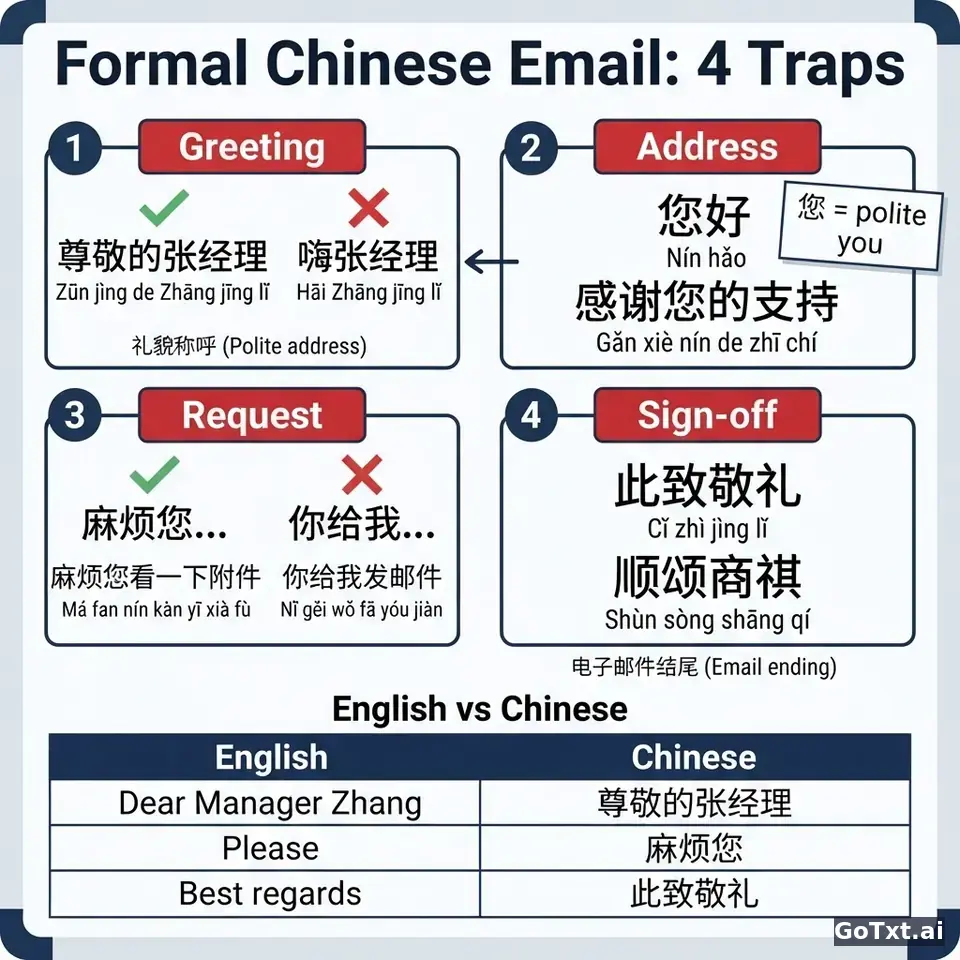
Trap 1: The greeting that's too friendly
English emails often start with "Hi" or "Hey" — and learners carry that habit straight into Chinese. The problem is that 嗨 and 你好 are for people you already know well. To a client, a government office, or a senior colleague you've never met, that opening reads as careless.
The safe formal opener is 尊敬的 followed by the person's title and surname. If you don't know the name, 尊敬的女士/先生 works. Notice that 尊敬的 already means "respected," so you don't add 亲爱的 on top — that combination sounds like a wedding invitation.
| English habit | Chinese formal | Why |
|---|---|---|
| Hi Manager Zhang | 尊敬的张经理 | Sets distance and respect |
| Dear Sir/Madam | 尊敬的女士/先生 | Safe when name unknown |
| Hey | 嗨 | Only for close contacts |
Trap 2: Forgetting 您 and the polite request frame
This is the trap that stings the most, because it's invisible to English speakers. English has one "you." Chinese has two: 你 and 您. In a formal email, 您 is not optional — it's the baseline. Using 你 with a client reads like you're talking to a subordinate.
The second half of this trap is the request itself. English softens with "Could you please…" Chinese softens with 麻烦您 or 请您. Dropping straight to an imperative — 你给我发一下 — is the written equivalent of pointing at someone.
| English | Correct Chinese | Wrong Chinese |
|---|---|---|
| Could you please send it? | 麻烦您发给我 | 你给我发一下 |
| Please confirm | 请您确认 | 你确认一下 |
| Thank you for your help | 感谢您的帮助 | 谢谢你的帮忙 |
Trap 3: The sign-off nobody teaches
Most textbooks teach 再见 and stop there. In a real business email, 再见 at the end looks like you're closing a phone call. Formal Chinese letters end with a fixed pair: 此致 on its own line, then 敬礼 on the next. For commercial correspondence, 顺颂商祺 is the polished choice — it literally wishes the recipient prosperous business.
Comments
Article discussion: learner comments and GoTxt teacher replies
Drop your emotions below — love, debates, even hate welcome. Comment 👇
Don't want to miss my reply? Leave your email — I'll send a copy.