Mei Blog Chinese Irregular Verbs: One Verb, All Its Forms, Explained Step by Step
Chinese Irregular Verbs: One Verb, All Its Forms, Explained Step by Step
Learn how Chinese handles irregular verbs by breaking down 是 (shì) step by step — every form, the logic behind it, and the mistakes English speakers make.
Every week a student asks me the same nervous question: "Mei, where is the list of Chinese irregular verbs?" I always smile, because the honest answer surprises them. Chinese has no conjugation tables like English does — no go/went/gone, no be/was/been. But Chinese is not "easy" here; it just hides its irregularity somewhere else. The verb 是 (shì) — "to be" — is the perfect example. It looks simple, yet it bends in ways that trip up almost every English speaker. Today we take 是 apart, form by form, and you will finally see the logic instead of memorizing chaos.
The Big Secret: Chinese Verbs Don't Change Shape
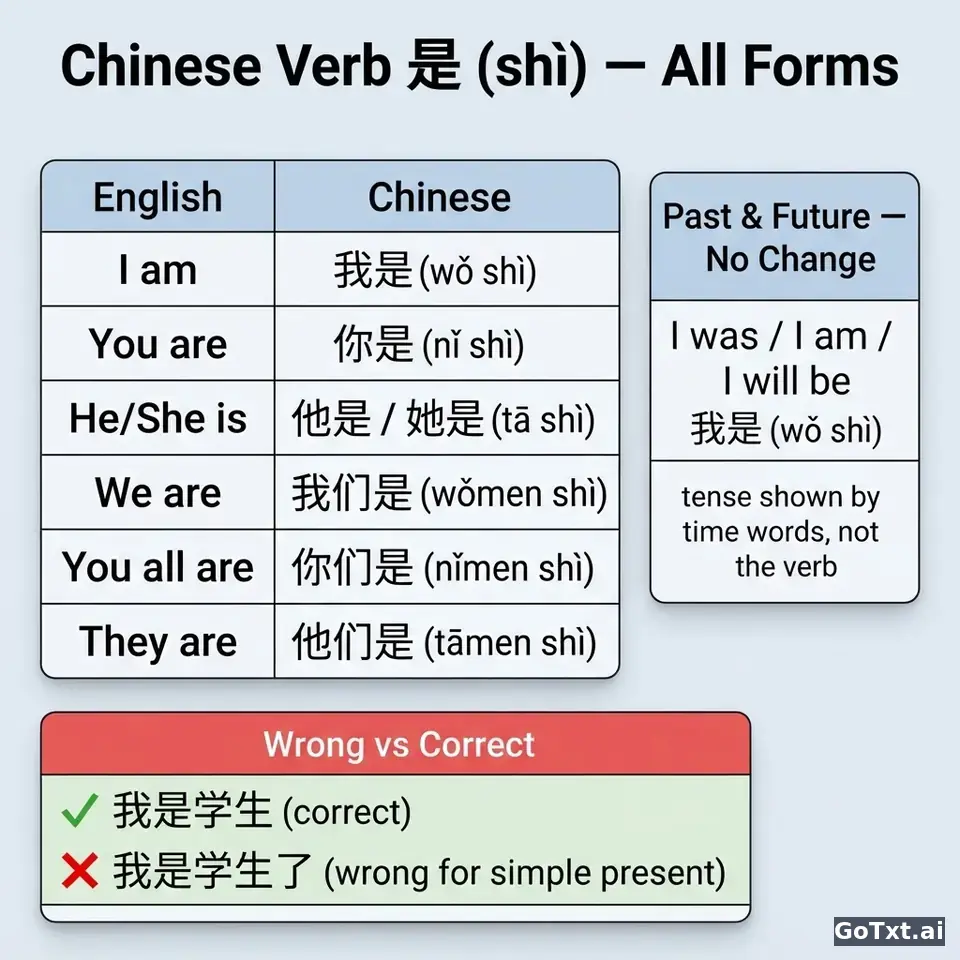
In English, the verb itself carries the tense: I am, I was, I will be. In Chinese, the verb 是 stays frozen. The person never changes it, and the tense never changes it either.
| English | Chinese | Note |
|---|---|---|
| I am | 我是 (wǒ shì) | no ending added |
| You are | 你是 (nǐ shì) | same verb |
| He / She is | 他是 / 她是 (tā shì) | same verb |
| We are | 我们是 (wǒmen shì) | 们 marks plural |
| They are | 他们是 (tāmen shì) | same verb |
So what changes? Only the pronoun in front. The verb 是 is the anchor that never moves. That is the whole "irregularity" — it is irregular because your English brain expects it to change, and it refuses.
Where the Real Trap Is: Negation and Tense
Here is where students actually lose points. To say "I am not," you do not touch 是 with "no." You put 不 (bù) in front:
| English | Correct | Wrong |
|---|---|---|
| I am not | 我不是 (wǒ bú shì) | 我不我是 |
| He is not | 他不是 (tā bú shì) | 他不他是 |
| We are not | 我们不是 (wǒmen bú shì) | 我们不我们 |
Notice the tone shift: 不 is normally bù, but before 是 it becomes bú (second tone). Small detail, big difference in how you sound.
For past and future, you still do not change 是. You add time words:
- 我昨天是学生 — "I was a student yesterday"
- 我明天是学生 — "I will be a student tomorrow"
The verb is identical. Only 昨天 (zuótiān) and 明天 (míngtiān) tell the listener when.
我昨天是学生 (wǒ zuótiān shì xuésheng)
The Mistake Almost Everyone Makes with 是
English speakers love to insert 是 everywhere, because English is is everywhere. But Chinese drops it in many places. With adjectives, you do not use 是:
| English | Correct | Wrong |
|---|---|---|
| I am tired | 我累 (wǒ lèi) | 我是累 |
| She is beautiful | 她漂亮 (tā piàoliang) | 她是漂亮 |
| It is cold | 冷 (lěng) | 是冷 |
Comments
Article discussion: learner comments and GoTxt teacher replies
Drop your emotions below — love, debates, even hate welcome. Comment 👇
Don't want to miss my reply? Leave your email — I'll send a copy.